Tuesday, February 9, 2021

Michigan Big Year Vol 5: A "Lifer," and an Unexpected Visitor at Home


A good friend of mine, Artist Christina Baal, (https://www.drawingtenthousandbirds.com/), gave me a book for Christmas called Zen Birding, and it's been most helpful for me in taking a different perspective on this listing thing. In it the authors David M. White and Susan M. Guyette talk about the usual Zen stuff--ego, expectation, beginner mind vs. expert mind. They talk about listing in the first chapter, its pitfalls as well as the joys it can bring. They warn that listing can sometimes become all about the list--simply checking off species names on a list and running to see the next. But they acknowledge that making lists is a common human trait, and that listing can actually increase one's enjoyment of birds, especially if we take time to observe and enjoy both them and the act of birding. That is, as long as we don't get angry or frustrated when we dip, and don't get jealous when someone else sees a bird and we didn't, or we get mad because we can't go birding because of work, (all about ego). This was a relief to me but also a lesson--I feel like I've been released to go make those lists, and warned that if I'm not enjoying it or if I'm having expectations or jealousy that I need to reexamine my priorities. And so, we move onward!


January 25

Lori had her knee replacement surgery last week so we have been sticking close to home and caring for her while she convalesces. That meant no chasing for a while, but today she was doing much better and there was a person coming for physical therapy in the afternoon, so Lisa and I decided to head to the pier in Muskegon to look for some of the rare waterbirds that had been reported over the previous days.

It had been sunny but by the time we arrived it had clouded up and the wind had increased, coming from the northeast. This meant off-shore, but it was still biting, even at 33°. We walked east into the wind along the channel as far as we could go, mostly with our heads down, then worked our way back slowly with the wind at our backs. Many birds drifted west on the current and we looked at each one carefully. A small flock of Long-tailed Ducks was drifting and feeding. Suddenly, as ducks do, they simultaneously started running and flapping across the water. They'd go several feet, stop, then start again. The goofy things never actually went anywhere but a little farther down the channel.

Long-tailed Ducks doing Long-tailed Duck things


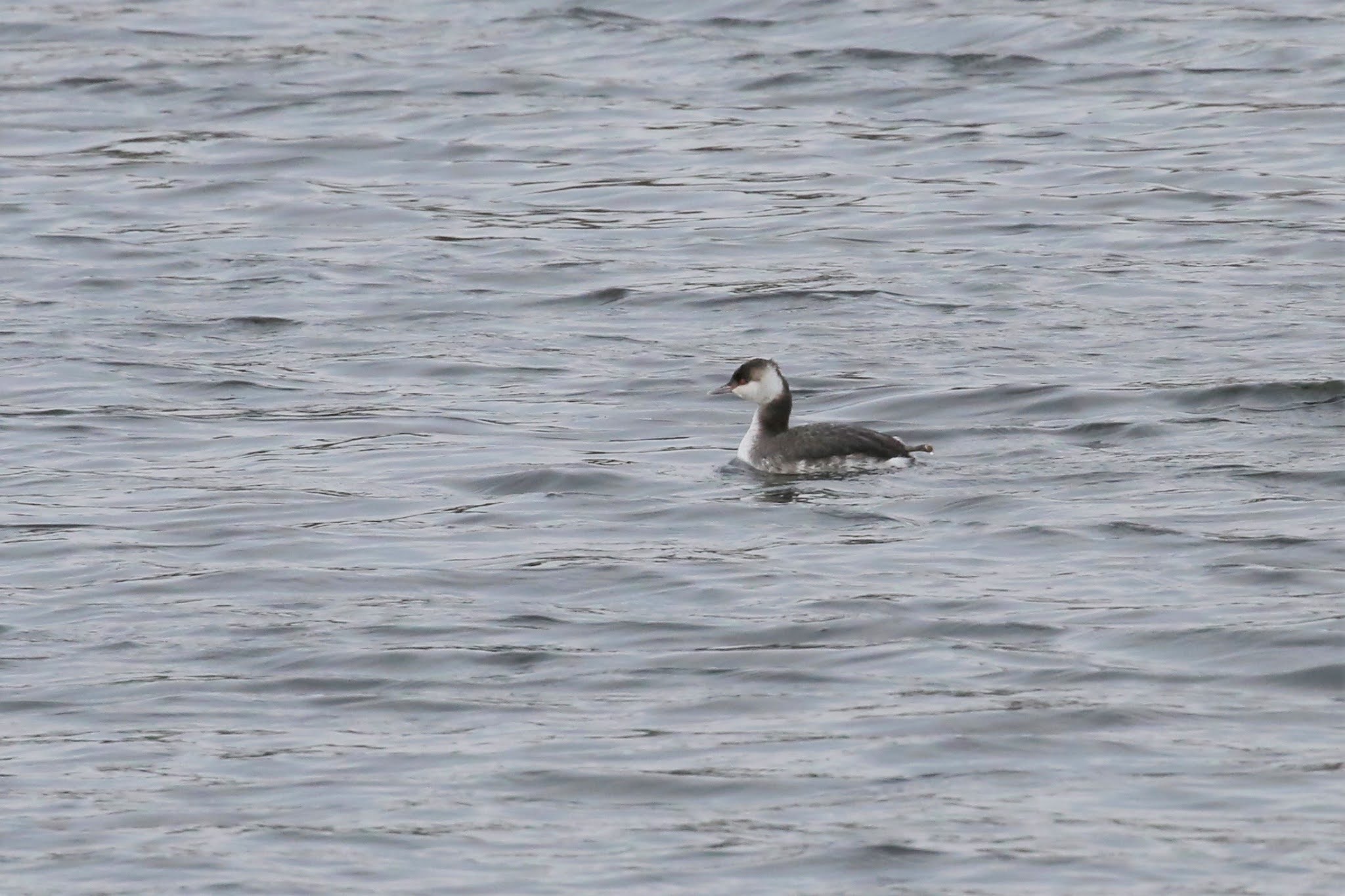
It was not long before I saw a Horned Grebe appear in the middle of the channel. Yay! This was a new life bird for me and the last of the seven North American grebe species I needed. I've seen Pied-billed Grebe just about everywhere, and Red-necked Grebe in Alaska in 2014, but then got the next four all in 2019--Clark's, Western, and Eared all out west over the summer, and Least down in Texas that fall. This Horned Grebe (MBY #68 and life bird #508) was the icing on the grebe cake, which by the way is probably my favorite family of birds.


Horned Grebe, non-breeding. I hope to see them in breeding plumage one day. Also, I realized when I was editing the photos that this poor thing is missing a foot
(that's it's footless leg sticking out behind it.)


After that we didn't see any new species in the canal, though we searched for some time. I knew some scoters and a Harlequin Duck had been seen the day before, and I hoped they had moved out into more open water. We watched the mergansers for a bit, hoping someone new might float by, then headed to the car and over to the south pier parking lot. On the way I stopped to check the harbor and had a small flock of Tundra Swans fly by, for MBY #69.

Female Red-breasted Merganser


Male Red-breasted Merganser taking off


We donned our spikes and walked out onto the icy pier. The big lake was fairly calm thanks to the off-shore winds but the pier was crusted with ice from waves pushed into the harbor from the northwest the previous day. We picked our way carefully along, checking the ducks as they dove and popped up here and there. The ducks we were looking for had frequently been seen with the long-tails, so we checked each and every one. Lisa spotted a lone Purple Sandpiper feeding on the water's edge among the boulders. Most of the surfaces were frozen, some with tick, opaque, gray ice and some with clear and smooth, but apparently there was enough exposed algae for this bird to pick through to find enough to eat.


Purple Sandpiper toughing it out on the ice along the pier.


We walked out as far as the bend in the pier, at which point the ice was so gnarly and bumpy that we didn't dare go farther, even with spikes. I looked longingly at the ducks at the end of the pier and scanned them with the scope, but couldn't pick out any oddities. We did see a lone Snowy Owl way out on the end of the north pier, which helped explain the blood and body parts we'd seen strewn along the pier.


Long-tailed Duck, becuase you can't ever have enough Long-tailed Duck photos.


January 26

At this point in the season I have seen most of the species that regularly occur at home, with the exception of Red-breasted Nuthatch. There is always the chance for a less-common bird to appear, but I wasn't holding my breath. We have hoards of Blue Jays who dominate the feeders, scooping up pounds of seed a day to cache in some secret location, and I think they are keeping some of the less-aggressive birds away. So imagine my surprise this morning as I was walking to the office and heard an unfamiliar call from the oak above my head. I paused and listened, then continued on to the office. As I started up my computer I looked out the window to see a juvenile Evening Grosbeak (MBY #70) at the feeder! I was hoping we'd have another shot at seeing one in spring as the flocks moved north, but apparently there's at least one still hanging around. These birds are very rare winter visitors here. Despite their name they are members of the finch family, and every 7-10 years they and other finches "irrupt" and flow south in huge numbers in search of food when the pine/spruce/larch cone crop is poor in the forests to our north. I was able to get back to the house and get a few photos for record. 


Evening Grosbeak


Lake Muskegon Channel, January 25

#68) Horned Grebe (also lifer)

#69) Tundra Swan

Home, January 26

#70) Evening Grosbeak

Thursday, February 4, 2021

Michigan Big Year Vol 4: Success at Muskegon Wastewater

One of the best birding locations in west Michigan in the 11,000 acre Muskegon Wastewater Treatment Facility. Here's what it says on their website on the page dedicated to birding: 

"The variety of habitat at the Wastewater System includes over 1,000 acres of even-aged conifer and dryland white and black oak woodlots; over 5,000 acres of alfalfa, corn, and soybean cropland; 20 miles of drainage ditches, 60 acres of treatment ponds, 11 miles of shoreline around 1,700 acres of storage lagoons; a few hundred acres of natural upland grasslands; and assorted wetland marshes and potholes. Because of this, the 11,000-acre treatment plant is considered one of the best birding sites in Michigan. At least 256 species of birds have been documented at the facility (two-thirds of all species ever recorded in Michigan). Possibly the rarest bird ever documented in the state was seen here in April of 1985, a White Wagtail.

Tens of thousands of geese and ducks spend part of the winter at the site, sharing the area with Bald Eagles, Peregrine Falcons, Snowy Owls, Snow Buntings, plovers, sandpipers, and dozens of other bird species. At other times of the year, birders might see Red Phalarope, Greater White-fronted Goose, Eurasian Wigeon, Gyrfalcon, Eared Grebe, or American White Pelican."

Now that I live in west-central Michigan, this hotspot is only an hour away, and the piers of Muskegon another half-hour from there, making a nice one-two punch for excellent birding. 

After a couple of trips dipping on my target birds, (see Vol. 3) I had picked up MBY (Michigan Big Year) bird #62 at home on January 16th--a Golden-crowned Kinglet foraging in the back yard with a mixed flock of chickadees and titmice. 

January 19

Lisa and I drove down to MWTF for a day of birding before Lori's second knee replacement surgery on the 20th, which would keep all of us house bound for several days. The day was chilly and windy but the sun was out and I needed a boost to my birding confidence.


Unable to find a map of the facility that isn't a pdf, this aerial with have to do. The sewage lagoons are the large bodies of water, the aerating pools are on the near edge of the lagoon on the right. The green rectangles are the filtration ponds with canals in between. 

As mentioned above the facility has a lot of water, but in winter there is little of it open. The two large storage lagoons freeze over, and only two of the aeration pools are open, one being the pool where septic trucks come and dump their goods (no birds there!). Several of the earthen pools where treated wastewater is pumped as well as the canals are also open, and waterfowl often gather in the pools in great numbers. The fields are good for raptors and grassland birds, and the woods harbor lots of sparrows in winter.

We started by driving up to the aeration pool to look for ducks. We saw mostly Gadwall, Canada Geese, and Mallard, but there were a handful of Ruddy Duck floating by the near side, for MBY bird #63. We scanned the geese on the pool and those bunched up on the ice for a Snow or Cackling Goose but found neither.


Ruddy Duck, #63


Driving down the center causeway between the storage lagoons we could see a large flock of geese out on the ice. We then found the large flock of Common Redpoll that have been there all winter. It's amazing that they haven't yet exhausted the supply of seeds there. The flock is a bit spooky, and if you drive too close they leap into the air en masse, twittering and wheeling, before coming to rest 10-20 feet down the road. Getting close enough for a photo can be a real challenge, but patience usually pays off. This center causeway is a great location to find all sorts of species. Snowy Owl often hang out there when the lagoons are open, picking off unwary ducks. I saw a very rare Buff-breasted Sandpiper there and had Snow Buntings last fall (but none yet this year).


Common Redpoll


Heading down from the west side of the lagoons Lisa spotted some Eastern Bluebirds feasting on sumac berries for MBY bird #64. They were on her side of the car so I didn't try for photos. We drove over to the ponds and while we debated which two-track to take, the geese that had been on the ice lifted off and made their way to one of the flooded ponds. Hundreds of birds poured in, disappearing behind the earthen dike. We made our way over, driving the car as close as we dared to the huge flock that was feasting on the vegetation. After a couple minutes we simultaneously saw the immature Snow Goose foraging among the Canadas. I was thrilled to finally add a rarity to my year list and to be as close to a Snow Goose as I'd ever been.


Immature Snow Goose, #65. This species has two color morphs--this bird will eventually be all white.


We scanned the flock of about 500 geese for a Cackling Goose (a nearly identical species to Canada but about half the size, with a squat head and short bill) and watched as many of the Mallards flew off to a neighboring pond. We drove around to check them out, and found about 70 Mallard and a handful of Gadwall. Then, for no reason we could discern, the ducks in the corner of the pool took off. The sun was behind me  and the birds fairly close, so I hopped out and started shooting. Mallard is one of those ultra-common species here that tend to get overlooked. I think they are strikingly beautiful birds.


Mallard, common and underappreciated.


As I was shooting the ducks, the geese from the next pool over--who I'm pretty sure couldn't even see me--took wing and headed back toward the storage lagoons. The sound these birds made--both with wing and voice--is indescribable. We watched in awe as the sky eventually emptied and quiet returned to the day. 


We saw a female Northern Harrier patrolling the ponds--apparently this is her turf, as she is there almost every time I've been to the facility--then we drove to the agricultural fields to look for larks, buntings, and anyone else that might be there. About halfway through Lisa saw a large raptor sitting in a tree near the edge of a field a hundred yards away, and getting it in my binoculars I could see it was a Golden Eagle. This is another Michigan rarity, and I had known that one was hanging out here, but without an extra pair of eyes I don't think I would have seen it. Birding is not only more fun with a friend, it's also more productive! The eagle eventually took to the sky and I got some shots as it flew past the car.


Golden Eagle fly-by


As we were making our way towards the main road and thinking of heading to the pier, I got a text that a Varied Thrush had been seen at some feeders at a house up in Manistee. It was just early enough that if we left right away we could get there with enough daylight to see the bird. It was a1 1/2 hour drive, and while it was likely to stick around for days (having found a food source) we decided to drive up that afternoon rather than head home and hope to see it the next day. Because the highway was fairly close travel time was going to be about the same from Muskegon or home, so off we went. But on the way out of the facility we were waylaid by a male Northern Harrier cruising the fields. Known colloquially as the "Gray Ghost" I couldn't resist a few distant shots.


Male Northern Harrier, the "Gray Ghost"


After a snack and potty stop along the way we made it to Manistee by 4:15. Another couple was already there, standing at the ready in the driveway. The homeowner had graciously given us bird-crazy folks permission to come see the bird. The couple turned out to be Linda and Chuck, who used to run the art show in Manistee and who knew me and my work. Small world! After about 15 minutes the thrush appeared in a tree in the back yard--spotted yet again by Lisa's sharp eye. It seemed reluctant to come to the feeders so Chuck and I crept to the back and got a few photos for proof of this rare visitor from the West. It was a great way to cap off a good day of birding.


Varied Thrush playing peek-a-boo

Home, Jan. 16

#62) Golden-crowned Kinglet

Muskegon Wastewater, Jan. 19

#63) Ruddy Duck

#64) Eastern Bluebird

#65) Snow Goose

#66) Golden Eagle

Manistee, Jan. 19

#67) Varied Thrush

Tuesday, February 2, 2021

Michigan Big Year Vol. 3: Dipping on Rarities

Birding is a fickle thing, and is all about timing. You might get word within minutes of a rarity showing up at someone's feeder, only to get there and miss it by 30 seconds. You might drive hundreds of miles to see a bird that's been at a location for weeks, only to be unable to locate it. Then, you'll be walking to your home office and hear one calling in the trees above your feeder. It's a bit like poker--while there is certainly skill and planning involved, a lot depends on dumb luck.

January 13

I spent yesterday planning a route that would take me to six different locations in southwest Michigan. Each location had been reporting rarities, and I hoped to pick up a couple of them. This would be my first day devoted specifically to birding, without other errands attached to it, and would involved hundreds of miles and hours of driving. My route and available time allowed for a half hour in each location, starting at Gull Lake in Kalamazoo.

The lake was remarkably unfrozen, as so many are this winter, and seemed to be opening up more in the 42° "heat." Right off I picked up Hooded Merganser and Trumpeter Swan, but these are species I'll likely see here at home this spring. I searched the lake for scoters, cackling geese, and especially the Barrow's Goldeneye and Greater White-fronted Goose that had been seen there. Nothing. There were plenty of ducks I could see, but many more out too far to identify. After over a half hour staring intently at every duck, I decided to head out but then spotted a pair of Canvasback ducks, a good find as it's not a species we would see at home, but not the rarity I'd hoped for. On the way back to my car I heard Sandhill Cranes in the field across the road.

From there I went to the Wolf Lake Fish Hatchery, about a half hour away, but didn't find any rarities there either. I did see a Song Sparrow but they are nesters on our lake and certainly not what I was hoping for. I did manage to get a few digiscoped shots of Trumpeter Swan, but that was it.


A short drive south brought me to Maple Lake in PawPaw, which was filled with Canada Geese. There had to be a couple thousand of them. I walked out to the island and scanned those geese twice, looking for cackling or g. white-fronted. Nope. Nada. There were lots of Common Goldeneye and I got to watch some of the males practicing their courtship dances, but I saw nothing new and nothing certainly nothing rare.


Common Goldeneye


At this point it was 2:00 pm and I had to decid if I was going to continue with my plan and head to the coast, or change it up and go back to Gull Lake. My gut was telling me to return to Gull Lake because of the number of birds there that I couldn't identify the first time around. My head said stick to the plan, and that's what I did. It was a lovely day on Lake Michigan, and I did find a Lesser Scaup in St. Joseph, but that was it. However, back at Gull Lake, at least one of my target birds was seen by another birder that afternoon. Ah, hindsight--and listening to your gut.

January 14th

I decided to stay home, even though it's another mild day. I should have planned an outing, but after dipping on four species yesterday, my heart isn't in it. I took Bailey for a walk around the lake and managed to find a Brown Creeper for bird #60 on the year.

January 15

I was not planning on birding today as it was windy and wet, but after lunch I decided to chase a Ross's Goose that had been reported at the Hart Wastewater Facility, about 45 minutes away. Basically a smaller version of a Snow Goose, the Ross's a rarity in Michigan, and had been seen there multiple times.

The dirt road the facility is on was a quagmire, thanks to the rain and the warmer temperatures that had allowed the road to begin to thaw. I was afraid I was going to slide right into a ditch. As I neared the facility I saw an American Kestrel on a wire, and managed a few shots before he flew off.


At the gate I saw a sign directing  birders to a specific parking area, stating that all birding had to be done on foot. It also said they wanted us out by 2:00 pm--and it was already 1:40. I parked, grabbed my binoculars, and started to walk towards one of the nearby pools that I could see had some open water. As I neared I could see waterfowl, but because of the high berm I couldn't see who was there. 

I got close enough to see over the edge and stopped, probably 40 feet away, but I had also been seen by the hoards of Mallards that were perched on the edge of the ice. A few heartbeats passed as we had a stare down, then on some undetectable (by me) cue they took to the air in unison. NO!!! I frantically scanned the ducks as they flew every which way, and did manage to identify a handful of American Black Ducks as they flew overhead, but that was it. That is not a bird we get on our lake so it was a good find, but not rare.

I continued to the far side and looked out over the stubbled cornfield that lie between the facility and an orchard and saw that it was stuffed with Canada Geese. It's hard to believe these birds were nearly hunted to extinction because they are freaking everywhere. At least a thousand were scattered across acres of stubble. I felt utterly defeated. 

I hurried back to the car and exited the facility, but realized I had a good view of the fields from outside the gate, so I pulled over and set up my scope, and spent the next 30 minutes scanning the fields, looking for a little white blob amid the browner, larger blobs and the corn stubble. Tucked up under my car's open rear hatch I was mostly out of the light rain that had begun to fall. I scanned that field over and over, but did not find a Ross's Goose. 

So that's five rarities I've chased in three days and dipped on. I know it's never a given when chasing birds but this was a very disappointing streak, and makes me start to question my decision to do a Big Year. Sure, I picked up other species, but missing so many after spending so much time might make me more reluctant to chase the next rarity. I will need a few days to rebuild my enthusiasm.


Gull Lake, Jan. 13

54) Hooded Merganser
55) Trumpeter Swan
56) Canvasback
57) Sandhill Crane

Wolf Lake Fish Hatchery, Jan 13

58) Song Sparrow

Saint Joseph Pier, Jan 13

59) Lesser Scaup

Home Jan. 14

60) Brown Creeper

Hart Sewage Treatment Facility, Jan. 15

61) American Black Duck 

Sunday, January 31, 2021

Michigan Big Year: Bohemian Waxwing Bonanza

The first several trips I took in search of birds for my Big Year were forays into the field tied to other errands, which helped ease my guilt over driving all over the place to look for birds. My trip to Reeds Lake was done as a side trip to Lori's doctor's visit, at a facility a half mile from the lake. On January 8th, we combined a trip to Costco on the west side of Grand Rapids to a hunt for a Smew, a Eurasian merganser that had been reported on Allegan Lake, about 20 minutes farther south. 

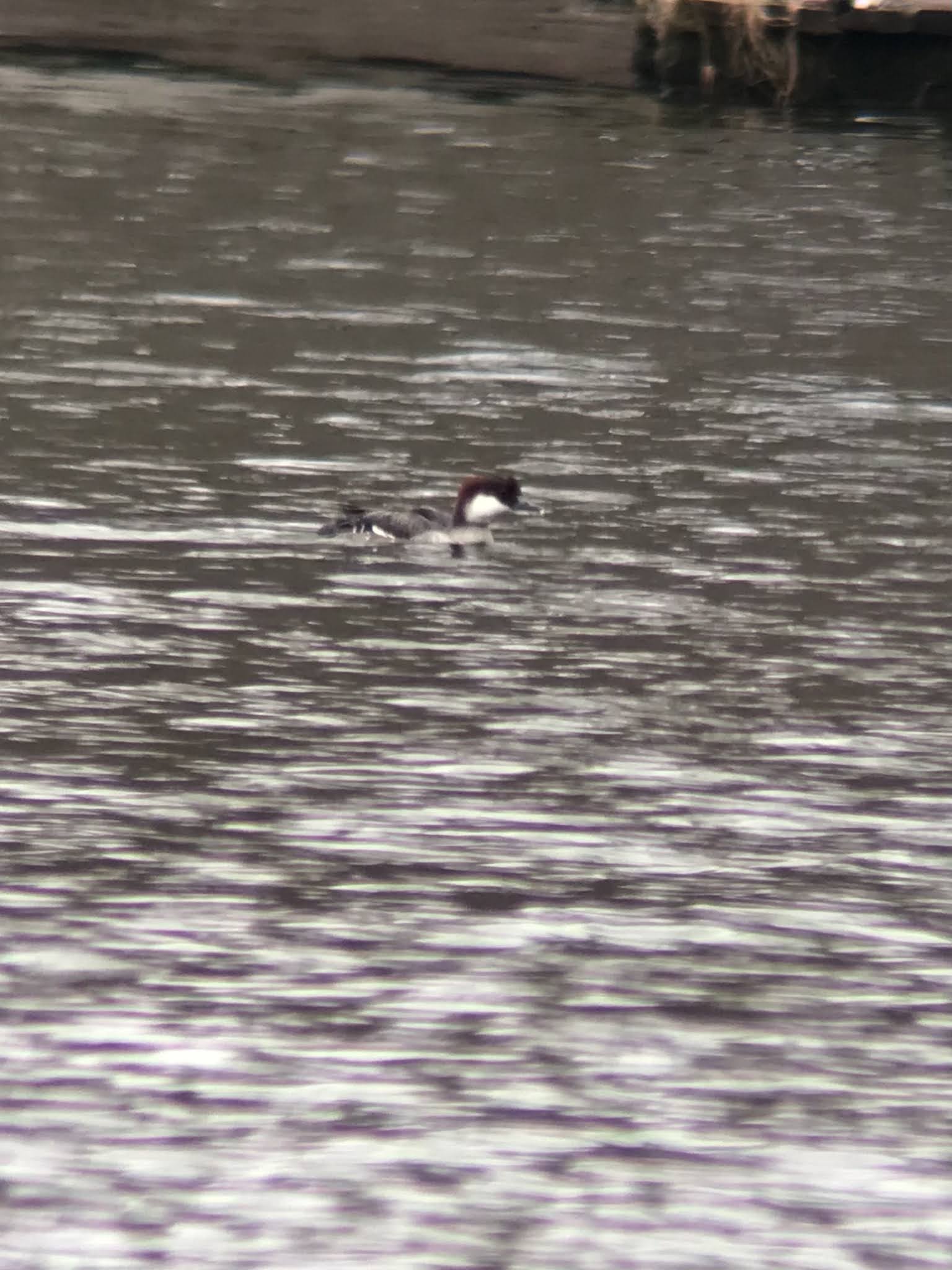
As with so many rarities, we found the Smew thanks to the group of birders already there with scopes and binoculars. At first it was hidden behind a dock, but came out within minutes, and I took some photos with my iPhone and scope (digiscoping). It is a species that is often purchased and bred by bird fanciers, and it is likely this is a bird that escaped from a collector rather than one that got here of it's own accord. If I was doing some sort of a formal list that would matter, but in this case I'm not going to sweat it too much. I also added Bonaparte's Gull at the lake, and an American Kestrel on a wire along Fruit Ridge Ave on the way home.


Smew, Allegan Lake, January 8


January 9th was the coldest day of the season (9°!), so we stayed home with fires blazing in the wood stoves. I wondered how the cold temps would affect the lakes in the area--one of the reasons we were able to see birds like the Smew is because it's been relatively warm here so far this winter. While highs in the 30's and lows in the 20's don't sound all that warm, it's still 5° to 10° above average for January, and it's been enough to keep lakes, most rivers, and even the shoreline and bays of Lake Michigan mostly ice free.

By January 10th the weather had warmed, and I had been alerted by a friend of a flock of Bohemian Waxwings--a totally new bird for me, one I'd been wanting to see for years--in the Pigeon River Country of Northeast Michigan. I think she was out looking for one of the elk herds the Vanderbilt area is famous for but found birds instead. Upon checking eBird I saw that this was near Inspiration Point, a known spot for waxwings as well as Pine Grosbeak, another not-so-easy-to-find Michigan bird. It was a three hour drive, but Grayling was right on the way, and I needed to restock prints at the AuSable Artisan Village, a gallery I had just rejoined in the fall. It was the perfect excuse to go look for birds.

After many detours and the GPS taking us down Forest Service two-tracks, or trying to take us down roads that literally no longer existed, we finally found the spot. I slowed as we neared the road for Inspiration Point because I could see birds flying all over the place. Across the road was a pullout, and I stopped before we reached it to get my gear and put some spikes on my boots, and there by the side of the road was a Pine Grosbeak, calling from a tree right next to the car. I pulled up into the turnout and saw the area lined with crabapple trees, still with fruit, and they were FULL of birds.

I parked the car near one tree and got out and stood in the open with my camera. The birds could not have cared less. They moved from tree to tree, eventually landing right next to the car where Lori had a clear view.  They flew overhead and I could hear the sound of their wings. 

This was only my second time seeing Pine Grosbeak, and I was able to get much better photos this time around (though I'd still like better). They are such gorgeous finches in raspberry and terra cotta, with those bold wingbars and blue-gray backs. 


Male Pine Grosbeak, a Northern Michigan specialty


Female Pine Grosbeak picking at crabapples. 


But the show stopper for me was the big flock of Bohemian Waxwings. In most places in Lower Michigan one sees Bohemian Waxwing as an individual or two mixed in with a flock of Cedar Waxwing. To find a flock of nothing but Bohemians was a bit overwhelming. I didn't know where to look, but settled on birds that were next to the car as the lighting was better for photos. 

Oh my.


These birds are distinguished from the Cedars by their overall gray appearance (Cedars are more yellow and brown), the rufous on the undertail coverts (Cedars are white), and the yellow and white tips on the flight feathers which make the zig-zag stripe down the wing.


I was gobsmaked watching these stunning birds, and if they hadn't flown off after about 15 minutes I might not have ever left. Last word I had (January 30th) is that the trees are now bare and birds have moved on.

As we turned and headed for home (this time on actual, plowed roads!) we saw a Ruffed Grouse fly across the road. A moment later I realized there were several birds along the road near a little wetland where there were also crabapples. I tried stopping quickly and the anti-lock brakes kicked in, grinding and crunching and not really stopping us, even though I was only going about 10 miles an hour. We finally came to rest about 40 feet away, and I managed a few photos before the birds spooked and flew into the woods.


Ruffed Grouse heinie.


We ended the day with three new species for the year, one lifer, and a boat-load of photographs. There were at least 50 waxwings in the flock and another 20 grosbeaks, and we counted seven grouse in the covey. Well worth the three hour drive!

Allegan Lake, Jan. 8

48) Smew (lifer)
49) Bonaparte's Gull
50) American Kestrel

Inspiration Point, Jan. 10

51) Pine Grosbeak
52) Bohemian Waxwing (lifer)
53) Ruffed Grouse

Tuesday, January 26, 2021

A Blogging Revival: Following My Michigan Big Year

It's been a while, yes? Almost two years since I last posted, and this feels oddly awkward. There have been many things getting in the way of me blogging, the biggest two being Facebook and the last administration. Facebook because it's so easy to just throw some images up, say a few things, and be done. The prior administration because I felt compelled to spend an inordinate amount of time watching the news, as if being in the know was going to help stave off some catastrophe. I also spent a lot of time playing Candy Crush as a way of dealing with my stress. Writing a blog is time consuming and requires a focus that I just haven't had in years.

Last year was so...weird. I only did three art shows (two art festivals and a birding festival) before COVID shut it all down. I was in Alabama in March, having just arrived for the first of three shows on the Gulf coast, when the middle of the three--and the biggest--cancelled. The third cancelled shortly after. I made the decision to skip the first show, notifying them the day before set up that while I was in town, I was not going to do the show. I had been feeling apprehensive about it, not sure how I was going to deal with customers and cleaning things they'd be touching. I was stocked up with hand sanitizer and wipes and Lysol spray, and there were only two confirmed cases in Alabama at that time, but I still did not feel safe (and this was before we knew how airborne the virus is). I spent a day in an Alabama state park, birding and relaxing, then returned home.

One by one every art festival was cancelled. I found myself with a summer off, something for which I'd been longing for years. I only wish it had not come with such misery and death. My unexpected, extended vacation gave me the opportunity to do more birding around home and in Michigan. I chased a few lifers (birds I had never seen before), and ended the year with 191 species in the state. Because I was home a lot more, we added over 20 new species to our "yard" list (which encompasses our 4.5 acres, the lake, and the immediate area around the lake), something I did not think would have been possible when we were already at 115 total species.

We started 2021 as we start every year, birding at home and getting our yearly yard list going, seeing 16 species on New Year's Day, a pretty good total for any day in winter. January 2nd found Lori and I running to Manistee to hopefully see an Iceland Gull, a would-be lifer for me, but we dipped (did not find it, in birding lingo), although I did see a Great Black-backed and Herring Gulls. 

On January 3rd I mentioned to Lisa that I had been thinking about doing a Michigan Big Year (seeing as many birds in the state in a calendar year) but was having a hard time dealing with the frivolity of such a thing. In the past I was willing to chase birds I'd never seen before, but this would mean chasing every bird, rare or not, in the state (or at least as many as I could) whether I'd seen them before or not. But Lisa encouraged me to do it, and now that it's the end of January I've really gotten into it and am having a good time--as long as I don't look at the miles I've put on my car already.

So the focus of my blog for the next 12 months will be my progress in this endeavor. I'm hoping for some good things, and will probably come away with some inspiration for art--as a matter of fact, I already have. I will start out recapping the first few weeks, and will end each post with my current list of birds. The first few posts will be a bit long, so if you just wanna look at the pictures that's totally cool. 


January 3rd, 2021: Let the Big Year Begin!

Lisa and I had already planned a day of birding, but I broached the subject of doing a "Big Year" before we left. My list for the year stood at 18, with 16 of those seen at our own feeders. It sounded like a fun thing to do if I could get over my reluctance at driving all over the state to see birds I'd seen before. But because so much of my life was still on hold thanks to the pandemic, we both thought this would be as good a time as any to do it. My earliest show wouldn't be until May (maybe) so I had many months to build my list. 

We stopped at Up North Gifts, a shop in Bitely that carries my work, and I picked up House Sparrows at their feeder (we have yet to see them here at home, thank goodness). From there we drove out to the western edge of Newaygo County, picking up Common Redpolls along the way, and checked the fields along 240th Ave for buntings, larks, and hawks. We noticed a truck on the road, moving slowly, stopping, starting, and it turned out to be Terry Grabill, a local birder who was also doing a Big Michigan Year. We shared stories then parted ways. Stopping at Walkinshaw Wetlands, a Sandhill Crane preserve, we got great looks at a Rough-legged Hawk, a regular winter visitor to Michigan that breeds in the Arctic.

A Rough-legged Hawk launches from a tree at Walkinshaw Wetlands

Short-eared Owl prowls the fields at dusk.


From there we drove out to Pentwater, a small town on the shore of Lake Michigan at the mouth of the Pentwater River, to look for waterfowl. I added 10 species there, including Long-tailed Duck, Mute Swan, and Greater Scaup, birds I'd be unlikely to see on our own lake in the spring.

With just a bit of daylight left we decided to swing back to Walkinshaw to look for Short-eared Owls. Crepuscular hunters, they tend to become active an hour or so before sunset. We were thrilled to see not one but two owls patrolling the fields around the preserve as well as a Northern Harrier, a grassland hawk. The lighting was poor, to say the least, but I managed a couple identifying shots of the owls in flight. The day's birding put me at 37 species--not bad for the third day of the year!


January 6th, 2021

Over the previous few days I added an odd assortment of birds to my list. On January 4th I dipped on some new ducks at Reed's Lake in Grand Rapids, only picking up Canada Goose. At home on January 5th I added Carolina Wren, who I heard singing on my way to the office at home. That evening we went back to Walkinshaw so Lori could see the owls, and saw a Northern Shrike for bird #42.

On the 6th Lisa and I planned another birding day. It was to be sunny for the first time in weeks, and a breeze from the east meant off-shore winds on Lake Michigan. Thanks to social media, What's App, and email alerts from eBird, I knew there were some birds on the coast that I needed. We had planned to go to Holland to look for a Purple Sandpiper we'd seen in December, but now needed for 2021, along with hopefully a scoter or some other rarity hanging out along the pier. 

On the way we stopped at the Muskegon Wastewater Facility. Yes, birders spend a lot of time at sewage treatment plants--some of the best birding in Florida is at wetlands that serve as filters for treated wastewater. MWW is known for Snowy Owls, a bird I'd seen and photographed in December but needed for 2021. When we arrived she was far out on the ice, but that's all I need for her to count. I also picked up Hoary Redpoll, a very uncommon finch from the north, mixed in with a large flock of  slightly less rare Common Redpolls. I also added Gadwall, for bird #45.

Since we were so close, we decided to check out Pere Marquette Park in Muskegon before driving to Holland. I'd seen reports off and on of Purple Sandpiper there, and any river mouth/pier could be good for all kinds of waterfowl. Lake Michigan was placid, a rarity in early January, and because the winter has been mild the big lake was not frozen. Ice coated some of the rocks along the pier but it was walkable all the way to the end.


Ice on the boulders at Pere Marquette Park, Muskegon


Long-tailed Ducks, one of the cutest waterfowl, were diving among the rocks along the pier. I studied the ducks in the channel and along the north pier but didn't see anything unusual.


Long-tailed Ducks. I want to pinch their sweet little cheeks.


Oh sunny day!


Ice-coated lighthouse.


While I was taking some photos of the lighthouse I saw movement among the boulders, and was delighted to find not one but THREE Purple Sandpipers. What an incredible gift! I had my little Panasonic camera with me and got some decent shots, then decided to go back to the car to get my DSLR. I could not pass up the opportunity to capture these rare vagrants, usually only seen along the Atlantic and Pacific coasts.


A trifecta of Purple Sandpipers!


The sun graciously went behind some clouds, giving me good light for some wonderful shots. I just sat down on a boulder and let the birds work around me. They showed little fear of me or others walking past--they nest on the tundra and had probably never seen people before!


They worked the rocks at the waterline, picking bits out of the algae.  They did not mind a gentle wave washing around them, so different from so many other shorebirds I've watched who seem to avoid the water as much as possible. At one point a wave engulfed one of the birds, and it seemed totally unfazed. Their behavior reminded me of the American Dipper, a songbird that feeds on the bottom of cold, fast rivers and streams out west (no, really--look it up!).


I was so delighted to finally see this species up close that I'm sure I overdid it on the photos, but such is the luxury of digital photography. The light was fantastic, the subject willing, and I had time to spare. When it comes to birders, are critical of photographers, thinking them just out to get a good shot, not caring all that much for the well-being of their subjects. I find that disingenuous. Yes, some do unethical things (like baiting owls with mice) but that is not most photographers. For me, watching a bird through my camera lens is no different than watching through a scope or binoculars, and there's a added sense of excitement when I think I've gotten a great pose or caught the bird doing something interesting. 


Scanning the channel I finally found a Black Scoter for bird #47, but it was too distant for any decent photos.


Bird list through January 6th 2021:

Home, Jan 1:
 
1) Northern Cardinal
2) Dark-eyed Junco
3) American Goldfinch
4) White-breasted Nuthatch
5) Tufted Titmouse
6) Black-capped Chickadee
7) American Crow
8) Blue Jay
9) Pileated Woodpecker
10) Hairy Woodpecker
11) Downy Woodpecker
12) Red-bellied Woodpecker
13) Red-headed Woodpecker
14) Mourning Dove
15) Red-shouldered Hawk
16) American Tree Sparrow

Manistee First Street Pier, Jan 2

17) Great Black-backed Gull
18) Herring Gull

Up North Gifts, Jan 3

19) House Sparrow

11th Street, Newaygo Co., Jan 3

20) Common Redpoll
21) European Starling
22) Bald Eagle

240th Ave, Newaygo Co., Jan 3

23) Common Raven
24) Rough-legged Hawk
25) Rock Dove

Pentwater River, Jan 3

26) Common Goldeneye
27) Bufflehead
28) Mallard
29) Mute Swan
30) Ring-billed Gull
31) Red-breasted Merganser
32) Common Merganser
33) Greater Scaup
34) Redhead (duck)
35) Long-tailed Duck

Walkinshaw Wetlands, Jan 3

36) Northern Harrier
37) Short-eared Owl

US 131, Kent Co, Jan 4

38) Red-tailed Hawk

Reeds Lake, East Grand Rapids, Jan 4

39) Canada Goose

Home, Jan 5

40) Carolina Wren

M-20, Oceana County?, Jan 5

41) Wild Turkey

Walkinshaw Wetlands, Jan 5

42) Northern Shrike

Muskegon Wastewater, Jan 6

43) Snowy Owl
44) Hoary Redpoll
45) Gadwall

Pere Marquette Park, south pier, Jan 6

46) Purple Sandpiper
47) Black Scoter


Friday, April 26, 2019

Snack for a Heron

If I had pitched a tent at Pinckney Island NWR, (not that it's allowed, mind you), and spent a week there, I would not have run out of things to photograph. So. Many. Birds. Birds nesting. Birds feeding. Birds fighting. Birds dancing. 

As I made my way around the pond I came across a tri-color heron working his way around the shoreline. He didn't seem too bothered by me, and I was able to stand about 10 feet from the edge of the water and watch him as he searched for food.


The long-legged wading birds always look so odd to me when they're on a branch. I remember the first time I saw a heron land in a tree (not knowing that they nest in trees) and was stunned--it looked like it would topple out. But while they have large, partially-webbed feet for walking along lake bottoms, their long toes allow them to get a strong grip on branches. Green herons especially are known for gripping a vertical branch and holding themselves horizontal over the water, waiting for something to swim by. The larger herons don't have enough strength to pull off that feat, but their longer necks afford them a similar hunting position.


He spent a few minutes searching along this branch, then flew a few feet to try a new spot.


Finding nothing, he moved again.


I had just gotten the camera set when SPLASH, he thrust his head into the water. I prayed it was in focus.


Pulling his head up, I could see he'd caught himself a snack. I was hoping he'd turn his head so I could get a better look at his fish, but he flipped his head back and swallowed it before I could get a good look. Not sure how many minnows you need to fill the crop of a heron, but I bet it's a lot!