Showing posts with label epiphytes. Show all posts

Wednesday, January 6, 2016

Corkscrew Swamp Sanctuary, Florida

So now that we have Alaska out of the way, I can get on with writing about the bazillion other places I've been in the past few years. Thanks to a bunch of out-of-state art shows I did in 2014, I visited a number of new places. While I've been to south Florida before, I'd never been to the Corkscrew Swamp Sanctuary and Blair Audubon Center near Bonita Springs, Florida.

I had booked a campsite at a place called Gulf Coast Camping RV Resort in Bonita Springs. My show was on Sanibel Island, home to "Ding" Darling National Wildlife Refuge, which I thought would be a good place for a wildlife artist (it wasn't, at least not for my style of work). Bonita Springs was the closest place I could find with an available site. When we arrived we discovered that this is a 55 and over community--oops! While there were some spaces available for the mobile retiree, most of the lots were filled with more permanent travel trailers--ones that had been skirted and sided and made to look like little houses. No one, as far as I know, objected to us camping there, and our neighbors were quite friendly.

It was in the office of the campground that I saw a brochure for Corkscrew Swamp Sanctuary. I had never heard of it, but since I was looking for something to do during our few days off after the show, I decided we should check it out. I was not disappointed!

At 13,000 acres, Corkscrew encompasses the largest intact stand of old-growth bald cypress trees in the world. The sanctuary includes a number of other types of habitat, making it a great place to see a wide variety of birds and mammals. No food is allowed on the 2.25 mile long boardwalk, so be sure to eat at the visitor's center, where there is a really good lunch counter as well as well-appointed gift shop.
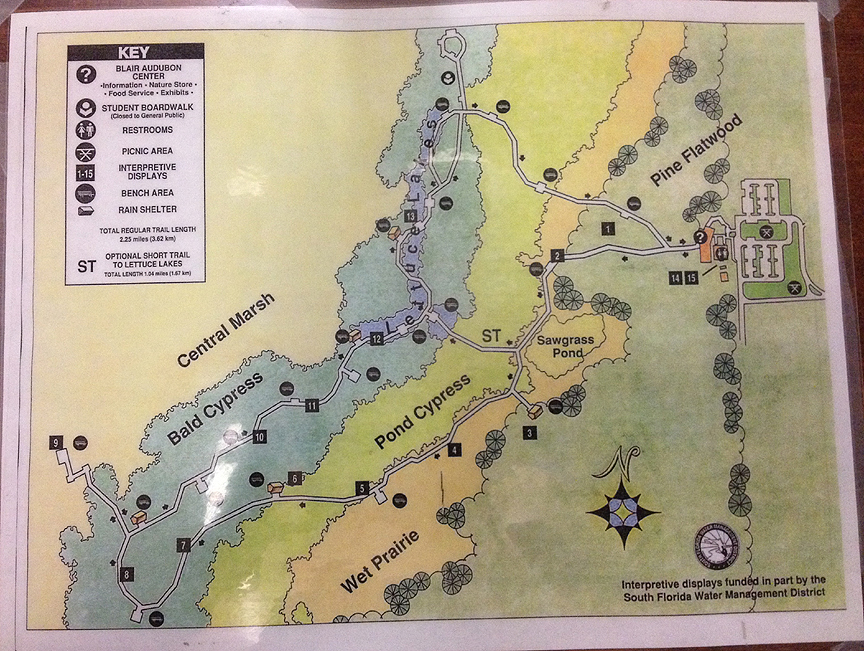

Map of Corkscrew Swamp showing different types of habitat in the sanctuary.

The trail lead us through the pine flatwoods and along the wet prairie, where grasses and ferns mixed with scraggly trees.


Once in the cypress grove, we were surrounded by towering trees that shade a bonanza of ponds and swamps teeming with birds. Many of the largest trees are named, but I found photographing them to be useless as I just can't convey the enormity of these giants, some of which are over 500 years old.


Boardwalk through Corkscrew.

Florida strangler figs, Ficus aurea, are prevalent. Here's what Wikipedia has to say about them:

"Ficus aurea is a strangler fig. In figs of this group, seed germination usually takes place in the canopy of a host tree with the seedling living as an epiphyte until its roots establish contact with the ground. After that, it enlarges and strangles its host, eventually becoming a free-standing tree in its own right. Individuals may reach 30 m (100 ft) in height. Like all figs, it has an obligate mutualism with fig wasps: figs are only pollinated by fig wasps, and fig wasps can only reproduce in fig flowers. The tree provides habitat, food and shelter for a host of tropical lifeforms including epiphytes in cloud forests and birds, mammals, reptiles and invertebrates. F. aurea is used intraditional medicine, for live fencing, as an ornamental and as a bonsai."


Florida strangler fig on bald cypress.

The low sun angle of mid-February cast long shadows through the afternoon swamp.


We didn't see any mammals, but there are several dozen in the sanctuary, including the critically endangered Florida panther. We did see several alligators, but not until later in the day when it had warmed up a bit.

Young gator warming up on a downed cypress, covered with water lettuce.

Several plants were in bloom, including this swamp lily, crinum americanum.

Swamp lily in the shade.

But perhaps the most spectacular find, plant-wise, was this cardinal air plant, Tillandsia fasciculata, a bromeliad, that was blooming right next to the trail. An epiphyte, these are plants that do not grow in soil, but rather attach themselves to trees and collect nutrients through their leaves. It's one of those plants that is so alien to someone who grew up in the north, and I spent quite a while studying and photographing it.


Cardinal air plant, or Tillandsia fasciculata

These amazing plants do not harm the tree, and actually serve to help other critters as the plants become small reservoirs up in the trees. Insects are drawn to them, which in turn benefits frogs and birds. I was smitten with the placement of the pistol and stamen on these plants--that tiny splash of purple that you could easily miss if you only gave this plant a passing look.


Next: the birds of Corkscrew Swamp

Monday, March 8, 2010

Maritime Hammock Santurary

So sorry for the long delay in the Florida posts. Getting ready for the show at the end of February put me behind in some of my other work and it's taken me a week to catch up!

After leaving the beach I drove south again on A1A. I was looking for a place to hike, and as I didn't have a good map or information I was looking out for signs along the road. I passed another parking area on the beach side, then passed a sign on my right warning about alligators along a trail. Ah ha! I thought, and then passed a parking area with a gated two-track and a kiosk. I turned the car around and headed back.

The Maritime Hammock Sanctuary is part of the Archie Carr NWR, and it turned out to be just what I was looking for--a moderate hike through forested terrain. The hike starts at the "kiosk/bike rack" area of the map below, then t's at the edge of the Banana River. I took the loop to the north, along the shore and then over to the pond and back.


I was just getting my camera gear, snacks and water together when a couple pulled up and got ready to hike the trail too. We said hello, then the man stopped and looked down at the ground. There, right by the gate in front of the kiosk, was this little critter--a gopher tortoise hatchling! He/she wasn't more than three inches long, and tried desperately to hide when I took its picture. We examined it, then moved it away from the kiosk so no one would inadvertently step on it. The website that I used to ID this tortoise claimed this is a rare sight.


I have spent a lot of time in Florida. If I want to see my grandma I have to go down, as she no longer comes up. I've done some hiking in the central part of the state, but not much along the coast. I was not prepared for the jungle-like quality of the environment here--for all the hiking I've done, I've never encountered a place like this! The vegetation was thick and in most places it was impossible to see more than five feet off the trail.


The sanctuary is actually a restored area of swampy marsh land that was walled in with earthen dams 40 to 60 years ago. I assumed it was done to dry the area out and make it buildable, when in fact it was done to flood it. The earthen dams were meant to hold rain water in, thus making the habitat unsuitable for a particular species of mosquito that was a problem in the area (can you say malaria?). To restore the natural flow of water into the ecosystem, large drainpipes were installed under the levees. To remove the levees completely would have been much too big an undertaking.


I am always curious about habitats that differ from what I'm used to here in SE Michigan. This jungle of a place, with its live oaks and palms, is about as different as you can get. I often wondered why they were called live oaks--I thought perhaps it was because they shed and regrow their glossy green leaves so quickly. Now I wonder if it is for the amazing plant communities they harbor in their canopies.


Light is at a premium in a forest as thick as this. Ground plants must be large-leaved and shade tolerant in order to survive. Other plants have developed another way of coping with the lack of light down below--climb up to the top!

When I first saw this plant, which I have so far been unable to identify, I thought it was actually growing out of the tree. I realized later that it is a vine growing up the tree in order to reach brighter light.


Wild pine is a yucca-looking plant that does actually grow on the tree--it is an epiphytic plant, an air plant, one that relies on the oak for support but not nutrients.


As I walked the trails, I kept coming across these large, dead or dying ferns. After the third or fourth one I stopped and looked around. I didn't see any of these growing along side the trail and was baffled as to where they came from.


Then I looked up. I am assuming this is another epiphyte as I didn't see any vines, but it is yet another plant I haven't been able to identify. Perhaps, with as much time as I spend in Florida, I should invest in some plant guidebooks!


Next: mangroves and more birds