Showing posts with label scarlet tanager. Show all posts

Thursday, August 19, 2021

Spa Day For A Tanager

Every birder has at least one nemesis bird, a species that they've either chased and been unable to find, or have not gotten clear views of. I've got several of those, but one notable species that stood out was the scarlet tanager. It's not an uncommon bird in Michigan in the summer, and I've actually seen them all over the place. I think my first look at one was on a bus tour in the Kirtland Warbler Management Area in NE Michigan during the Tawas Point Birding Festival way back in 2011 (I think). It was distant but utterly stunning, that bright red bird bopping through the tree tops in an oak savannah. I've seen them in Michigan's "thumb" at the Sanilac Petroglyphs. I've seen them in the mulberry tree at our last house in Pinckney, in the woods, along roads--heck, even here along the lake shore. But I had NEVER managed to get a decent photo of one. Either they were gone by the time I got my camera, they were a million miles away, obscured my something, or my camera settings were off.

But finally this year we had one show up at our feeders. I looked out the window and there it was, sitting on the suet feeder. It flew to a nearby oak and just SAT. I got great photos and the curse was finally broken. 

Fast forward a couple weeks and we are having dinner. My seat at the table allows for a view across the living room and out the door to the deck. It had been hot, we were in the midst of a year-long drought, and our oaks had been decimated by gypsy moth larvae. It was recommended that we water the trees to help them recover, so I'd been running a hose to water the two trees the deck is built around. Movement caught my eye and I looked up to see the tanager, in full sunlight, bathing in a thin puddle on one of the deck boards. OMG. I got a couple quick shots through the window.


At this point the hose was off but I wanted to give him more water to bathe in. He had hopped farther down the deck, so I grabbed snuck out the side door, careful not to spook him. I inched over to the shutoff and turned the water back on, then hunkered down next to the hose caddy to wait. 

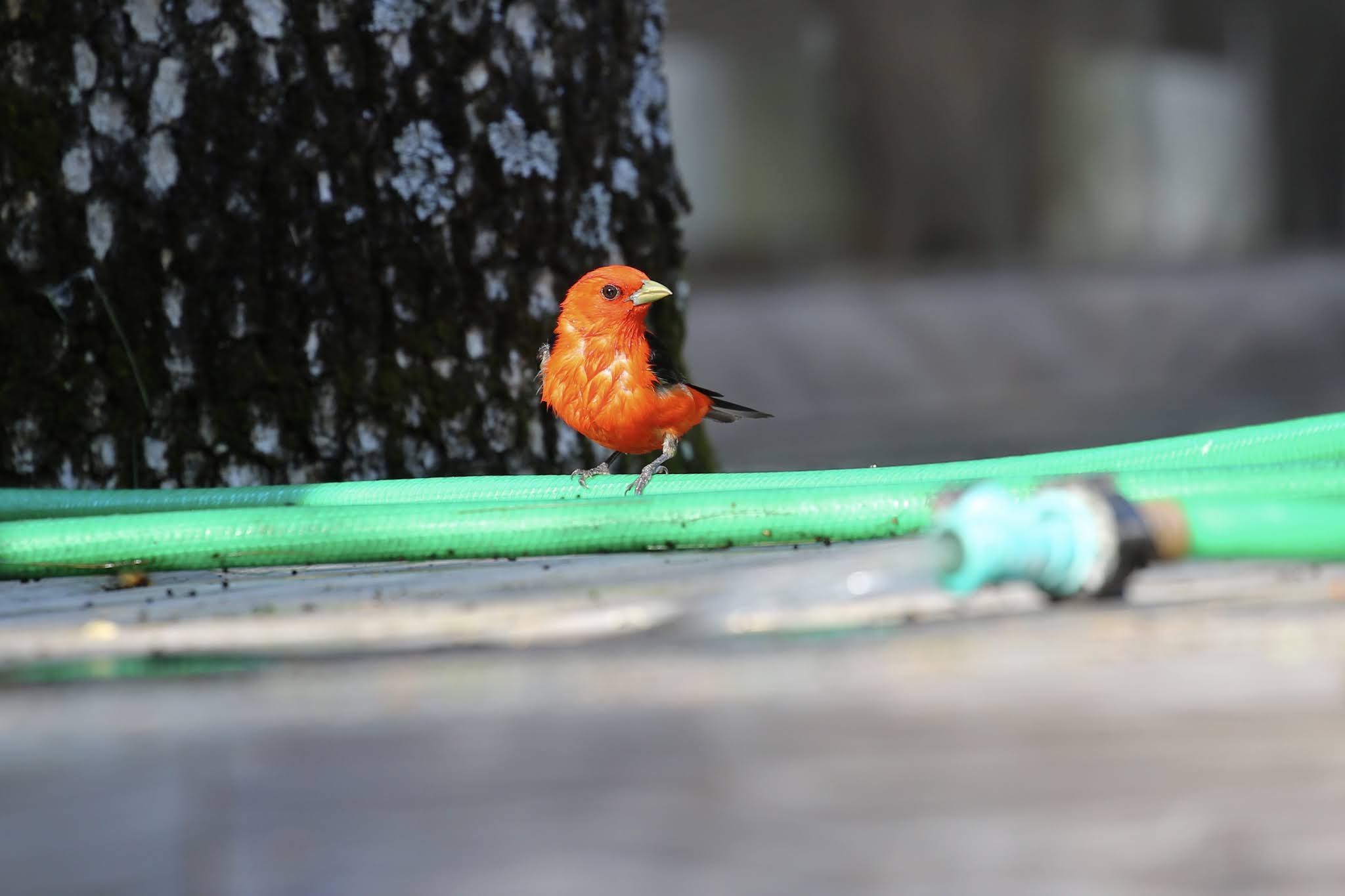
The sound of running water got his attention and he hopped over to investigate. He perched on the hose and eyed the water streaming out of the end.


Hello, what's this?


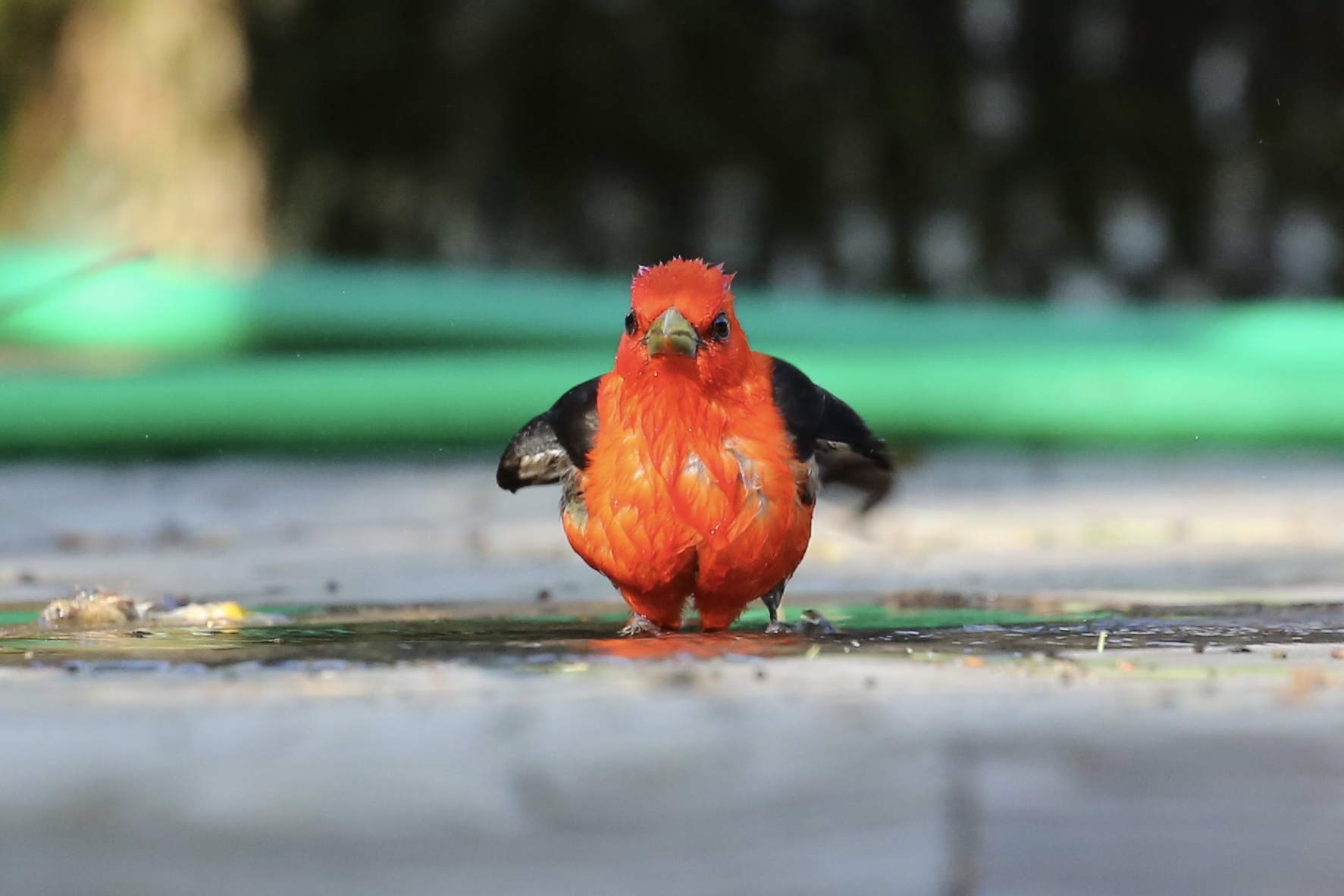
A puddle!!


I shall bathe like no one is watching.


He eventually flew of to preen and fluff, and I was left breathless and so very happy to have had a moment with this gorgeous bird.


Tuesday, June 7, 2011

Kirtland's Warbler Management Area

Friday morning at the Tawas Point Birding Festival found a group of us on a bus bound for the Kirtland's Warbler Management Area in search of, naturally, Kirtland's Warblers. The old school bus bounced and thrashed its way down the un-maintained sand roads of this public land, the roar of its engine all but drowning out the voice of our guide, whose name I have shamefully forgotten. At any rate, he filled us in on all the basics of Kirtland's Warbler management and why the bird needs it.


The Kirtland's is a particular bird. It nests on the ground beneath the drooping branches of Jack pines. Period. No other tree will do. Not only that, but it needs those trees to be of a certain age--between 5 and 20 years old, and of equal height. Any older (taller) than that and the tree no longer provides adequate cover for the nest.

Jack pine habitat is very limited, and is concentrated in the northern lower peninsula of Michigan. This area is very sandy and dry, and historically was prone to frequent fires. These fires kept the Jack pine habitat regularly rejuvenated--the Jack pine's cones need fire in order to release it seeds.


The problem is that we don't like fires. Fires burn up our stuff. So when modern fire suppression began around the turn of the 20th century, the Kirtland's numbers suffered a sharp decline, and by the 1960's there were fewer than 200 singing males reported. So when the Endangered Species Act was passed, we began to manage public lands to replicate the natural conditions that this bird needs in order to survive. It's very labor intensive as we still don't burn the areas. The trees are harvested, the ground prepared and young trees are planted. But it has been a successful effort--in 2010 the number of singing males was recorded at 1,820, and for the first time since we've been paying attention, there are breeding pairs in Ontario and Wisconsin.


It was a gray morning and rain threatened. We spread out along the dirt road and our guides listened for the male's song. We were there perhaps 10 minutes when someone spotted a male, perched atop a young oak, warbling away. I was lucky to be pretty close and got a few shots before he flew away.


Others were spotted as we moved through the area but they were all even farther away and only clearly visible with a strong spotting scope. I was satisfied with having seen one so I started watching to see who else was out there. This pretty little Nashville Warbler stopped close by.


The rather open habitat was dotted with taller trees and snags, providing great perches for males of all species to sing their songs. At one stop this Brown Thrasher sang the entire time we were there.


A female Rose-breasted Grosbeak perched prettily by the side of the road, offering us some great looks.


We moved out of the Jack pine habitat into one of hardwoods with an open forest floor. This area was maintained as a fire break, and had had a controlled burn done in it just a week before. The smell of the fresh burn struck us as we stepped off the bus. We had stopped there to look for Red-headed Woodpeckers, although I never saw one. I did however finally get a few (fuzzy) shots of a male Scarlet Tanager!


My big moment came while we were woodpecker hunting. I looked up at this oak and noticed a funny lump on a branch silhouetted against the sky. I got the camera around on it and saw this:


Most of the group was off to my right, 20 to 40 feet or so. I said, to no one in particular, "I think I see a Whip-poor-will." I was stunned by the reaction! It was like in a cartoon--the group moved, en masse and at record speed, to surrounded me. "Where! Where!" they asked excitedly. You'd have thought I'd spotted Johnny Depp or Angelina Jolie out there in the woods. I pointed it out and the scopes went up.

It turned out not to be a Whip-poor-will but a Common Nighthawk. Well, I was close, anyway--at least I didn't call it a Snow Bunting or something. This was a life bird for many (and me too, as I had only heard it before this), so the group was all a-twitter.

Here it is, cropped in. I wish I could figure out in what direction it's looking--I imagine it's squat head is turned toward the camera, but it could just as easily be looking the other way.


It was just a matter of luck that I spotted this bird. Twenty feet to my right or left put the bird in front of a background of branches and trees--once I moved I had a hard time finding it again even though I knew where it was. I received many congratulations and I felt, for a moment, like a bona fide birder--even if I hadn't known at first what the heck I was looking at!

Thursday, June 2, 2011

Birds on the Beach Pt. 2

Before I left for the Tawas Point Birding Festival I was flipping through a bird book, taking a look at the warblers. Good grief, I had no idea how many of the damn things there are! I was signed up for a bus tour through the Kirtland's Warbler Management Area, but was not really all that excited about seeing one. Because of its endangered status, and because it breeds almost exclusively in Michigan, we hear about it A LOT. But as I was flipping pages I saw a little bird called a Black and White Warbler. How cute! And better yet, I didn't even know such a thing existed, so I got all excited at the prospect of seeing one, and I mentioned this to Lisa and Lori. I had done the same last spring before one my Florida trips, announcing that I wanted to see a Loggerhead Shrike, then saw one in the parking lot at Pelican Island.

I should say that I'd like to see a winning lottery ticket, because as I was making my way off the beach and back into the trees, who did I see but this male Black and White Warbler.


I very nearly squealed, and wrestled my camera and tripod into place. It was starting to get pretty dark and I worried about not having enough light, but I managed a handful of fuzzy shots.


Much like a nuthatch or creeper, this little warbler works the trunks of trees, gleaning insects from the nooks and crannies. Quick and agile it was a challenge keeping up with him.


I watched until he flew away, then did a little dance.


Soon after a Yellow-rumped Warbler appeared, showing off his bold markings. I want to pinch his cheeks!


Not nearly so interested in having his picture taken, this American Redstart, another of the warbler family, wouldn't come out of the brush, so this was the best I could do.


The sun was nearly set and the light getting quite dim on this mostly overcast night so I made my way back to the paved trail. Of course movement caught my eye and I stopped to watch this bird, nearly double the size of the warblers but looking, to me, very warbler like. Yellow-breasted Chat? I thought excitedly. Thank goodness I have a camera to record what I see, because this isn't a chat-they have black on their faces. So what the heck...? Not until I got home and had time to study this bird did I realize it was a female Scarlet Tanager. I had seen one once before, here at home, and it took me over a month to identify it. Perhaps next time I'll know her on sight!


The sun made one last appearance before it slipped below the horizon, and shone on the lighthouse. I headed back to the van, amazed and exhausted by the fabulous day. I photographed 29 birds that day, 23 different species, three of which were "life" birds. Not too shabby!


Next: Kirtland's Warbler and more!

Friday, September 18, 2009

The Rest of the Rifle River

You may think from my posts that all I'm interested in are loons. Don't get my wrong, they're fascinating birds, but I know there's a lot more out there than stunning, 100 million year old waterfowl. Loons are unique to me is all, and I'm excited to learn about new things.

There was a lot to see in the Rifle River Rec Area. In addition to loons and coyotes and remnant forests there were lots of birds--robins and ducks and kingfishers and warblers and flycatchers. I wasn't able to get good shots of most of them, but here's a female scarlet tanager that I caught flitting about along the shoreline.


I saw tanagers--both a male and female--here at home for the first time this summer and what a thrill that was! I had never seen one before except in a book, so it was wonderful to see one for the first time in my own backyard.

Trying to capture birds in flight has got to be one of the most difficult things for any photographer to accomplish. They are relatively small targets, so focus becomes an issue, and they are usually strongly back lit so exposure is a problem. You have to pan along with them as they fly so the shot's not blurry, and then when you're bobbing up and down in a boat, well, you're happy when then bird is even recognizable!


Above is a shot of a female hooded merganser, recognizable by the white patch on her wing, and by her rusty-colored head (just visible in this photo). Often the only way I can identify a bird is if I get a clear picture of it and look it up later. I am not a proficient birder (though I'm learning!) and I rely heavily on my bird guides. My personal favorite is Sibley's--he has the most accurate illustrations, provides more than one view (shows birds in flight, wings up and down, which is invaluable) and gives you ranges and habitats all on one page. If you're looking for a good guide, that would be my recommendation.

Here is a solitary sandpiper poking around on a floating mat of grass and weeds. (Again, thank you Sibley!)


Mammals are more difficult to find, being much more shy of us (and with good reason!). Usually one is left looking for signs of their presence and only rarely seeing the beasts themselves. Here is an old beaver lodge. You can see the pile of sticks and logs up along the shore, with more branches strewn along the lake bottom all the way to my kayak. This was an impressive lodge, stretching 30 to 40 feet from the shore and maybe 15 to 20 feet wide. It was clear though that it hadn't been used in some time (trapping is allowed in the park).


A walk in the woods on Sunday was a needed break from months of sitting in front of my computer, at my drawing table, in a kayak, at a show.... My hip ached not long into my hike from lack of activity. The morning sun slanted through the trees and until the mists burned off it felt like I was walking through a fairy forest.


For me spring is the prettiest time in the forest, as the trees are just beginning to leaf out and the forest floor is a riot of spring flowers. But there are things blooming in the woods in autumn, and Indian Pipes are one of them. This unique plant does not engage in photosynthesis and therefore lacks chlorophyll. It feeds off a particular fungus that in turn feeds off of tree roots. It is not an easy plant to find as its habitat is quite limited, but there was a stretch of about 150 feet of the trail along which this plant was growing abundantly.


We are hoping to get at least one more trip up north in this fall, perhaps to the Pigeon River area, for a long weekend. But first we have a wedding, then a show, then an open house, then another show.... Can be hard for a nature artist to get out into nature!