Showing posts with label Shiawassee National Wildlife Refuge. Show all posts

Tuesday, May 31, 2011

Artwork--Chickadee triptych

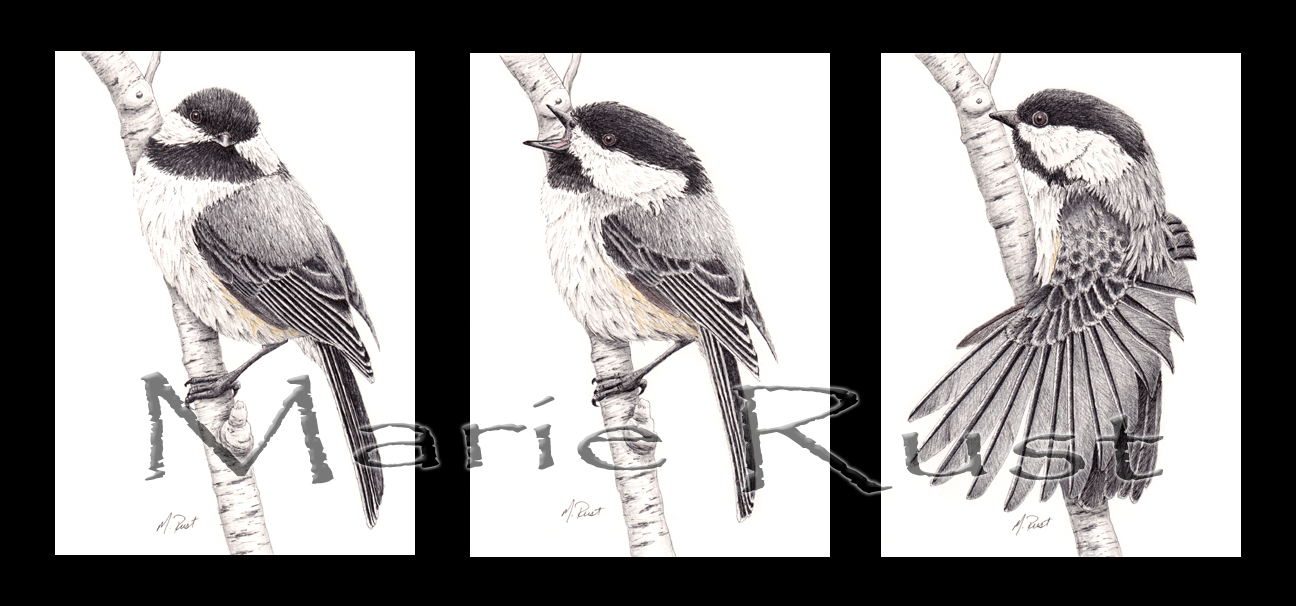
Just finished a series of three Black-capped chickadees. I ran across this little fellow at the Shiawasee National Wildlife Refuge last spring. He posed so prettily and did all sorts of cute things like yawn and stretch his wings. He was really checking us out, must have watched him for nearly 5 minutes. It was quite a treat.


The originals will be matted and framed together, though I am not certain of the size yet. The prints will be done like this and matted to 10x20. Be sure to click on the image to get a bigger view.

Wednesday, May 26, 2010

Finishing Shiawassee

Flush with the thrill of the chickadee encounter, we moved on down the trail, coming to a tangle of downed trees and grape vine, and my keen eye (*snicker*) spotted some movement among the vines--a brown creeper!!


I have only seen one on two occasions, first on a walk in Huron Hills Metropark just down the road from my house, and once this past winter in the trees next to my studio. That time I had been out filling up feeders and again caught movement on a tree trunk about 15 feet away. I froze instantly and saw a creeper working its way down the rotting wood of a dead slippery elm. Within moments it flew closer, landing on a black cherry not four feet in front of me. I watched it for a minute or so before it flew away, then I ran to the house to tell the girls.

They can be very difficult to see thanks to their camouflage coloring and markings. I know this one isn't particularly clear, but you can imagine how on a rough-barked tree this bird would virtually disappear.


Eventually the path left the riverbank and turned back into the woods. It occurred to me after a bit that we were walking on a raised bed, not unlike the dikes in Florida in the Maritime Hammock Sanctuary. I looked along both sides of the trail and could see in places that it had probably been dredged at some point, although I imagine the area had been previously swampy, like in this photo.


Then Lisa picked up a funny looking rock and we gathered round to examine it. Huh. Looks a bit like coal. Oh hey, that's right, I remember reading that the area had been mined for coal decades ago! What we were walking on was probably an old rail bed that was used to get the coal to a barge waiting on the river.


This deer and its partner where checking us out from across the swamp. A bit rough looking, I assume it's shedding its winter coat.


I was disappointed at the number and density of invasive plants in this wildlife "refuge"--it was thick with barberry, glossy buckthorn and garlic mustard to name a few. But in spite of that we came across a decent variety of wildflowers, including the densest concentration of wild ginger any of us has ever seen.


Lots of wild geranium...


and Jack-in-the-pulpit too.


Nearing the end of the trail we spotted this eastern phoebe near a marsh, watching us closely.


Finally, as we neared the parking lot, we came to a small flock of cedar waxwings feasting in...well, I'm not sure what this is. It could be glossy buckthorn--the berries they were eating had to be from last year as no plants had produced yet. This of course is how this plant gets spread all over the place--birds eat the berries and then poop out the seeds. Sigh.


Here is a shot of the backside of a waxwing. Shows off the yellow tips on the tail and the red adornments on the ends of some of the wing feathers--breeding plumage that will be lost when the birds moult in the fall.


We got back to the RV--remember the RV?--and were famished, not having packed any snacks and too little water. Our hikes always take longer than we think they ought to considering the distance we travel, and this was a warmer day than most we'd had up to this point in late April. We sat and had lunch then headed on home.

A week or so later I visited their website, http://www.fws.gov/midwest/shiawassee/, and found that they have a list of bird sightings that is just amazing. Again, we were there about a week too early to really see a huge variety of birds, and I would guess that many of the sightings were near the marsh, not the river and woods. Oh well, someday we'll figure out how to plan our travel times better!
Tuesday, May 18, 2010

Uneasy Neighbors

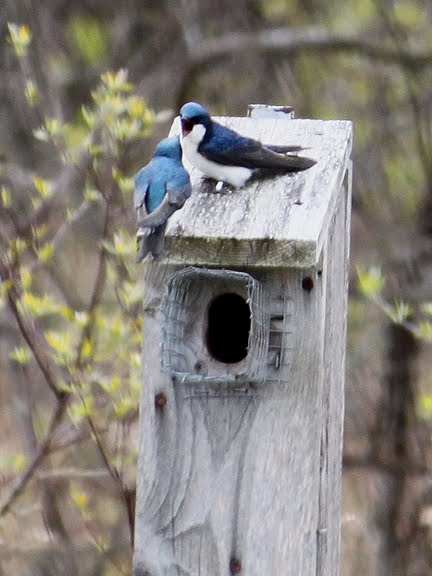
As the trail at the Shiawassee NRW finally reached the Titabawassee River we saw swallows swooping and swerving over the water. Down along the river bank path we came across some bluebird boxes, complete with bluebirds.


Upon the neighboring box sat a tree swallow.


Tree swallows are known for taking over bluebird boxes, and, along with starlings and house sparrows, have earned a bad reputation for doing so. I never really understood this, as tree swallows are a native like the bluebird, (unlike the house sparrow and starling, both of which came from Europe), and seem to me to be equally deserving of nesting sites.

These two are checking the place out.


I have seen other birds, cardinals for instance, that will feed each other I would guess as part of a mating ritual. I have only seen the male feeding the female, as if to say, "look at what a good father I can be!" as it is after all the female who chooses with whom to mate. At first I thought that is what was going on here, but now that I look more closely at these photos it looks like a male above and the female below, so I don't really know what is going on here. Perhaps they aren't even mates.


I was curious about this nesting competition with bluebirds and the anger some people feel towards the three swallows, so I did a little research about it. Turns out there are plenty of others who don't quite understand the vitriol some reserve for the tree swallow, and feel it is ill placed. Bluebird numbers are quite healthy, and yes it is thanks in part to the folks who put up bluebird boxes all over the Eastern US. But historically (and we're talking pre-European settlers) much of the east was not great habitat for the bluebird. It was densely forested, and the bluebird needs open land in order to hunt for it's prey. Numbers soared in the 1800's as we cleared the land for farms, but then fell thanks to the introduction of the house sparrow and the starling. Numbers declined further with the use of pesticides that killed off the bluebird's main food source.

But now, estimates put bluebird numbers on par with tree swallows. After watching the swallows scooping up bugs over the river I would be more than happy to have them nesting in boxes at my house! However, as one who is trying in vain to establish native vegetation on my property only to have it munched down to the ground by white-tail deer, I understand the frustration one can feel when they have a certain goal in mind but are thwarted again and again by Nature, who generally has a plan all its own--or no plan at all.

But don't worry too much about the bluebirds. They can fend for themselves.


Tuesday, May 11, 2010

Shiawassee National Wildlife Refuge

Leaving the ick of Bay City behind us, we drove back south to the city of Saginaw. We were a bit perplexed as we drove through town, wondering where on earth one would hide a wildlife refuge in all of this concrete. After navigating the city streets and a major detour we finally pulled into the parking lot for the Shiawassee National Wildlife Refuge. We had opted for the Woodland trail, a four mile loop that we figured we would walk part of and then walk back. When we got there we looked at their trail maps and found several smaller loops were available and decided to take a two mile loop that went along the Tittabawasee River for a spell.


Also on the message board was an announcement warning people not to eat the following: Deer liver, any part of a wild turkey, several fish including catfish and white bass, and waterfowl. Apparently the Tittabawassee River has been contaminated with dioxin. Nice. We could have called this our Toxic Vacation! We tried our best to put the specter of contamination out of our minds and enjoy the scenery.


Shortly after striking out we came to a bridge crossing Bullhead Creek, (another fish on the "Don't Eat" list).


The day was fair even though it lacked sunshine. The turtles were quite appreciative of the heat. Here a painted turtle warms its bones.


There were piles of turtles on nearly every branch, log and rock.


Ah, the unmistakable snapping turtle, with its phallic head. According to Wikipedia a basking snapper is a rare sight--lucky me. Snappers are mean, aggressive and agile, as anyone who has tried to move one out of the road knows--the ungrateful sot--and they smell like dead things. This one has quite an impressive crop of algae growing on its back. They are best left alone--they eat baby ducks, fer cryin' out loud. 'Nuff said.


As we moved on down the trail we came across this fungus. I don't know my fungus, but this one was really interesting. Anyone want to school me here?


We couldn't go 50 feet, it seemed, without something to look at. This comma butterfly landed in the path right in front of me. My books tell me this butterfly is typically shy, so I guess another fairly rare sight.


Not a minute later this red admiral landed in front of me. Both these butterflies were only about 1 1/2 inches long. These butterflies are apparently more gregarious. I fished one out of the laundry hamper this morning, a stow-away on a shirt hung on the clothes line Sunday. I let it out the front door.


Not too far from the creek we found several crayfish burrows. Yes, they really live down there. They dig down in the mud to get to the water table, bringing up pellets of mud that make up the chimney. Snakes will some times take up residence in dried out crayfish burrows so I wouldn't stick my finger down one.


The girls had gone on ahead while I was chasing butterflies. After a bit I noticed they had stopped and were peering into a hole in a tree trunk. I came over slowly and peeked over Lisa's shoulder. I thought at first I was looking at an Eastern screech owl, but then I noticed an ear and fuzzy tail--a gray squirrel, possibly on a next of youngin's. Kind of a risky place to build a nest, next to the trail at eye level, but perhaps all the prime spots were already taken. Anyone got a peanut?


Next: chicken update