Showing posts with label Pigeon River Country. Show all posts

Sunday, January 31, 2021

Michigan Big Year: Bohemian Waxwing Bonanza

The first several trips I took in search of birds for my Big Year were forays into the field tied to other errands, which helped ease my guilt over driving all over the place to look for birds. My trip to Reeds Lake was done as a side trip to Lori's doctor's visit, at a facility a half mile from the lake. On January 8th, we combined a trip to Costco on the west side of Grand Rapids to a hunt for a Smew, a Eurasian merganser that had been reported on Allegan Lake, about 20 minutes farther south. 

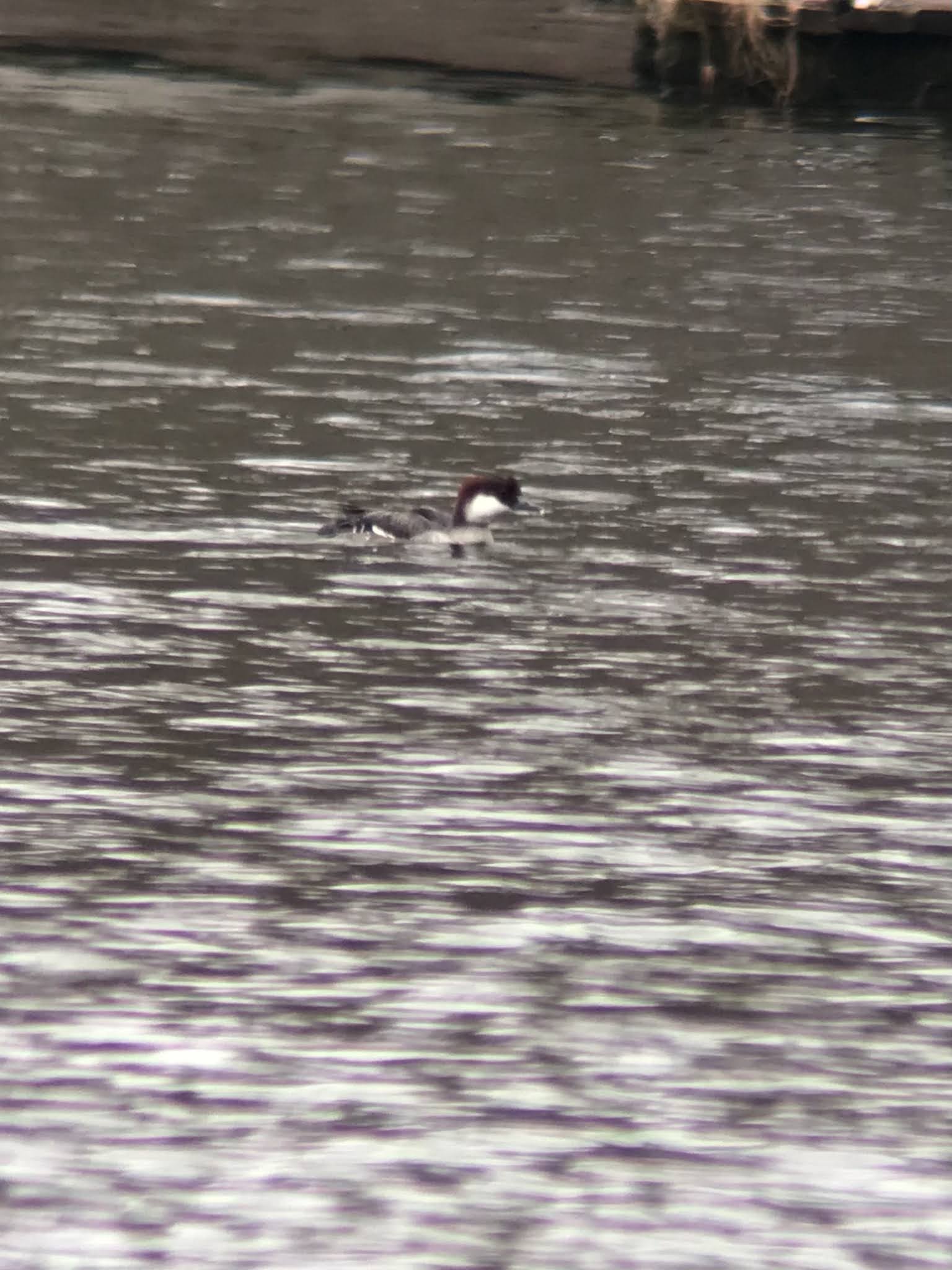
As with so many rarities, we found the Smew thanks to the group of birders already there with scopes and binoculars. At first it was hidden behind a dock, but came out within minutes, and I took some photos with my iPhone and scope (digiscoping). It is a species that is often purchased and bred by bird fanciers, and it is likely this is a bird that escaped from a collector rather than one that got here of it's own accord. If I was doing some sort of a formal list that would matter, but in this case I'm not going to sweat it too much. I also added Bonaparte's Gull at the lake, and an American Kestrel on a wire along Fruit Ridge Ave on the way home.


Smew, Allegan Lake, January 8


January 9th was the coldest day of the season (9°!), so we stayed home with fires blazing in the wood stoves. I wondered how the cold temps would affect the lakes in the area--one of the reasons we were able to see birds like the Smew is because it's been relatively warm here so far this winter. While highs in the 30's and lows in the 20's don't sound all that warm, it's still 5° to 10° above average for January, and it's been enough to keep lakes, most rivers, and even the shoreline and bays of Lake Michigan mostly ice free.

By January 10th the weather had warmed, and I had been alerted by a friend of a flock of Bohemian Waxwings--a totally new bird for me, one I'd been wanting to see for years--in the Pigeon River Country of Northeast Michigan. I think she was out looking for one of the elk herds the Vanderbilt area is famous for but found birds instead. Upon checking eBird I saw that this was near Inspiration Point, a known spot for waxwings as well as Pine Grosbeak, another not-so-easy-to-find Michigan bird. It was a three hour drive, but Grayling was right on the way, and I needed to restock prints at the AuSable Artisan Village, a gallery I had just rejoined in the fall. It was the perfect excuse to go look for birds.

After many detours and the GPS taking us down Forest Service two-tracks, or trying to take us down roads that literally no longer existed, we finally found the spot. I slowed as we neared the road for Inspiration Point because I could see birds flying all over the place. Across the road was a pullout, and I stopped before we reached it to get my gear and put some spikes on my boots, and there by the side of the road was a Pine Grosbeak, calling from a tree right next to the car. I pulled up into the turnout and saw the area lined with crabapple trees, still with fruit, and they were FULL of birds.

I parked the car near one tree and got out and stood in the open with my camera. The birds could not have cared less. They moved from tree to tree, eventually landing right next to the car where Lori had a clear view.  They flew overhead and I could hear the sound of their wings. 

This was only my second time seeing Pine Grosbeak, and I was able to get much better photos this time around (though I'd still like better). They are such gorgeous finches in raspberry and terra cotta, with those bold wingbars and blue-gray backs. 


Male Pine Grosbeak, a Northern Michigan specialty


Female Pine Grosbeak picking at crabapples. 


But the show stopper for me was the big flock of Bohemian Waxwings. In most places in Lower Michigan one sees Bohemian Waxwing as an individual or two mixed in with a flock of Cedar Waxwing. To find a flock of nothing but Bohemians was a bit overwhelming. I didn't know where to look, but settled on birds that were next to the car as the lighting was better for photos. 

Oh my.


These birds are distinguished from the Cedars by their overall gray appearance (Cedars are more yellow and brown), the rufous on the undertail coverts (Cedars are white), and the yellow and white tips on the flight feathers which make the zig-zag stripe down the wing.


I was gobsmaked watching these stunning birds, and if they hadn't flown off after about 15 minutes I might not have ever left. Last word I had (January 30th) is that the trees are now bare and birds have moved on.

As we turned and headed for home (this time on actual, plowed roads!) we saw a Ruffed Grouse fly across the road. A moment later I realized there were several birds along the road near a little wetland where there were also crabapples. I tried stopping quickly and the anti-lock brakes kicked in, grinding and crunching and not really stopping us, even though I was only going about 10 miles an hour. We finally came to rest about 40 feet away, and I managed a few photos before the birds spooked and flew into the woods.


Ruffed Grouse heinie.


We ended the day with three new species for the year, one lifer, and a boat-load of photographs. There were at least 50 waxwings in the flock and another 20 grosbeaks, and we counted seven grouse in the covey. Well worth the three hour drive!

Allegan Lake, Jan. 8

48) Smew (lifer)
49) Bonaparte's Gull
50) American Kestrel

Inspiration Point, Jan. 10

51) Pine Grosbeak
52) Bohemian Waxwing (lifer)
53) Ruffed Grouse

Friday, October 14, 2011

Last Leg of the Shingle Mill Pathway

 (Pigeon River Country posts continued)

Shortly after my rest stop at Ford Lake the trail met back up with the main loop and turned south, headed back to the trail head.  I was tired, which I knew in part because every soft dry spot looked like a good place to take a nap.  I wasn't carrying a lot of gear but I did have my camera backpack on, with all manner of things in it, just in case, such as rain ponchos, a knife, an emergency whistle and tush towelettes.  My water bottle, which was clipped to the back with a carabiner, added to the weight.  When I stopped to take pictures I had to wait for it to stop swinging back and forth before I could shoot.  The backpack has a hip belt, but because the bag is so short it doesn't reach my hips, so much of the weight was on my shoulders, and I was starting to get a stiff neck and accompanying headache.  I was glad at this point that I had opted for the shorter loop.

The last leg of a hike can be a slog to the finish.  Something changes, psychologically, when you're near the end, especially when you're tired, and you just want to be done.  I did my best to stay alert and keep looking around and be wowed by things, but it wasn't easy.

There hadn't been a lot of evidence of logging in this area although it had, like all of northern Michigan, been completely cut over in the 1880's.  A few large, chest-high stumps remained here and there, testament to the slaughter of the white pines, but most of what I saw from the trail were more recently cut red pine, much smaller and closer to the ground.


I think it is interesting how we tend to believe that what we see is exactly how something has always been.  People who hike this trail who don't know Michigan's logging history probably think they're looking at healthy, undisturbed habitat.  But the reality is that this looks nothing like it did 150 years ago (or 15,000 years ago for that matter, during our last ice age). Not only did we vastly change this region with our hunger for lumber but it is still being logged today, evidenced by the enormous lumber trucks that sped past the campground every now and then, loaded with red pine trunks.  I tried not to think about that, because part of me really wanted to feel like I was in un-managed and un-trammeled wilderness.

Shortly after passing under some power lines (which totally destroyed my wilderness fantasy) I noticed a change in the light, the color of the trees, the air temperature.  I stopped and looked around, and realized I had just entered a part of the forest dominated by balsam fir.  What a joy!  Nothing that I can think of makes me feel like I'm in the north woods more than the scent of balsam fir--there's just nothing like it.  I was so happy for the change of scenery so close to the end of the hike, when I really needed a distraction from my aching shoulders and something new to be excited about.


 The dampness of these woods and the deep greens of the trees filled my senses.


And if that weren't enough, past the fir forest the trail entered a cedar swamp!  I had seen it on the map but had forgotten about it.  Darker and damper still, the cedars felt close and welcoming, almost protective.


By now the rain that had threatened all day had begun to fall, and the already damp and slippery boardwalk became even more so.  I was loathe to break out a rain poncho so close to camp so I tucked my camera under my fleece and kept going.


I stopped for a few more photos as the trail moved out of the cedar swamp and into more open woodlands.  This slime mold caught my eye, a blaze of orange on a rotting log.


High bush cranberry also lent a splash of color.


Rain now began to fall harder, and I put my head down and pushed through a meadow, soaking my pants.  Not 100 feet from the road I scared off another deer.  All this land and I saw the most wildlife within 1/4 mile of the campground.

Once on the road I had to cross back over the Pigeon River to reach the campground.  I was hot and sweaty for the first time that day, trying to hustle back to miss the rain.  As I crossed the bridge I saw this katydid on top of the reflector on the guard rail.  A passing car slowed down to see what I was taking pictures of--I doubt they could even see the insect, all of two inches long.  Probably thought I was nuts.


Back at the RV I got out of my wet clothes and into dry ones, ate some leftover spaghetti and took a nap.  The rain had stopped so to keep my muscles loose I walked along the river, then sat for a bit and read.  The heavier rain waited until after dark to really come down and I was glad I hadn't bothered with a campfire.  It rained all night and into the next morning.  I decided, with heavy heart, to leave the Pigeon River Country and head east to Lake Huron.  I didn't know how long it was going to rain but the clouds were low and did not look like they were going to break up any time soon.  Rather than sit in the RV and wait for the rain to end I decided to spend that time on the road.  I cannot wait to go back, though, and explore more of this beautiful country.


Next:  Negwegon and Tawas State Parks

Thursday, October 13, 2011

Shingle Mill Pt. 2

 Continuation of the Pigeon River posts.

By the time I reached the Forest Area Headquarters (see map, arrow at bottom right) the fog had lifted.  The building was closed but I stopped and had a snack and looked at my map.  I needed to pee but decided I could wait until I got to the Pigeon River campground.


Just past the headquarters the trail meets back up with the river.  Much of this stretch is up on a high bluff, with nice views of the water below.


The I came upon this curiosity, a marker for someone named P. S. Lovejoy.  I looked him up when I got home.   


Turns out he was a conservationist, born in Illinois, who studied at U of M in Ann Arbor as one of its first forestry program students.  He worked for the Forest Service at Medicine Bow and Olympic National Forests before returning to U of M as an associate professor in the forestry department.  He was also the head of Michigan's Conservation Department and was instrumental in establishing our refuge system.  Aldo Leopold wrote his obituary, published in The Journal of Wildlife Management in 1942.  Lovejoy was apparently very fond of the Pigeon River area, a place he called "the Big Wild."

When I finally reached the campground I was pleased to find new toilet facilities with not one but four air fresheners perched along the handicap railing.  The campground was much more secluded than the Pigeon Bridge campground, where I was camping, and the sites themselves were bigger and much more private.  There were only two campers there and not a soul in site.

The campground road crossed over the river here and deposited me on its western bank.  I sat for a while and wrote in my journal, ate some lunch, and kept a close eye on the sky and its lowering clouds.


Past the campground the trail stays with the river for a little while, then starts climbing upwards again.  It was here I came to the fork in the road, and I paused to consider one last time which trail to take.  I felt good, having hiked not quite three miles, but knew that another seven would do me in.  It takes me a long time to get anywhere as I stop frequently to look at stuff, so a three mile hike often takes me 2 1/2 to three hours.  While I don't cover a lot of ground I am on my feet pretty much the whole time, so I get more tired walking three miles than folks who just push through it do.  I turned left and headed for number 12. (See arrow at left on map above.)


I had seen very few signs of animals on this trail, even though there's probably more wildlife here than just about anywhere else in the state.  I had seen four deer early in the hike, not a 1/4 mile from the trail head.  Some coyote tracks, deer tracks, and various birds were the only other things that I had seen.

But as I made my way to marker 12, I came across some scrapings on the trail.  I tried to distinguish foot prints in them but could not. 


I looked around and found this rotted log torn apart.


That's when I noticed the blueberries.  I had not seen any along the trail up to now.  Blueberries are, of course, one of the black bear's favorite foods. There were no berries this late in the year, but this told me I was certainly in bear country.  The scrapings and shredded logs could have been done by a skunk or coon, but I liked the idea that it was a bear.


Thanks to the fact that I spent a lot of time scanning the woods around me, looking for critters who might like to make lunch out of me, I noticed water off the trail a few hundred feet on my right.  I detoured to it and came to Ford Lake.  I found a comfy place to sit and got out my gorp and journal.


While I sat munching and writing, a flock of 20 to 30 Yellow-rumped warblers appeared on my right, seemingly from out of nowhere.  I watched, rapt, as the flock moved around and above me, peeping and gleaning insects from the trees.  I slowly brought my binoculars up and watched an adult male nab an inch-long caterpillar and proceed to devour it.  I one point I was literally surrounded by birds--above, behind and in front, to my right and left, even below me as I was sitting on the side of hill.  At one point a bird sat perched on a branch not five feet away, at eye level.  I have no way of knowing if they were aware of me, but the moment, which lasted maybe five minutes, left me breathless.  As they moved off down the shoreline the forest returned to silence, and I sat, grinning like a fool.


My view of Ford Lake from my resting spot


Next:  The final leg of the Shingle Mill Pathway.

Tuesday, October 11, 2011

Shingle Mill Pathway

 (Pigeon River Country continued)


The main reason I decided to visit the Pigeon River area was to hike the Shingle Mill Pathway.  A loop trail, it has 5 loops from 3/4 of a mile to 11 miles.  I had heard great things about the area and so had chosen to camp here for a day or two.


The trail head is at the back of the Pigeon Bridge campground, where I was parked.  In my previous post, I talked about the 1 1/2 mile loop I had hiked that evening.  This day I was planning on the six mile loop (see highlighted area in map below).  My heart longed for the 10 mile loop, but my head told me that I had been sitting at art fairs most of the summer and that I was in no condition to be walking that far, especially by myself.  So I decided I would do the inner loop next time and settled on the 6 mile jaunt.


When I woke up that morning I could see stars winking between the leaves.  By the time I left the RV, at around 8:30 am, thick fog had rolled in.


It was utterly delightful.  The fog gave a depth to the forest that you just don't see on a bright, sunny day.


Everywhere I looked was a breath-taking scene.  Fog had begun to condense on the leaves and needles and drip gently to the forest floor. It was just about the only sound save for the occasional peep of a near-by bird.  Not a breath of wind stirred needle or leaf.


This was the scene at the meadow where the day before I seen the little bluestem.  This morning found it draped in a grey cloak.


But the color was there, some of it hard to miss.  The leaves of this red maple were glazed and glowing.


 From thick forests to meadows to glades edged with poplar, the scene seemed to change with every step.


As I came up a short rise I saw red pines towering over me.  I stopped and looked up into the canopy, and found if I squinted my eyes just right I could imagine I was in a redwood forest somewhere on the Pacific Coast.


But I was happy to be in this most beautiful state of Michigan.


Next:  2nd leg of the hike

Monday, October 3, 2011

Pigeon River Getaway

I love autumn.  Each summer I wait patiently for the air to cool, the sky turn deep blue, the grasses to turn to gold, and the trees to blaze.  This is when I long for the woods, when the air is dry, the ground warm and the bugs long gone.  Being an artist who does shows all summer, fall is the time when I get to take a break, a much needed break.

I was not certain until the day before I left where I was going to go.  I had looked at the Pigeon River area for several years but never gone there.  I decided it was finally time.

Pigeon River Country may be one of the most "remote" areas of northern lower Michigan.  Northeast of Gaylord by some 20 miles, it is home to the High Country Pathway, a 70 mile loop trail, and the Shingle Mill Pathway, a multi-loop trail.  As you'll see from the map below there are many "roads" that cris-cross the area but they are mostly two-tracks, probably old logging roads, and don't host any real traffic.

This is state forest land and there is still some logging, but out on trail you wouldn't know it.  The area was logged extensively in the late 1800's but there are now areas of the forest where one can find 100 year old white pines.  There are also cedar swamps and a variety of woodland habitat such as upland pine, hardwoods and fir.  The area is also populated by white-tailed deer, elk, black bear, cougar (probably) and wolves (maybe--wolves were recently confirmed in the northern lower peninsula this spring, and this seems like a logical place for them to be).

I camped at the Pigeon Bridge campground.  This campground is the official trail head for both the Shingle Mill and High Country Pathways.  Knowing I would arrive late afternoon on Tuesday, I had decided to camp there instead of the more remote Pigeon River campground so that I could hike the short 1 1/4 mile loop in the evening.

Shingle Mill Pathway--arrows indicate campground and trail.

It was a spectacular afternoon, cool and clear.  The drive up had been amazing--I don't think there's a prettier drive anywhere than U.S. 127/I-75 north of Claire in late September.  Much of the route is divided highway and so you are treated to blazing colors on both sides of the road.  Where the median wasn't forested it was full of golden rod and New England asters, and the golds mixed with deep purple just took my breath away.  I wanted to stop along the highway and take pictures, but I didn't think that was a good idea with the RV.

I was a bit surprised then to get to the Pigeon River and find very little color at all, at least where I was.  The area hosts a lot of pine, white and red, and very little hardwoods.  None the less, the hike was gorgeous.


 The trail passed through open woods carpeted with bracken fern.  The air had a spicy scent from the drying ferns.


Within a half mile the landscape opened up into a meadow, turned silver by acres of little bluestem going to seed.


The bracken fern here were in the midst of their color change.


Ah a red maple!  What a joy, that riotous color!


The loop back toward the campground hugged the eastern shore of the Pigeon River.  Chickadees and Yellow-rumped warblers plied the shrubby vegetation gleaning bugs.


So here's a quiz:  What do you get when you take a river and add a stand of poplar?


That's right, you get BEAVERS!  Now I did not see any beavers, but by golly there was lots of beaver activity, and much of it clearly recent.  The wood of this "beaver pencil" was still wet.


There were well defined paths from the trees to the water where these heavy-bodied rodents (they can weight upwards of 60 pounds) dragged their poplar dinner to their lodge.


While it seems like beavers do a lot of damage, they in fact keep meadows open by removing invading trees.  Poplars are aggressive growers, and since we work so hard to suppress fires these days, beavers are the only things that will keep these meadows open.  These beavers were clearly quite busy!

Can you find all the beaver pencils?

There was no cell signal out there, and it had not occurred to me to call the girls when I got off the highway, so after my hike I drove back to Vanderbuilt to let them know I'd arrived.  I did not bother with a fire that night--I feel that they are generally more work than they're worth--and instead read a few chapters, played Angry Birds on my phone, and turned in around 10pm.  The following day I was planning to hike one of the longer loops and wanted to get an early start.

Next:  The Shingle Mill Pathway