Showing posts with label Yellowstone River. Show all posts

Sunday, March 25, 2018

American Dipper--The Songbird That Swims

Yellowstone 2016 cont:

I know. It's 2018, and I still haven't finished blogging about our Yellowstone trip. The past 18 months have been really crazy--our move and getting studios and homes put together took forever, and since October I've been on the road for shows as much as I've been home. Writing seems to be falling to the bottom of the priority list, but I miss it, so here we are!

After spending an afternoon with the Great Gray Owls (see previous post) we started back to the Madison campground. The southeast section of the Loop Road follows the Yellowstone River, and we stopped near the LeHardy Rapids because we'd heard there were American Dippers there. That info turned out to be correct.


American Dipper at LeHardy Rapids on the Lewis River

The dipper is a fascinating bird. While it is considered a passerine, or song bird, it spends its life in the water. It doesn't actually swim, as it lacks webbed feet, but it will completely submerge itself and work its way along the bottom of a river or stream, gleaning insect larvae and tadpoles. They have an inner eyelid, or nictitating membrane, that covers the eye underwater but allows for vision, and they have scales over their nostrils that can be closed when underwater.


We watched several birds working the near shore of the river where the rocks that made the riffles hid many juicy bits. While I had seen juvenile dippers in Alaska, this was my first look at adults in action, and it was fascinating.


While their plummage is rather dull, they do have tiny white feathers on their eyelid, which flashes when they blink. This little one was taking a nap.


Leaving the dippers we continued north, making a stop at sunset along the Hayden Valley. It was quiet this day, but ten years before I had seen my first wild wolves here.


Sunday was a day set aside for birding. Rather than go back into the park, we decided to head out to West Yellowstone and the Gallatin National Forest, and drive part of the West Yellowstone Birding Trail. We stopped at the Fir Ridge Cemetery, where the aspens were ablaze. The sky was so clear and blue it made my heart ache.


Aspens in Gallatin NF


We birded Hebgen Lake, a reservoir of the Madison created by the Hebgen Dam, where there were thousands of waterfowl, but most were too far to identify, even with my scope. Beaver ponds are more my speed anyway.

Beaver pond along the West Yellowstone Birding Trail

Past the Hebgen Dam on US 287, you'll come to a visitor's center dedicated to the 1959 earthquake and subsequent landslide. The quake, whose epicenter was 20 miles below Hebgen Lake and measured a staggering 7.2 on the Richter scale, caused the landslide downstream of the dam. 28 people, many of whom were at a campground near the slide, lost their lives. The landslide also blocked the Madison River, causing a dangerous backup of the river. Channels had to be cut into the slide, but a new lake, called Quake Lake, still formed behind the slide.


Landslide from 1959 Yellowstone earthquake
Back in Yellowstone we stopped at a picnic area along the Madison River. We'd done so much driving around and searching for wildlife that we hadn't taken any time to sit and relax and enjoy the scenery, so we parked and lounged in the autumn sun, taking a cue from a lone bison bull.


Monday, October 24, 2016

First Day in Yellowstone: Bison and the Lamar Valley

We rolled into Yellowstone National Park around 9:00 am, a bit later than we wanted. Our plan had been to camp at Pebble Creek, a small rustic campground in the northeast corner of the park. But on the way in we checked the availability on Lisa's iPad (while we still had a signal) and found that it was full. All the campgrounds that were still open for the season were in the north and west sides of the park, so we had over an hour drive to reach any one of them. We wanted to spend at least part of our time in the Lamar Valley area, so we headed north on the Grand Loop Road towards Tower Falls.

This route takes you up and around Mt. Washburn and across Dunraven Pass. This is an area that typically sees the earliest and latest snowfall in the park, and I think it had already been closed once this year but had reopened. In any case, it's a bit of a harrowing drive when you're pulling a camper, though I saw folks with MUCH bigger rigs than us.

For those of you who have never been to Yellowstone, the place is huge. Approximately 63 miles by 54 miles, it is over 2.2 million acres. The speed limit is 45 mph, (slower in busy places), and the roads wind around geologic features, so it takes a long time to get anywhere. Of course the scenery is amazing, so that's not a problem, but it's certainly something you have to prepare for. Many of the campgrounds are first come/first served, which is why we didn't have reservations--that and the fact we weren't sure when we were going to arrive. We thought coming in on a Monday would mean a better chance of getting a site. We were quite surprised to find that not to be the case, as the park was still very busy.

We made it to the Tower Falls campground some time after 10 am, and there were no sites available. We were told there were still sites at Mammoth, 45 minutes away in the northeast corner of the park, so we headed up. Until we secured a site, I was going to be a nervous wreck. I shouldn't have worried--there were still six sites at Mammoth when we arrived. I was so relieved. We got camp set up, and our site had a beautiful view of the mountains in the Custer Gallatin National Forest. We ended up staying three nights at Mammoth, spending most of that time in the Lamar Valley.


Setting up camp in Mammoth. What a view!

By 1:00 we were back on the road and ready to explore. Our first stop was Lava Creek, a little bump out in the road where there's a picnic area and trail. With the dogs along we couldn't go more than 100 feet from any developed area, (or someone had to stay back with them), so we weren't able to explore as much as I would have liked. The general rule about Yellowstone is that over 90% of people never leave their cars, or venture past developed areas. So if you've avoided the park because of its crowed, bear-jammed reputation, try planning some day hikes, or backpack. Walk more than about a quarter mile down a trail and you may not see another person all day. (But be sure to pack bear spray!!)


Lava Creek

At Tower Junction we continued east along the NE Entrance Road and into Lamar Valley. If you're looking for wildlife in Yellowstone, this is the place to be. While you can reasonably expect to see critters just about anywhere, this is where they gather in the greatest numbers. The famed Druid Pack of wolves made their home here. Bison, pronghorn, elk, all frequent the valley, and nine years ago we saw two bull moose there, although moose are now rarely seen in Yellowstone.

NE Entrance Road crosses first the Yellowstone River, then the Lamar River. We pulled over on the far side of the bridge over the Lamar to poke around and take some photos. Finally feeling freed from the confines of the van and the constant travel, I climbed down to the river's edge. The view wasn't all that great from down there, but I sat for a bit, enjoying the sun, marveling at the huge boulders in the river.


The Lamar River near the NE Entrance Rd overpass

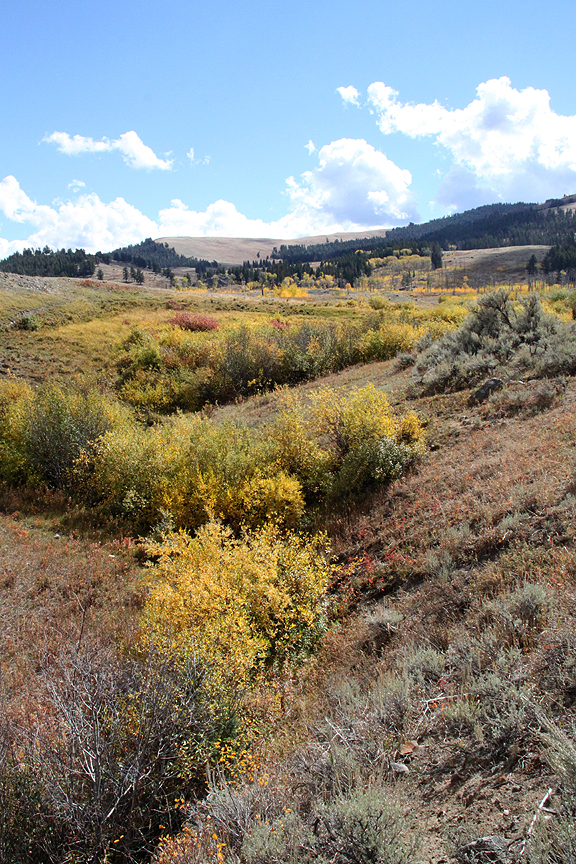
We had timed the trip perfectly with the park's peak color. In this part of the country there's little more than yellow to set the park ablaze, but by golly, it's enough.


Fall color near the Lamar River


Willows ablaze


Even though the day use area and campground were closed, we paid a visit to the Slough Creek area anyway. The Buffalo Creek fire was still burning somewhere over the ridge, and while we could not see or smell smoke on Monday, we did on Tuesday morning when we returned to wolf watch. The Junction Butte pack had denned on the south side of the hills north of the road, and apparently provided quite a show to many folks this year as the pack was clearly visible. Their den area burned, but the pack survived.

(They did not, however, survive Montana hunters. Since being delisted, all the states around Yellowstone have a wolf hunting season. This pack, so close to the border, was hard hit--the day the season opened, three members were shot, JUST outside the border. Hunters learn the pack's habits, then lay in wait, and as soon as the animals cross the invisible line, they're shot dead. This happened the day we left for home at the end of our trip. The pack had lost its Alpha male on September 15th. He was injured, but had taken an elk down in the Lamar River. He had sustained further injury, and was then killed himself by the Prospect Peak pack. Whether the Junction Buttes survive and rebuild, or disperse, remains to be seen. It's not an easy life, being a wolf.)

Bison were plentiful. In 2007 we did not see nearly this many bison, but it could be that this year they were already moving down into the valleys for winter. I could write an entire post--or three--about bison, but I decided to pick a handful of images for this post instead. Such massive animals, they still have a grace about them. And to see them on the plains in Yellowstone, you could imagine what it looked like before we nearly wiped them out.


Bison near Slough Creek


This big bull stood sentinel, the west wind blowing through his thick hair.


Female bison horns tend to curve inward less than the male's, so I am guessing this is a young-ish male, with a European Starling along for the ride. This is typically where you'd see Brown-headed Cowbirds, a species that evolved along with bison and developed nomadic tendencies. This meant they could not incubate their own eggs and raise their own young, so they learned to lay an egg in another bird's nest, and let them do the work.


Bison and starling.

There were mamma's with calves too, though the calves by now were a pretty good size and already growing their horns.


Bison calf


We drove all the way out to the Pebble Creek campground to check it out, then drove back through the Lamar Valley. We stopped at Tower Falls and at the Narrows. I wasn't all that impressed with the view of the falls, but loved the view of the Yellowstone River as it approaches the falls.


Classic West--fast, rocky rivers, spruce-covered hills, and bare buttes.

We stopped a few more times on the way back to camp, including this spot along Yancy Creek to see the basalt cliffs.


Basalt cliffs along Yancy Creek

The warm day brought with it some late pop-up storms. The sky threatened but we did not get any rain where we were. The clouds to the north sure made for a dramatic backdrop for the light of the lowering sun.


And better yet? A Yellowstone rainbow.


Back at camp we had several elk cows wander by. There were two big bull elk in Mammoth, one with a large harem. It's not unusual for them to congregate in areas populated by humans. Elk in the park are not hunted, so they feel safe with us, especially because wolves tend to avoid us. The same thing happens on Isle Royale with the moose, where cows and calves like to hang out near Rock Harbor.


Elk cow in Mammoth campground.


We ended the day with this gorgeous view above the campground. Already, I didn't want to leave. And later that evening, I heard my first elk bugle.


Tuesday, January 12, 2010

Wolves in Hayden Valley

By eight am we had made it down into the Hayden Valley. The Grand Loop Road's eastern arm runs along the Yellowstone River as it flows north out of Yellowstone Lake along the eastern edge of the Hayden Valley. This is another "hot spot" for wildlife viewing and we had our fingers crossed. Must have had our toes crossed too because we could not have hoped for what we were about to see.

Once again, rounding a bend in the road we came upon a large clot of vehicles pulled to the side and filling a turnout. Out we hopped with camera and binoculars and approached a small group of folks talking excitedly. What was all the commotion about? A wolf pack, just on the other side of a copse of trees jutting out from the road toward the river.

There was no sign of them from our vantage point, but then a fellow's two-way radio crackled. Someone had gone up ahead along the road, and had found a clear sight line to the pack on the other side of the trees. It was like a scramble at an air force base, everyone grabbing gear, folding up their spotting scopes and running for their cars and vans.

I don't recall how far we drove, 1/2 mile to a mile I'd guess, before we came to another turn out. We all piled out (now I'm seeing the Keystone Cops) and rushed to the edge of the pavement. There, there they were, probably a half mile away, tucked just at the base of the trees, basking in the morning sun.

Don't see them? I couldn't very well either. Look to the left of the dead tree at the center of the frame.


Ah, there they are!


The aptly named Hayden Valley pack was cavorting and romping in the sunrise. The Alpha female was white, and she stood out like a firebrand in the sunshine. Her pups, probably 4 or 5 months by this time, were frolicking in the prairie grass. This wolf pack was fairly known, it turns out, as they tended to hang out very near the road, and could often be seen crossing the road. Lucky they didn't get run over!

Do you see the wolf on the right edge of this image?


I didn't have a tripod, so I knelt by the railing and balanced my camera on top, and took some shots, hoping against hope that something would be visible. I'm happy that I was able to get these, poor as they are (and super blown up at that).


Many of the people there watching with us did this on a regular basis. Some were retirees who spent much of their time exploring the park. Others were private tour guides who knew the park inside and out and would take groups around to the best sights. These folks knew everything about the regulars of any particular area--I remember one fellow talking about the bald eagle pair and where they usually hung out and where their nest was. They were all gracious and friendly and let us watch the wolves through their spotting scopes.

While I knelt on the ground and the group of 40 or so chatted, one woman raised her voice above the rest. Without shouting, she calmly said, "If you listen you can hear them."

The group went silent instantly. And yes, there, rolling across the valley floor, was the sound of howling wolves.

First, one of a moderate tone, then joined by another, lower. Then a third, higher. Then a fourth. They howled and yipped and sang in the sunrise. I was utterly flabbergasted. Never in my dreams could I have imagined this, a morning beside the Yellowstone River listening to the singing of the wolves. I put my head down on my arm and cried like a baby.


We stayed for a while there by the river, but the day was wearing on and we had other things we wanted to do. If the wolves had been closer, more visible, we would have stayed longer. We decided to return in the evening, to see if there were still around. To our delight, that evening around 6:30 when we made it back into the valley, the wolves were still in the area.

Here, the alpha female, wolf number 540f, sniffs along the river's banks. Several of these wolves were collared for tracking purposes, to help biologists study them and learn their behaviors. They are never given names, to help those studying them be less likely to anthropomorphise, I guess. So 540f it is.


Whatever her name, she was beautiful.


Upstream from the white wolf was one of her pups with another adult, nosing around in the flats. The yellowed, hazy skies that hung over Yellowstone that day was from the smoke of Idaho wildfires.


Here they are, cropped.


For months after our return home I was haunted by the howling of the wolves. That moment followed me everywhere. Anyone who has had the good fortune of hearing wolves in the wild knows what I mean. It never leaves you, that feeling. Wolves were never really the enemy of man, not until we domesticated their prey. I would not be surprised if for millenia we didn't work together, one following the other to sustenance. How else did we end up with dogs? We have a certain kinship to these creatures, and I for one am forever grateful to those who made possible the reintroduction of wolves into Yellowstone.

By February of the following year I couldn't take it any more and decided to do a piece in honor of my experience. The alpha female, wolf 540f, was burned onto my brain. I didn't have images good enough to work from, so I stated a search online for photos. I came across some awesome shots of the pack taken near the end of October 2007, three months after we'd seen them. I do not recall the photographer's name, but I downloaded a few. Here's one of them calling in the pack. The fellow who shot these watched them take down an elk a day later.


From some other photos I found I created this piece.


With my prints I like to include information sheet about the animal, physiological info, habitat etc and my experiences with that animal. I wanted to write a piece about this magical morning, and started doing some research about the pack.

I was shocked by what I found. Here is the end of the story:

As we know, Nature is not sentimental. Nature cares little for beauty or mystical moments, as these are human inventions. A few weeks after finishing this drawing, I decided to do some research on the Hayden Valley pack. After some searching, the news I found was initially stunning—the Alpha male and female, wolves 540f and 541, had been killed in late October of 2007, probably by a neighboring pack, just three months after I had seen them and been so moved by them. It was a jolt to my psyche, yet at the same time a confirmation of how Nature works. Yes, life can be brutal, and often is. Life needs death to sustain it, whether to feed it or to make room for the next generation, the next ruling pack. There is no room in Nature for the sentimentality of a broken heart.


The Alpha female of Hayden Valley and her pack were, for many thousands of Yellowstone visitors, the first and perhaps only wolf pack they will see in the wild. I am only one of many who was moved by this powerful animal. The knowledge of her fate only makes my oh-so-human tribute to her that much more personal and intense.


Yes, by the end of October, wolf 540f was no more. No one is sure how many of her pack survived, although several months later an adult was spotted with one of the pups near Old Faithful. Life goes on. Perhaps they started a new pack, or were taken in by another. Life goes on.

I will never ever forget that moment, that experience that still brings tears to my eyes.

What majesty.


What grace.

Tuesday, December 29, 2009

A River Runs Through It

After the elk wandered off we continued our drive up toward Lamar Valley. At Norris Junction Norris-Canyon Road bisects the Grand Loop, crossing the Solfatara Plateau and meeting up with the loop road again at Canyon Village. Just south of this junction is the place where the Yellowstone River, the longest un-damed river in the lower 48 states, plunges off the plateau and into the Grand Canyon of Yellowstone.


The canyon, according to one guide, is 1,200 feet deep at its deepest point and 4,000 feet across at its widest, and runs for 24 miles through the park. The canyon walls are awash with color, inspiring John Muir to write, "All the hearabouts seems to be paint." The image above looks to the northeast--notice the spires in the fore to mid-ground. Some call these hoodoos, but hoodoos are generally found in desert lands and have a varied thickness from top to bottom, giving them a totem pole look (think Bryce Canyon). These spires are more uniform, thicker at the bottom and tapering at the top.


The North Rim Road offers spectacular views of the canyon and falls. In the photo below, looking upriver, you can just see the Lower Falls in the distance, the white vertical stripe below the horizon line.


As is the norm, you can see cool stuff from your car but if you want the best views you've gotta get out and walk. So we did. I don't recall how long the path was, but it wound down and down into the valley. Notice the boardwalk at the bottom left corner of the next shot.


Down and down we walked along the switch-back path until we came to another viewing platform. What a sight. The Lower Falls towers 308 feet above the canyon floor, and the spray from the falls supports a micro-habitat along the rock walls at the base of the falls. There were only six or seven people here, so we lingered awhile, soaking in the sights and sounds and catching our breath for the hike back UP the path.


After viewing the falls we continued north toward Tower-Roosevelt. Just south of the junction with Northeast Entrance Road, the river and road meet again near Tower Creek. Here, along the far bank, are more cliffs like the basalt formations along the Gardiner River.


More cliffs, spires, and the Yellowstone, passing through The Narrows.


Along this stretch of road I felt like I was in the middle of a western movie, with sweeping panoramas, the river rapids, buttes and clear blue sky. In fact, much of Robert Redford's film A River Runs Through It was shot along the Montana portion of this river.


We would soon be leaving off the Yellowstone to make our way into the Lamar Valley and a hike along the Slough (pronounced slew) Creek. This area is home to the famed Druid and Slough Creek wolf packs, and we were hoping against hope to see one of those magnificent animals. As for the Yellowstone River, it continues north into Montana, takes a turn to the northeast and continues on until it empties into the mighty Missouri River.


Next: The Slough Creek and some exciting finds.