Showing posts with label Swainsons Thrush. Show all posts

Wednesday, October 30, 2013

Whitefish Point

 Once Lisa and I had recovered from our five mile hike from the Lower to the Upper Falls at Tahquamenon State Park, we decided to make the best of what looked like might be the only dry time left to us that weekend. We decided to drive up to Whitefish Point, a place that can be decidedly nasty when the weather takes a turn for the worse.

There are any number of reasons to visit the area. Number one for us of course is it's a great place to go birding. Michigan Audubon runs the Whitefish Point Bird Observatory there, where they do owl banding, among other things. There is also the Shipwreck Museum, gift shop, and several other buildings as well as, of course, the Whitefish Point Light Station. (Get more info about the place at Michigan.org).

Lori and Lisa with Mr. Pickles at the Whitefish Point Light Station.

The geography of the place lends itself nicely to birdwatching--any bit of land sticking out into a big body of water is going to attract birds looking for rest and shelter. Whitefish Bay also attracts lots of boats and ships (I will not enter the debate about what's a boat and what's a ship), and happens to be the place where literally hundreds of them have met their demise. The bay offers shelter, but the point can also create confounding waves for captains to try to navigate. The most famous sinking here was on November 10, 1975, when the ore boat Edmund Fitzgerald sank only 15 miles or so from Whitefish Bay, taking with it a crew of 29. Storms in this part of the world can blow up quickly, and the huge expanse of Lake Superior can allow for waves over 25 feet.


Reference for those unfamiliar with Lake Superior.

We decided to forgo the museum in favor of the wildlife refuge adjacent to the observatory, which apparently is part of the Seney NWR unit. I guess the place was "officially" closed as we were there during the government shutdown, but there were no gates, and the two older fellas who were sitting watching the bird feeders made to attempt to stop us.


Sign at Whitefish Point

The habitat here is very brushy--high winds and brutal winters keep most vegetation low to the ground. It's very shrubby, which is great for birding--they can't escape to the tops of tall trees here!


Woods, Whitefish Point-style.

The woods were abuzz with birds, but we didn't have a lot of time to linger and identify. We did see Swainson's and Hermit thrushes, Ruby-crowned kinglets, Cedar waxwings and Yellow-rumped warblers in this part of the refuge.


Swainson's thrush--note the paler color and buffy markings on head.
 
The trail ultimately lead towards the beach. This area was populated by scrubby pines, probably all that could live in this sandy environment. The space between the woods and the dunes was scattered with palm-sized stones, which are found pretty much everywhere along the south and east shores of Lake Superior. My guess is this area used to be the shoreline, where stones get piled up by the waves, then it was cut off either by the dunes piling up or the lake level dropping--or both.


Dunes between woods and shoreline.

Down on the beach I spied bird prints in the sand, probably made by a crow.


The big lake was lively that evening, but not frighteningly so. The sun had come out and while the wind was pretty cold, the day was pleasant.


Lake Superior's famous rocky beaches.

At the bird observatory building we had seen a list of recently sighted species, which included two not normally seen in the area--a Parasitic jaeger and a petral (we couldn't remember which one). So of course we were certain that every bird flying by was one of these exotic creatures. It turns out that we didn't see either bird, though I did see my first adult Black tern (I am pretty sure I saw a juvenile in North Dakota).


Black tern fly by--NOT a petral!

I do not know my gulls and terns, and thought this one might be a jaeger, but it turned out to be an immature Herring gull. Poo.

Young Herring gull.

I did get to see one of my favorite birds, the Sanderling, working the beach over for supper. This one caught what looks to be some kind of shield bug.


Sanderling.

 Just to the west of the light station are rows of what I can only imagine are breakwaters. No one in their right mind would have tried to build a pier or other structure here. I liked the color of the wood against the deep blue of the cold water. The land mass in the distance is Canada, on the Eastern shore of Lake Superior. To the left, around a bend, is Lake Superior Provincial Park.


Oh Canada!

 As the sun began to dip below the dunes we headed back to the parking lot. That's when I noticed, there on the beach within view of the light station, a memorial to the crew of the Edmund Fitzgerald. And as we prepare for a late autumn storm here in the Great Lakes (winds gusts up to 50 mph!!) we will keep our fingers crossed that we don't see another tragedy like this in our lifetimes.


Here is a video with footage of the Edmund Fitzgerald set to Gordon Lightfoot's 1976 tribute to the sunken vessel (which, BTW, was the first single I ever bought. Come on--I was 10!).  http://www.youtube.com/watch?v=hgI8bta-7aw


Monday, October 8, 2012

Sleeping Bear Redux

I think it is safe to say that pretty much everyone has a place in their hearts that they are drawn to, inexplicably, like a moth to a flame. There exists some magic, some mystery yet familiarity that keeps us intrigued and smitten, like a school girl with a crush. These places haunt us, calling out to us like spirits from beyond the grave.

I am finding that Sleeping Bear Dunes National Lakeshore is, for me, one of those places. I don't know exactly what it is about this area that is so appealing. I think all of the Lake Michigan shoreline--most of the Great Lake's shorelines, for that matter--are very visually appealing, and you just can't beat big water for drowning your demons. There are lots and lots of parks all along the coasts, and each has their draw, but it is this park, this place, that I keep coming back to.

So, for my annual "Up North Autumn Escape" I decided to spend three or four days at the Dunes.  I drove our old conversion van rather than the RV because I wanted to be pretty mobile. It has a fold-down seat in the back that converts to a full-size bed, and I packed a small folding table and chair to set up behind the front seats (the middle row captain's chairs had been removed) so I had a place to sit and read after dark. A cooler full of food, camera gear and warm clothes and I was ready to go!

I drove up on a Tuesday, through some beautiful fall colors along Highway 115, which cuts diagonally from the center of the state northwest to Frankfort, just south of the park. I arrived around 2 pm, got my campsite at the Platte River Campground (modern--I wanted electricity so I could plug in a space heater) and hiked down to the beach.

The walk from the campground to the beach is about a mile. The trail passes by the "hike in" campsites, not really backcountry but not sites you can pull your car up to. There is a modern bathroom with showers in the parking area, and the trailhead to Platte Bay. For over 1/2 mile the trail passes through a coniferous/hardwood forest, where I saw several warblers and this thrush.


Swainson's thrush? Not completely sure, but looks paler than the hermit thrush.

It was a windy day, and therewas  a lot of noise from the wind in the leaves. But at some point before I exited the woods I realized I could hear a very steady roar coming from in front of me--the sound of waves pounding the shore! Soon after, the woods opened up and I found myself in an open dune area studded with pines.


I trudged along through the sand, up one rise and down. At the top of the last rise I stopped and gasped.
There before me lay the Platte Bay, with Empire Bluffs and the Sleeping Bear laid out under the crisp blue sky.


I have been here before, although not this exact spot--once farther north along the bay and once south at the Platte River Point. It's not like I didn't know what to expect as I topped that last rise. But something about this scene literally took my breath away.


The Sleeping Bear with North Manitou Island to the left.

Empire Bluffs. A building in the tiny town of Empire is just visible on the shore left of the bluffs.

The wind was fierce coming off the big lake, and I only saw three other people on the beach that day, at quite a distance. I pretty much had the place to myself.


Platte Bay
 
 I found a log and sat down, my back to the wind. I had remembered to pack ear muffs and gloves, thank goodness, or I wouldn't have lasted long. I read a little and wrote some, then turned around to watch the gulls cruising the shoreline.
 

Herring gull

As I watched the gulls, a lone sanderling caught my eye. I was following him with my camera when I noticed a little brown bird scurrying along the beach, then another, and another. Hello, what have we here?!?  I was pretty sure this was a new bird for me. I was so excited!!


I did a quick change and put my long lens on, then squatted on the beach and waited for the birds to get closer....

Next: Well, you'll see!

Monday, June 13, 2011

Grasslands and More

Saturday dawned wet and windy. I drove down to the hotel to meet the car pool group for the grasslands birding tour. I had run into a couple of friends at the dinner the previous night, Kathleen and Hartley. Kathleen is a biologist and works for Oakland County Parks and knows a great deal about birds. Since I have a conversion van that seats something like 57 people I invited them to ride along with me. That morning I ran into two ladies in the hotel lobby I had met on day one (Karen and Mary? again it has been too long and I have forgotten their names!) who joined us on the trip.

We met up with our guide, a first-timer named Matt, and we caravaned out to the old air force base in Oscoda. He proved to be quite adept at finding and identifying birds, especially by the their song. During the 20 minute trip Kathleen read to us about all the birds we could potentially see at the airport grassland--larks and sparrows of various kinds, Bobolinks and the elusive Upland Sandpiper. We were all a-twitter by the time we got to the airbase, excited by the prospects of what we might see.

We parked on an old concrete slab near the tarmac and poured out of our cars. It was 45 degrees, drizzling, with a wind from the north east at 25 mph. I could think of worse conditions to be birding in, but would be hard pressed to do so. Even so our enthusiasm wasn't dampened. Matt began briefing us on the birds that might be seen and then stopped and said, "I hear a Savannah Sparrow over there somewhere" and pointed to his left. All I could hear was the wind-driven rain against my slicker so I took his word for it.

As usual the group shuffled off one way and I went another. I guess I am just not one to follow the crowd. I saw two brown dots off at some distance moving through the green grass, which at this time was only about four inches tall. My camera was in the van so I got my glasses on the birds--through my binoculars they just looked like bigger brown lumps. So I said, again to no one in particular, "There are a couple of birds out there." The group came running. "Where? Where?!?" "There, just forward from that utility pole." The glasses and scopes went up, and after some careful consideration Matt announced "Upland Sandpipers!!" The group was elated. I looked again. Yep, brown lumps, but I was willing to take Matt's word for it, and made a mental note to check them off my list.

We moved a ways down a dirt path then stopped again. This time I got my camera out, and crouched in the lee of the van. Someone pointed out a pair of Bobolinks in the grass--this was the best I could do. There was also a Meadowlark on the fence but it was even farther away so I didn't bother with a photo.


As we watched the Bobolinks some else pointed out Horned Larks at the edge of the road. This was another new bird for me, and one that I had really hoped to see. I think its horns were plastered to its head by the rain, but here it is. Never did turn and face the camera.


I did eventually see the Savannah Sparrow, perched on a twig along the other fence row. Another new bird! Very similar to the White-throated but paler and with a longer yellow eyebrow. I noticed many of the grassland birds had yellow on them. Hmmm.....


We eventually bailed on the open fields in favor of a more sheltered area. Near the air base was a marsh that had only recently been opened to the public. This was the first place on this trip where I felt like I was up north--boggy with birch trees, black spruce and bearberry, I took a moment here to soak it in.


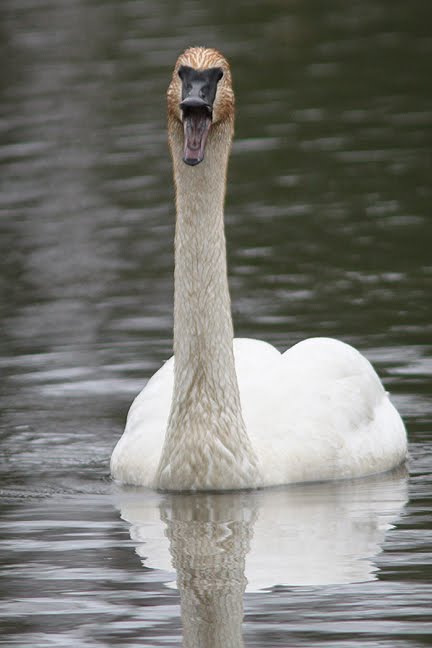
A pair of Trumpeter Swans glided across the water. They moved with such ease and speed it seemed as if they were being pulled across the water by strings.


I guess we were boring them....


After the grasslands tour Kathleen, Hartley and I stopped at a Mexican restaurant for lunch, then decided to skip the presentations that day and head back to the campground and hike the point. We parked near the lighthouse and picked up the trail head. A volunteer maintains an oriole feeding station near the trail head and the place was filthy with them. The two ladies who had ridden with us that morning had pulled into the lot five minutes before us and said they had been watching an Orchard Oriole from their car but it had just flown away. Darn it! I did get some nice poses from the Baltimore Orioles, though.


Not too long into the hike we saw the Ring-necked Pheasant cock that I had heard on previous jaunts. He hurried along the other arm of the trail.


The weather was still pretty nasty, and we talked about turning around and heading back, but I was determined to walk the loop. I'm glad I did. Just around the corner was a Swainson's Thrush, another first. Cute little bird with long legs and a buffy face, he did not seem too bothered by us.


Around another bend and this Blue-gray Gnatcatcher posed prettily among some branches.


But the most exciting moment for me came out on the point. The trail was turning to head back but a short off-shoot went out towards the water. I followed its call. There among the grasses was a female American Redstart, hunting bugs in the rain.


I followed her, trying to keep her in focus as she hopped and fluttered. Finally she landed on this branch and flashed her tail feathers at me.


The end!