Showing posts with label Lesser Scaup. Show all posts

Thursday, February 25, 2021

By Land Or By Sea (MBY Vol 8)

For the sake of getting caught up a bit I'm going to make a quick run-through of February 3rd to the 19th. Those dates saw relatively little birding beyond watching my feeders thanks in large part to the terrible cold, wind and heavy snow that plagued us as well as 2/3 of the country. I've been doing these posts as journal entries (and yes, I'm keeping a written journal cuz that's how I roll) and will get back to that format starting on February 20th, farther down the page.


Lisa and I drove down to Ottawa County on February 3rd to a hotspot where several grassland birds that I needed for this year had been reported. It was forecast to become frigid for at least the next 10 days starting the 4th, so we decided to make a day of it and get in as much birding as we could. We stopped at Muskegon Wastewater on the way down and while we didn't see anything new we did get great looks at a male Northern Harrier. He was flying towards us as we drove down the lagoon road, and I slammed on the brakes when I realized what it was. Trying to get out of the car in a hurry to get some photos I jammed the car into park, got tangled up in my seatbelt, and just about took my head off on the visor that was across the driver's side window, blocking the sun. I scurried around the back of the car, camera ready, but the bird had vanished. I looked around, perplexed, then saw him rise up out of the ditch like a pale Phoenix. He must have whiffed on lunch as his talons were empty. He continued past us and I did manage a few decent photos, way better than anything I had before. I'll keep trying!


Male Northern Harrier, the "Gray Ghost"

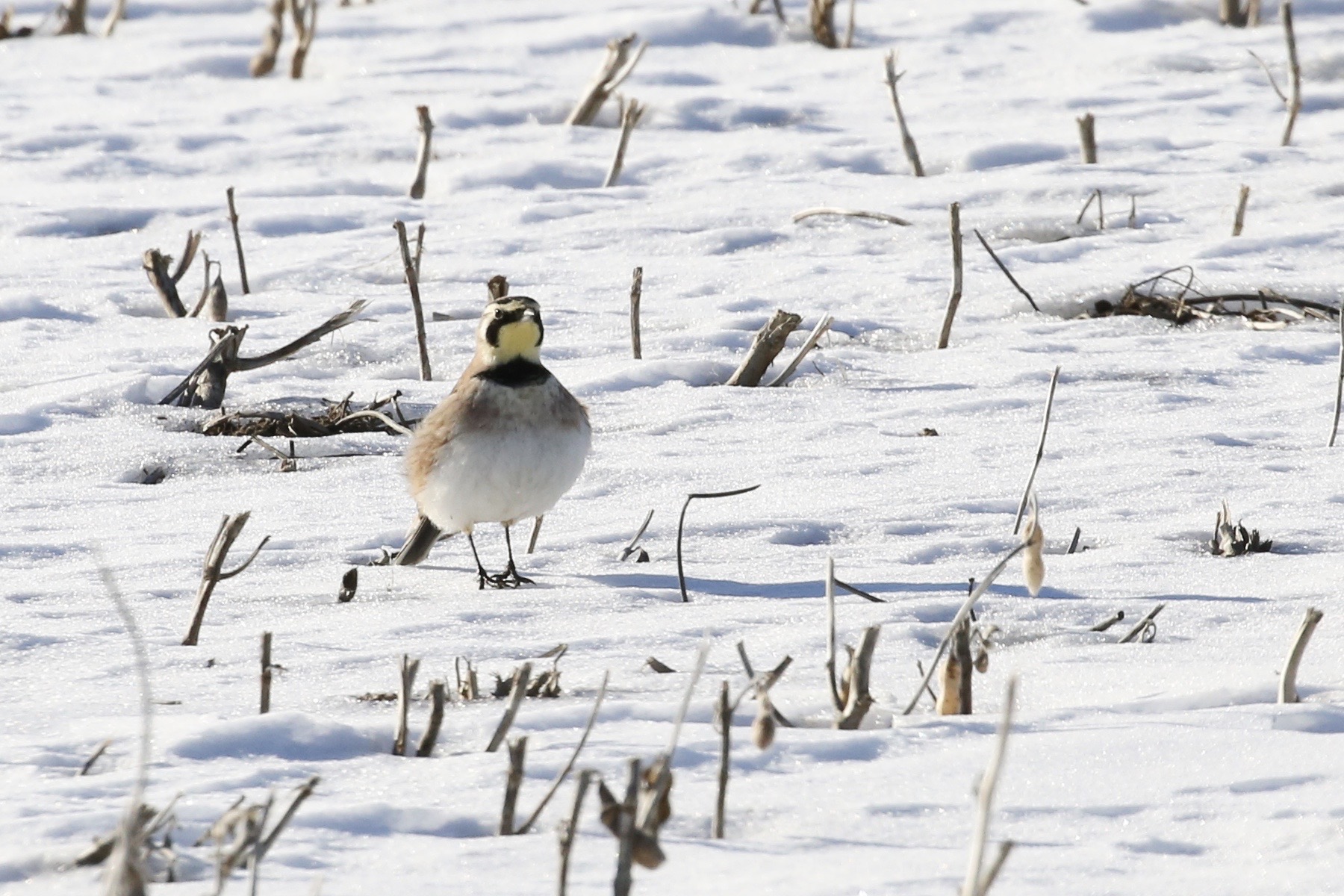
We drove from there to the hotspot at 128th Ave and Bingham Street in Ottawa County. It did not look remarkable in the least--mostly empty fields and a farm with maybe 50 head of cattle. As we neared the intersection Lisa asked what exactly we were looking for. I told her grassland birds so to watch the fields. She immediately pointed out her window and said, "Like those?" I slammed on the brakes again--there's a lot of that when birding--and backed the car up. Right there by the side of the road was a pair of Horned Larks (MBY bird #76). I was able to get some shots off before they began chasing each other around. We looked for Snow Bunting and Lapland Longspur but came up empty. We did find a flock of over 40 larks but they were out in a field and I could not pick out any other species.  


Horned Lark floofed by the wind


On February 10th we took a few hours in the  morning to drive some of the backroads near home to see what might be in our own back yard. We'd gotten 8+ inches of snow on the 5th, so now there was easily a foot and a half on the ground. While we saw three pairs of Red-tailed Hawks (getting ready for mating season?) we didn't find anything to add to the list until we were getting ready to head home, when we found a house with feeders and I picked up MBY birds #77 (House Finch) and #78 (Pine Siskin).

On the 11th we dipped on a Barrow's Goldeneye in Manistee. This bird was at a marina that had bubblers, keeping the water open around the docks. As the temperatures have plunged, with some nights falling below zero, the waterfowl that have stayed are forced to seek refuge in places they might not normally be. When we arrived there were plenty of Common Goldeneye and several other species of ducks but we didn't see the Barrow's. All hope was lost when a couple drove in, parked, and proceeded to drag their ice fishing gear right past the marina, flushing all the birds to who knows where. The bird has been seen since but I've not yet made it back to look for it. 

By the 15th we were 11 days into the frigid weather, and Texas was getting slammed with crazy cold, ice, and snow. I was starting to go bonkers from being cooped up in the house. We had more snow forecast for the coming night, and the weather wasn't too bad (relatively speaking) so we went back to 128th Ave to look for the birds we'd missed. The snow that had fallen since we'd last been there had forced the birds out of the fields and into the roads to scrounge whatever they could find--wind-blown seeds and bits of hay, as far as I could tell. We found plenty of larks before finally finding a flock with a couple Lapland Longspurs, MBY bird #79.


Lapland Longspur


Named for it's exceptionally long hind toenail, or spur, this is an Arctic tundra breeder, here only in the winter. The male is gorgeous in breeding plumage with a black face and neck and rufous nape (back of neck). I saw a couple in breeding plumage in Alaska in 2014, and had first seen at Sleeping Bear Dunes in 2012. Before heading home we also found one Snow Bunting for MBY bird #80.


Probably the best photo showing that extra long spur. Click image for a better look,
or follow the link above to see pics from Sleeping Bear. 


OK, back to the journal entry:

February 20th

A message came through late yesterday that a King Eider had been seen in Saint Joseph at Tiscornia Park, about a 2 1/2 drive from here. I moaned. We are preparing for a trip to the U.P. and we're leaving tomorrow, but a King Eider would be a life bird and a great addition to my Michigan Big Year, so I sent a message to our What's App group asking if the bird was still present this morning.

It was.

I considered timing and what we still needed to do to get ready to go north (pretty much everything) and decided to go. As I was running out the door Lisa stumbled out of bed and came along for the adventure.

We arrived before noon, gathered up our gear and donned our ice cleats. A message came through a half hour before we arrived detailing the rough conditions out on the pier. I had wondered about that since the piers and lighthouses are usually blanketed with ice this time of year. We had been lucky, up until February 4th, that the winter had been mild enough to keep the piers fairly open and walkable. The eider was feeding directly off the end of the north pier, so there was little choice but to give it a go.

Most of the channel was frozen, with just a patch here and there of open water, but a lead of open water could be seen off the end of the pier that extended north for several hundred yards. About halfway down the pier there's a gate, and I recall from earlier this year there are signs on it warning of the conditions and lack of life saving flotation devices. Now, however, the gate was encased in ice 1-2 feet thick and hip high. Beyond it the pier was a wasteland of jumbled shards of ice, frozen into crags of snow-covered misery. But there were people out there so I knew it was doable.

At a low and slightly narrow spot in the ice wall I was able to get my left leg partway over, like mounting a horse. But it was too high for me--I was on my tip-toe of my right foot with no way to get my body up onto the ice horse. I pulled my foot back over and contemplated my options, discussing it with Lisa and another person who had joined us.

Looking around I realized that quite a crowd had gathered and everyone was looking at me, like they were waiting for me to lead them to the promised land. The pressure was on. A young woman came sliding up in winter boots that had hard soles, and we urged her to go get ice cleats. She had come for the eider too, and if she were slipping here, there's no way she'd make it down the second half of the pier. After actually falling to her knees she retreated back to the parking lot.

With the help of a kind stranger and a boost from Lisa I was able to get my leg over and my body upright, then slid over sideways to the other side. In doing so I bashed the inside of my right knee and scraped the inside of my left thigh on an ice ridge on the other side of the gate. My God the bruises (and how I wish I'd taken some pictures of this)!

We got Lisa up and over and we picked our way along the lumpy, bumpy, hilly landscape until we came to the end of the pier. Lisa took shelter from the wind in the lee of the lighthouse while I pulled gear out of my bag. I turned around and there it was--an immature King Eider, diving and surfacing not 15 feet from the end of the pier.


King Eider (immature male) Life bird #511, MBY bird #82


He stood out from the rest of the waterfowl with that large white breast. There were Long-tailed Ducks, goldeneye, scaups, Redhead, mergansers, and all three scoters there as well, and all were diving down to the base of the pier, presumably picking at crustaceans and other juicy bits on the submerged rocks.


Eider with Long-tailed Duck


Thick, jumbled ice extended far out into the lake, and with most of the channel frozen the birds were within easy viewing off the end of the pier, the reward for those nasty bruises. It was a beautiful day, one of the first "warm" days we'd had in weeks (low 30's) and the sun was popping in and out, but the stiff breeze off the water was finger-numbingly cold. Others had joined us, and two women who had made the trek "for the heck of it" asked what we were looking at. I lent them my binoculars and pointed out the different species.


Surf Scoter (adult male, center), with female SUSC (bottom)
and adult male Common Goldeneye (top) 


I was thrilled to see an adult male Surf Scoter, a bird I'd seen fleetingly in Alaska. Such a clownish bird with that multicolored bill! All adult male scoters have colorful, oddly-shaped bills but none of the other scoters there were adult males.


From top left: Lesser Scaup, immature Surf Scoter, adult male Surf Scoter


I started chatting with another birder who was there with his scope. Something was familiar so I asked his name. He said Ross, and I thought nah, can't be, but I asked him if he'd been in Frankfort to see the Yellow-throated Warbler. He had indeed! We chatted and counted ducks until Lisa's toes started to go numb.


White-winged Scoter, probably immature male, (bottom) with immature scaup.


Black Scoter, immature. I had seen one of these at quite a distance in January so was happy to 
get a photo this time around


Male and female Common Goldeneye


The thing that really stole the show, though, were the ice sculptures the wind and waves had made of the lighthouse and catwalk. Spray from pounding waves had coated everything in thick swirls of wind-shaped iced. I walked around and took a few photos of this oddly beautiful sight before we headed back.


Saint Joseph lighthouse


A good look at the condition of the pier we'd just traversed--and
now had to walk back down!


Open lead full of waterfowl.

On the way back down the pier we crossed paths with the young woman in the slippery boots who had gone downtown and gotten herself some ice cleats. She was practically turning cartwheels as she bounded down the ice, and she thanked us for the advice. We exited the pier much as we entered, mindful of our bruises, then walked down along the channel to the open water at the near end to find the Harlequin Duck (too far for photos) for MBY bird #83. On the way home we had a gorgeous male Cooper's Hawk fly across the road right in front of the car for MBY bird #84.

Next up: A U.P. birding adventure!


Ottawa County, February 3

#76) Horned Lark

17 Mile Road, Newaygo County, February 10

#77) House Finch

#78) Pine Siskin

Ottawa County, February 15

#79) Lapland Longspur

#80) Snow Bunting

Boardman Lake, Traverse City, February 17

#81) Iceland Gull (Life bird #510)

Tiscornia Park, Saint Joseph, February 20

#82) King Eider (life bird #511)

#83) Harlequin Duck

#84) Cooper's Hawk


Tuesday, February 2, 2021

Michigan Big Year Vol. 3: Dipping on Rarities

Birding is a fickle thing, and is all about timing. You might get word within minutes of a rarity showing up at someone's feeder, only to get there and miss it by 30 seconds. You might drive hundreds of miles to see a bird that's been at a location for weeks, only to be unable to locate it. Then, you'll be walking to your home office and hear one calling in the trees above your feeder. It's a bit like poker--while there is certainly skill and planning involved, a lot depends on dumb luck.

January 13

I spent yesterday planning a route that would take me to six different locations in southwest Michigan. Each location had been reporting rarities, and I hoped to pick up a couple of them. This would be my first day devoted specifically to birding, without other errands attached to it, and would involved hundreds of miles and hours of driving. My route and available time allowed for a half hour in each location, starting at Gull Lake in Kalamazoo.

The lake was remarkably unfrozen, as so many are this winter, and seemed to be opening up more in the 42° "heat." Right off I picked up Hooded Merganser and Trumpeter Swan, but these are species I'll likely see here at home this spring. I searched the lake for scoters, cackling geese, and especially the Barrow's Goldeneye and Greater White-fronted Goose that had been seen there. Nothing. There were plenty of ducks I could see, but many more out too far to identify. After over a half hour staring intently at every duck, I decided to head out but then spotted a pair of Canvasback ducks, a good find as it's not a species we would see at home, but not the rarity I'd hoped for. On the way back to my car I heard Sandhill Cranes in the field across the road.

From there I went to the Wolf Lake Fish Hatchery, about a half hour away, but didn't find any rarities there either. I did see a Song Sparrow but they are nesters on our lake and certainly not what I was hoping for. I did manage to get a few digiscoped shots of Trumpeter Swan, but that was it.


A short drive south brought me to Maple Lake in PawPaw, which was filled with Canada Geese. There had to be a couple thousand of them. I walked out to the island and scanned those geese twice, looking for cackling or g. white-fronted. Nope. Nada. There were lots of Common Goldeneye and I got to watch some of the males practicing their courtship dances, but I saw nothing new and nothing certainly nothing rare.


Common Goldeneye


At this point it was 2:00 pm and I had to decid if I was going to continue with my plan and head to the coast, or change it up and go back to Gull Lake. My gut was telling me to return to Gull Lake because of the number of birds there that I couldn't identify the first time around. My head said stick to the plan, and that's what I did. It was a lovely day on Lake Michigan, and I did find a Lesser Scaup in St. Joseph, but that was it. However, back at Gull Lake, at least one of my target birds was seen by another birder that afternoon. Ah, hindsight--and listening to your gut.

January 14th

I decided to stay home, even though it's another mild day. I should have planned an outing, but after dipping on four species yesterday, my heart isn't in it. I took Bailey for a walk around the lake and managed to find a Brown Creeper for bird #60 on the year.

January 15

I was not planning on birding today as it was windy and wet, but after lunch I decided to chase a Ross's Goose that had been reported at the Hart Wastewater Facility, about 45 minutes away. Basically a smaller version of a Snow Goose, the Ross's a rarity in Michigan, and had been seen there multiple times.

The dirt road the facility is on was a quagmire, thanks to the rain and the warmer temperatures that had allowed the road to begin to thaw. I was afraid I was going to slide right into a ditch. As I neared the facility I saw an American Kestrel on a wire, and managed a few shots before he flew off.


At the gate I saw a sign directing  birders to a specific parking area, stating that all birding had to be done on foot. It also said they wanted us out by 2:00 pm--and it was already 1:40. I parked, grabbed my binoculars, and started to walk towards one of the nearby pools that I could see had some open water. As I neared I could see waterfowl, but because of the high berm I couldn't see who was there. 

I got close enough to see over the edge and stopped, probably 40 feet away, but I had also been seen by the hoards of Mallards that were perched on the edge of the ice. A few heartbeats passed as we had a stare down, then on some undetectable (by me) cue they took to the air in unison. NO!!! I frantically scanned the ducks as they flew every which way, and did manage to identify a handful of American Black Ducks as they flew overhead, but that was it. That is not a bird we get on our lake so it was a good find, but not rare.

I continued to the far side and looked out over the stubbled cornfield that lie between the facility and an orchard and saw that it was stuffed with Canada Geese. It's hard to believe these birds were nearly hunted to extinction because they are freaking everywhere. At least a thousand were scattered across acres of stubble. I felt utterly defeated. 

I hurried back to the car and exited the facility, but realized I had a good view of the fields from outside the gate, so I pulled over and set up my scope, and spent the next 30 minutes scanning the fields, looking for a little white blob amid the browner, larger blobs and the corn stubble. Tucked up under my car's open rear hatch I was mostly out of the light rain that had begun to fall. I scanned that field over and over, but did not find a Ross's Goose. 

So that's five rarities I've chased in three days and dipped on. I know it's never a given when chasing birds but this was a very disappointing streak, and makes me start to question my decision to do a Big Year. Sure, I picked up other species, but missing so many after spending so much time might make me more reluctant to chase the next rarity. I will need a few days to rebuild my enthusiasm.


Gull Lake, Jan. 13

54) Hooded Merganser
55) Trumpeter Swan
56) Canvasback
57) Sandhill Crane

Wolf Lake Fish Hatchery, Jan 13

58) Song Sparrow

Saint Joseph Pier, Jan 13

59) Lesser Scaup

Home Jan. 14

60) Brown Creeper

Hart Sewage Treatment Facility, Jan. 15

61) American Black Duck 

Wednesday, May 27, 2015

From Seward to Wasilla, Alaska Day Seven

 Alaska 2014 continued:


The drive from Seward to Wasilla was punctuated by several stops for birding. Traveling up along Turnagain Arm, a branch of Cook Inlet, we stopped at a roadside park where a creek flowed under the road, and found a pair of fledgling American Dippers sitting on a log. We never did see an adult. If you're not familiar with the dipper, it is the only aquatic songbird in the U.S.  That's right--the dipper feeds entirely on what it catches underwater clean, swift-moving streams, which is about the craziest thing I've ever heard. (If you'd like to see the bird in action, follow this link. Notice how the bird nearly always faces upstream.)

Immature American Dipper waiting for lunch.

We made another stop near Anchorage, at what I think was a ski park, and walked the trails there after having lunch. I don't recall exactly what we were looking for, but I got another great look at what was one of my target birds, the Boreal Chickadee. I'm pretty sure nothing so cute has ever lived.


Boreal Chickadee posing.

The big birding spot of the day was Westchester Lagoon in Anchorage. This pretty, public park surrounds a large pond which has a small island. It was in the 60's, sunny, but breezy. Even so, the Alaskans were out in number, dressed in shorts and t-shirts and enjoying the sun. You could tell us apart from them because we were all in jackets and long pants.

The man-made lagoon is a waterfowl sanctuary. Downdown Anchorage and the Chugach Mountains frame the park.

 Right off we got great looks at an Arctic Tern sitting on a post near the boat launch.


Arctic Tern. I love how tiny their feet are in relation to those long wings and tail.

A mother Mallard took to the water with her brood as we approached.


A Mallard hen with chicks because who doesn't love chicks? Like the sign on the Kachemak Bay boat tour said, they're all good birds.

Bill pointed out a small flock of Hudsonian Godwits resting on the shore of the island. The lighting was terrible for photos but I was excited anyway as these were a new bird for me.


Hudsonian Godwits with a Herring Gull.

While there wasn't the abundance of waterfowl that Bill would have like to have seen, what was there was pretty close to shore, probably used to being fed. I got some nice shots of a Lesser Scaup preening.

Lesser Scaup preening.


This pair of Greater Scaup floated by too.

Greater Scaup. They are differentiated from the lesser primarily by head shape as well as size.

A Gadwall also made an appearance near to shore. While none of these were new to me I was quite happy to get some really nice up-close photos.


Gadwall drake.

We finished the day with a drive up to Wasilla, where we stayed at the Best Western on Lucile Lake. After dinner I crashed on the shore, utterly worn out. The short nights and busy days were starting to get to us all. I really wanted to climb in a canoe and paddle to the middle and sleep. We saw Lesser Yellowlegs on the hotel dock and several pair of nesting Red-necked Grebe, and heard Common Loons calling from across the lake. It was a picture-perfect evening.


Next: We travel up to DENALI!!

Wednesday, April 17, 2013

Evening on the Black Pond Wildlife Drive

Florida 2013 continued

We left the Visitor Center and headed back out to the Black Pond Wildlife Drive around 4pm. I could not believe the change in the weather. Cold, 20 mph north winds had calmed to nearly nothing, and the air had warmed and softened. The light was amazing and the park nearly deserted. I think next time around I will either spend two days at the Merritt Island NWR, one at the Visitor Center and one along the drive, or do the center in the morning and the drive in the afternoon, as the light is so much better.

At any rate, we saw all sorts of birds, whose energy seemed a bit lower--the morning scramble for food was over and the birds were a bit more laid back, like these dowitchers.


Dowitchers--short or long billed, I have no idea--relaxing in the evening sun.


There was a large flock of lesser scaups in the pond where we'd seen the reddish egret earlier. I like this image, showing two females and a male.


Lesser scaup


We parked again at the Ducks Unlimited lot, where we had seen the shrike and sora earlier, and strolled down the path towards the far observation tower. There were quite a few birds in the pond along the trail, including a pair of napping blue-winged teal and these pied-billed grebes.


Pied-billed grebes. Such sweet faces!

 I was excited to see the mottled ducks were still there. Earlier they had been hanging out here with the teals but the light was behind them and so the photos were poor. I got lucky and caught this one very close to shore and right in the sun.  It was wary, though, and watched me carefully as it swam away to my left.

Mottled duck. This is a VAST improvement on the images I had of this duck.

I read somewhere recently that mottled ducks were not common so I looked them up on the Cornell site. According to Cornell they are the only duck adapted to breeding in southern marshes, so their range is limited to Florida and the Gulf coast. They are listed as a species of least concern, but they face the usual threats of habitat loss. They also breed with introduced mallards (who apparently are not native to the south?) so they could possibly be faced with being bread out of existence.

American coots are abundant at MINWR, and we saw several flocks that had to contain at least 500 birds each in several locations. This one was alone, though, and very close to the path.


American coot. Love the red knob that matches its eyes.

An anhinga swam by, looking all mysterious and snake-like.


Once at the platform we watched a number of birds, including this preening snowy egret.


Fun pose of a snowy egret.


Later, leaving the observation tower and getting back on the drive, we saw a pair of American wigeons. These are by far the best images I have gotten of these cute little ducks.


Female American wigeon.


Male American wigeon, perhaps my favorite duck.


As we approached the turn out for the bathrooms and the Cruickshank trail head we saw a large flock of Northern pintails.


Northern pintails.

 Most of them were at quite a distance but a small group was napping on a tiny island near shore. Another favorite, such gorgeous, stately birds.


We are not quite done with Florida. There will be at least one more post, perhaps two, where we'll go back in time just a bit and back to the observation tower and trail where we had two close encounters with two more birds.  Then we will be back to real time, as spring has finally sprung here in Southeast Michigan, and we will be looking to do some birding in our own neck of the woods.

Thursday, April 21, 2011

Pelican Island NWR Redux

(I am still waiting patiently for spring to arrive here in Southeast Michigan. Highs 15 to 20 degrees below normal and endlessly cloudy days have stalled the emergence of plants, as well as me from my home. I am tired of being cold and it's wearing on me. Good thing I still have Florida posts to take at least my mind somewhere warm!)

Tuesday was Grandma Day. Suffering from macular degeneration as well as a bit of vertigo, she is unable to get herself around any more. Oh, she is still quite active, bowling two nights a week, hosting a bridge club on Thursdays. She does this with the help of John, her companion of 30 years. She's 88, he's 90, so while they manage to get around for the usual stuff, they don't do any extraneous travel any more.

So we decided to take Andree (John doesn't walk very well) down to Pelican Island, the first National Wildlife Refuge which was established in 1906 by Teddy Roosevelt to protect the Brown pelican. You see, they were being wiped out for their feathers, which ladies wore on their hats. The park has a nice paved walkway with lots of benches and a viewing platform that overlooks Pelican Island and the Indian River Lagoon.

The first bird we saw--OK, maybe Andree didn't see it, but I told her about it--was this palm warbler. I first saw this bird last year at the same park.


There is a small pond near the parking lot, with a pavilion and benches, and it is probably the best place to see birds. Several pair of Lesser Scaup were puttering around.


As we watched the ducks, one of the girls pointed out the hawk circling some distance away. Its white wing banding was startlingly bright. After some debate we decided this is a Red-shouldered Hawk, although none of the bird guides show it with such distinctive banding.


After several rest stops and a potty break were Andree went and peed behind a bush (I love my grandma!) we made it to the observation deck that overlooks Pelican Island. Yep, that's it. Doesn't look like much, but this is the place where we began protecting wildlife in earnest. It was quite literally protected by a gentleman named Paul Kroegel, who chased would-be pelican harvesters off with a shotgun. (You can read more about the history here.)


Once back at the parking lot, we spotted an American Kestrel. I recall last year the most interesting birds--the warblers and a Loggerhead Shrike--were hanging out by the parking lot. Lesson learned!