Showing posts with label Lake Michigan. Show all posts

Thursday, February 25, 2021

By Land Or By Sea (MBY Vol 8)

For the sake of getting caught up a bit I'm going to make a quick run-through of February 3rd to the 19th. Those dates saw relatively little birding beyond watching my feeders thanks in large part to the terrible cold, wind and heavy snow that plagued us as well as 2/3 of the country. I've been doing these posts as journal entries (and yes, I'm keeping a written journal cuz that's how I roll) and will get back to that format starting on February 20th, farther down the page.


Lisa and I drove down to Ottawa County on February 3rd to a hotspot where several grassland birds that I needed for this year had been reported. It was forecast to become frigid for at least the next 10 days starting the 4th, so we decided to make a day of it and get in as much birding as we could. We stopped at Muskegon Wastewater on the way down and while we didn't see anything new we did get great looks at a male Northern Harrier. He was flying towards us as we drove down the lagoon road, and I slammed on the brakes when I realized what it was. Trying to get out of the car in a hurry to get some photos I jammed the car into park, got tangled up in my seatbelt, and just about took my head off on the visor that was across the driver's side window, blocking the sun. I scurried around the back of the car, camera ready, but the bird had vanished. I looked around, perplexed, then saw him rise up out of the ditch like a pale Phoenix. He must have whiffed on lunch as his talons were empty. He continued past us and I did manage a few decent photos, way better than anything I had before. I'll keep trying!


Male Northern Harrier, the "Gray Ghost"

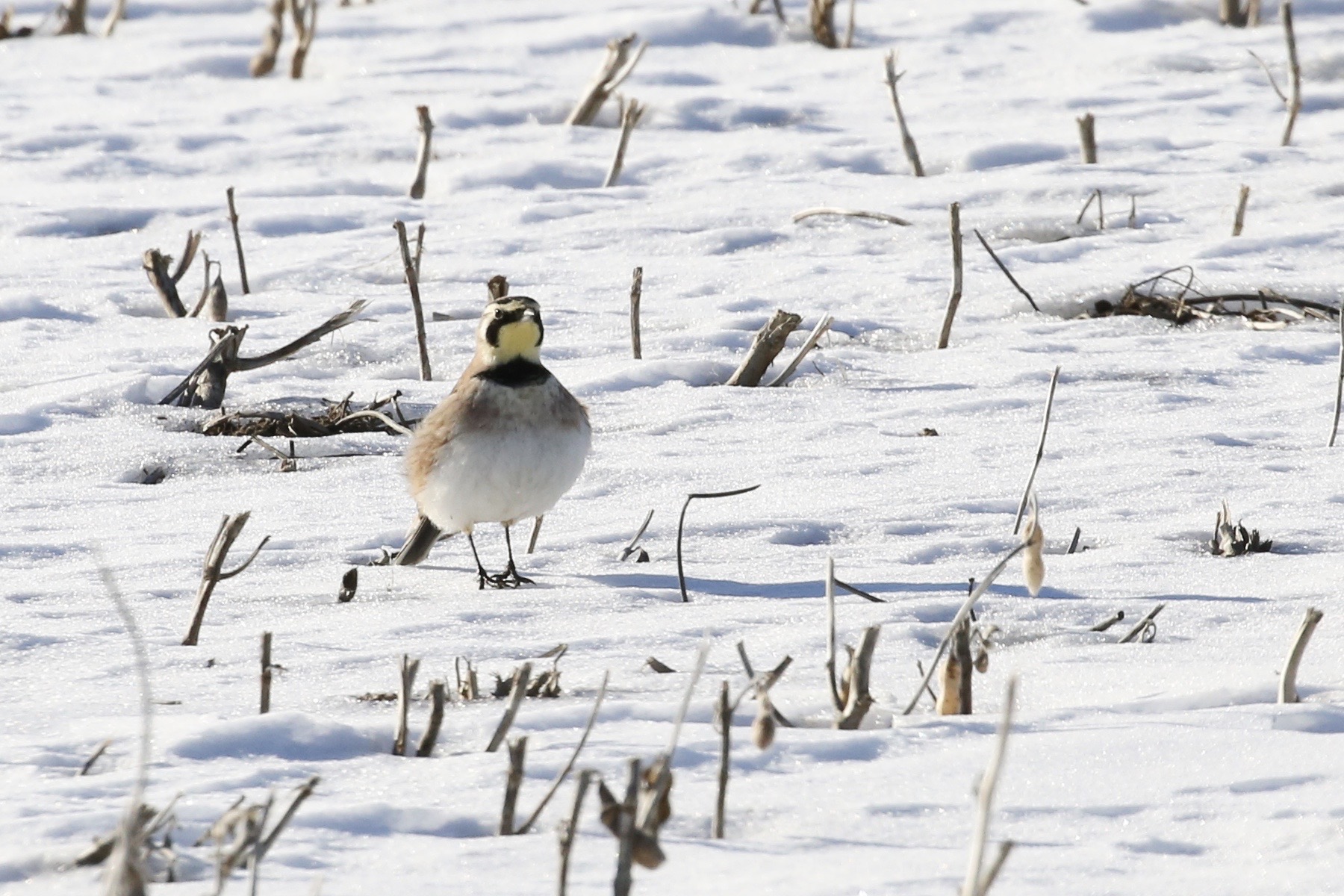
We drove from there to the hotspot at 128th Ave and Bingham Street in Ottawa County. It did not look remarkable in the least--mostly empty fields and a farm with maybe 50 head of cattle. As we neared the intersection Lisa asked what exactly we were looking for. I told her grassland birds so to watch the fields. She immediately pointed out her window and said, "Like those?" I slammed on the brakes again--there's a lot of that when birding--and backed the car up. Right there by the side of the road was a pair of Horned Larks (MBY bird #76). I was able to get some shots off before they began chasing each other around. We looked for Snow Bunting and Lapland Longspur but came up empty. We did find a flock of over 40 larks but they were out in a field and I could not pick out any other species.  


Horned Lark floofed by the wind


On February 10th we took a few hours in the  morning to drive some of the backroads near home to see what might be in our own back yard. We'd gotten 8+ inches of snow on the 5th, so now there was easily a foot and a half on the ground. While we saw three pairs of Red-tailed Hawks (getting ready for mating season?) we didn't find anything to add to the list until we were getting ready to head home, when we found a house with feeders and I picked up MBY birds #77 (House Finch) and #78 (Pine Siskin).

On the 11th we dipped on a Barrow's Goldeneye in Manistee. This bird was at a marina that had bubblers, keeping the water open around the docks. As the temperatures have plunged, with some nights falling below zero, the waterfowl that have stayed are forced to seek refuge in places they might not normally be. When we arrived there were plenty of Common Goldeneye and several other species of ducks but we didn't see the Barrow's. All hope was lost when a couple drove in, parked, and proceeded to drag their ice fishing gear right past the marina, flushing all the birds to who knows where. The bird has been seen since but I've not yet made it back to look for it. 

By the 15th we were 11 days into the frigid weather, and Texas was getting slammed with crazy cold, ice, and snow. I was starting to go bonkers from being cooped up in the house. We had more snow forecast for the coming night, and the weather wasn't too bad (relatively speaking) so we went back to 128th Ave to look for the birds we'd missed. The snow that had fallen since we'd last been there had forced the birds out of the fields and into the roads to scrounge whatever they could find--wind-blown seeds and bits of hay, as far as I could tell. We found plenty of larks before finally finding a flock with a couple Lapland Longspurs, MBY bird #79.


Lapland Longspur


Named for it's exceptionally long hind toenail, or spur, this is an Arctic tundra breeder, here only in the winter. The male is gorgeous in breeding plumage with a black face and neck and rufous nape (back of neck). I saw a couple in breeding plumage in Alaska in 2014, and had first seen at Sleeping Bear Dunes in 2012. Before heading home we also found one Snow Bunting for MBY bird #80.


Probably the best photo showing that extra long spur. Click image for a better look,
or follow the link above to see pics from Sleeping Bear. 


OK, back to the journal entry:

February 20th

A message came through late yesterday that a King Eider had been seen in Saint Joseph at Tiscornia Park, about a 2 1/2 drive from here. I moaned. We are preparing for a trip to the U.P. and we're leaving tomorrow, but a King Eider would be a life bird and a great addition to my Michigan Big Year, so I sent a message to our What's App group asking if the bird was still present this morning.

It was.

I considered timing and what we still needed to do to get ready to go north (pretty much everything) and decided to go. As I was running out the door Lisa stumbled out of bed and came along for the adventure.

We arrived before noon, gathered up our gear and donned our ice cleats. A message came through a half hour before we arrived detailing the rough conditions out on the pier. I had wondered about that since the piers and lighthouses are usually blanketed with ice this time of year. We had been lucky, up until February 4th, that the winter had been mild enough to keep the piers fairly open and walkable. The eider was feeding directly off the end of the north pier, so there was little choice but to give it a go.

Most of the channel was frozen, with just a patch here and there of open water, but a lead of open water could be seen off the end of the pier that extended north for several hundred yards. About halfway down the pier there's a gate, and I recall from earlier this year there are signs on it warning of the conditions and lack of life saving flotation devices. Now, however, the gate was encased in ice 1-2 feet thick and hip high. Beyond it the pier was a wasteland of jumbled shards of ice, frozen into crags of snow-covered misery. But there were people out there so I knew it was doable.

At a low and slightly narrow spot in the ice wall I was able to get my left leg partway over, like mounting a horse. But it was too high for me--I was on my tip-toe of my right foot with no way to get my body up onto the ice horse. I pulled my foot back over and contemplated my options, discussing it with Lisa and another person who had joined us.

Looking around I realized that quite a crowd had gathered and everyone was looking at me, like they were waiting for me to lead them to the promised land. The pressure was on. A young woman came sliding up in winter boots that had hard soles, and we urged her to go get ice cleats. She had come for the eider too, and if she were slipping here, there's no way she'd make it down the second half of the pier. After actually falling to her knees she retreated back to the parking lot.

With the help of a kind stranger and a boost from Lisa I was able to get my leg over and my body upright, then slid over sideways to the other side. In doing so I bashed the inside of my right knee and scraped the inside of my left thigh on an ice ridge on the other side of the gate. My God the bruises (and how I wish I'd taken some pictures of this)!

We got Lisa up and over and we picked our way along the lumpy, bumpy, hilly landscape until we came to the end of the pier. Lisa took shelter from the wind in the lee of the lighthouse while I pulled gear out of my bag. I turned around and there it was--an immature King Eider, diving and surfacing not 15 feet from the end of the pier.


King Eider (immature male) Life bird #511, MBY bird #82


He stood out from the rest of the waterfowl with that large white breast. There were Long-tailed Ducks, goldeneye, scaups, Redhead, mergansers, and all three scoters there as well, and all were diving down to the base of the pier, presumably picking at crustaceans and other juicy bits on the submerged rocks.


Eider with Long-tailed Duck


Thick, jumbled ice extended far out into the lake, and with most of the channel frozen the birds were within easy viewing off the end of the pier, the reward for those nasty bruises. It was a beautiful day, one of the first "warm" days we'd had in weeks (low 30's) and the sun was popping in and out, but the stiff breeze off the water was finger-numbingly cold. Others had joined us, and two women who had made the trek "for the heck of it" asked what we were looking at. I lent them my binoculars and pointed out the different species.


Surf Scoter (adult male, center), with female SUSC (bottom)
and adult male Common Goldeneye (top) 


I was thrilled to see an adult male Surf Scoter, a bird I'd seen fleetingly in Alaska. Such a clownish bird with that multicolored bill! All adult male scoters have colorful, oddly-shaped bills but none of the other scoters there were adult males.


From top left: Lesser Scaup, immature Surf Scoter, adult male Surf Scoter


I started chatting with another birder who was there with his scope. Something was familiar so I asked his name. He said Ross, and I thought nah, can't be, but I asked him if he'd been in Frankfort to see the Yellow-throated Warbler. He had indeed! We chatted and counted ducks until Lisa's toes started to go numb.


White-winged Scoter, probably immature male, (bottom) with immature scaup.


Black Scoter, immature. I had seen one of these at quite a distance in January so was happy to 
get a photo this time around


Male and female Common Goldeneye


The thing that really stole the show, though, were the ice sculptures the wind and waves had made of the lighthouse and catwalk. Spray from pounding waves had coated everything in thick swirls of wind-shaped iced. I walked around and took a few photos of this oddly beautiful sight before we headed back.


Saint Joseph lighthouse


A good look at the condition of the pier we'd just traversed--and
now had to walk back down!


Open lead full of waterfowl.

On the way back down the pier we crossed paths with the young woman in the slippery boots who had gone downtown and gotten herself some ice cleats. She was practically turning cartwheels as she bounded down the ice, and she thanked us for the advice. We exited the pier much as we entered, mindful of our bruises, then walked down along the channel to the open water at the near end to find the Harlequin Duck (too far for photos) for MBY bird #83. On the way home we had a gorgeous male Cooper's Hawk fly across the road right in front of the car for MBY bird #84.

Next up: A U.P. birding adventure!


Ottawa County, February 3

#76) Horned Lark

17 Mile Road, Newaygo County, February 10

#77) House Finch

#78) Pine Siskin

Ottawa County, February 15

#79) Lapland Longspur

#80) Snow Bunting

Boardman Lake, Traverse City, February 17

#81) Iceland Gull (Life bird #510)

Tiscornia Park, Saint Joseph, February 20

#82) King Eider (life bird #511)

#83) Harlequin Duck

#84) Cooper's Hawk


Thursday, February 18, 2021

Sleeping Bear Dunes, and a Hawk Visits the Feeders (MBY Vol 7)

January 30

After getting great looks of the Yellow-throated Warbler in Frankfort (see previous post) I drove up into Michigan's "pinky" and into Sleeping Bear Dunes, hoping to find the pair of Red-necked Grebes that had been hanging out in Sleeping Bear Bay all winter. 

I arrived before Mike and Ross so I scanned the open waters of the bay for birds. All I saw were a couple heads bobbing in the waves to the west, so I struck out that way to get a closer look. It was windier here than I had hoped, with the northeast wind clearing Pyramid Point enough to ruffle the water. I shouldered my scope and started walking.

Glen Haven beach at Sleeping Bear Bay, looking west. South and North Manitou Islands visible offshore.

I got within sight of the waterfowl which turned out to be a handful of Bufflehead. I scanned the bay again but didn't see anything close enough to ID. I was now about halfway to Sleeping Bear Point so I decided to keep walking until I could see around it--after being relatively cooped up all winter it felt good to stretch my legs.

The lakeshore was without snow and fairly ice-free--the only reason grebes were even possible in the bay. But on shore every log and shrub was coated with frozen spray and run-off, and the beach was a layer cake of ice and sand.


The beach here is still substantial but much less that it's been in years past. The Great Lakes are still very high and erosion has been an issue all around the lakes. A few spots along the beach had steep sand cliffs a couple feet tall with just a foot or two of flat sand and ice upon which to walk along the shore. The stark beauty of the winter beach was captivating.


Buried tree with South Manitou in the background


The sun tried to poke through the clouds, but it gave no warmth. Snow was pushing up from the south and the edges of the storm blurred the sun.


On my way back from the point I saw a couple birders with scopes looking out over the water. As I neared I could see it was Mike and Ross along with another couple. They had not found our grebes either but had seen me down the beach. We decided to move east to Glen Arbor to see what we could from there. 

Being around the curve of the bay gave the beach in Glen Arbor just enough shelter to keep the wind down. We found lots of mergansers, and Mike saw Long-tailed Ducks far out in the bay, but still no grebes. It was starting to get late but I decided to move east around the bay to get a better look at the waterfowl we could see but not ID. 


Sleeping Bear Point (L) and the Manitous from Glen Arbor


Around the bay towards Pyramid Point there was even less wind. I scanned the waters but saw nothing but goldeneye and mergansers. There were hundreds of birds in the bay but I did not see any grebes. It was a disappointment after the success of seeing the warbler earlier that day. Checking the eBird reports for bay tonight I saw someone had seen the grebes around 1:30 this afternoon, a couple hours before I arrived, hanging out with Long-tailed Ducks.


January 31

This morning I was working on my journal, sitting at the dining table, when all of a sudden the couple dozen Blue Jays at the feeders let a whoop and took to the air in unison, along with all the other birds. The jays are often playing pranks and sending out false alarm calls, but this sounded different--more urgent. I assumed there was a hawk and got up to take a look. Sure enough, a young Sharp-shinned Hawk sat in the willow between the driveway and the feeders. I managed to get some photos of it in the willow, then it flew up into an oak. I ran upstairs and got a few more shots before it flew off. This was quite a treat as this bird is not common here this time of year, and to get such good looks at it made it even better. They can be hard to tell apart from Cooper's Hawks, so to get good identifying shots was nice. I think these are also my first "sharpie" photos, period.

Earlier in the morning I had finally seen a Red-breasted Nuthatch, who clearly favors the feeders at Lori's house over ours, as I have yet to see it here this year--and we're only a couple hundred feet apart!


Sharp-shinned Hawk, immature, looking a bit baffled.


Home, January 31

#74) Red-breasted Nuthatch

#75) Sharp-shinned Hawk

Sunday, February 14, 2021

Scoters and Warblers, Michigan Big Year Vol 6

 January 29

I got a text from fellow Michigan Big Year birder Terry Grabill around 11:00 am that he'd seen all three scoters (surf, white-winged, and black) at the pier in Muskegon. I wasn't planning on birding today, but after letting it stew for a couple hours I couldn't resist going. I already had black, but needed the other two.

I walked the channel from the harbor mouth to the submarine museum, as Lisa and I had done a few days prior. I saw the White-winged Scoters right away, drifting and diving not far from shore, but a search for the Surf Scoter came up empty. 


White-winged Scoter, Muskegon Lake Channel


White-winged Scoter laughing at the silly birders.


I took advantage of the nice light to admire a pair of Red-breasted Mergansers and, of course, a Long-tailed Duck.


Red-breasted Mergansers, Muskegon Lake Channel


Love that red eye!


Long-tailed Duck. I just wanna pinch his cheeks.


The weather was pleasant with little wind so I walked out the short middle pier to check out the harbor but it was all mergansers, Mallards, and a ton of gulls on the ice that has built up on the south side of the north pier. I set up the scope and scanned for anything that looked unusual. My gull identification, beyond our normally occurring gulls, begins and ends with looking at their primary feathers (the flight feathers that you see extending over the tail when a bird's wings are folded) and looking to see if any of them were white or gray (most gulls have black primaries). White primaries would indicate an Iceland, Glaucous, or Glaucous-winged Gull, rare but not unheard of winter visitors.  I didn't see anything odd among the 200 or so birds, so I went back to the car and drove over to the south pier parking area. 


Inner light at Muskegon Lake harbor, from shore.


Harbor at Pere Marquette Park, Muskegon


I walked out the south pier as far as was safe. There were ducks off the end of the pier, and another birder was set up ahead of me with her scope. After about 20 minutes she packed up and I asked her if she'd seen a Surf Scoter, but she had not. I moved up to take her place. As clouds pushed in the temperature dropped, and I was starting to feel the cold come up through the soles of my hiking boots. I had watched as flocks of Redhead flew in down the channel to join the multitudes, continuing to scan for scoters. Just as I was about to give up I finally found the Surf Scoter, hanging out with a White-winged Scoter. Having the two together was helpful in identifying them both. They were too far to bother with trying to even get photos with my scope, so I packed up and headed home, not getting back until after 7:00 pm.


Lake Michigan sunset from the south pier, rocks coated with ice.

January 30

I was minding my own business, eating lunch and checking emails, when I read that the Yellow-throated Warbler that had been seen in December was still hanging around the feeders at a home up in Frankfort. A rare bird any time and anywhere in Michigan, it is a super rare bird this far north in January. Looking at other birds on my eBird needs email I saw that the pair of Red-necked Grebes were still being seen at Sleeping Bear Harbor in Glen Haven, about 1/2 hour north of Frankfort. The weather was still mild (relatively speaking) so I decided to make a day of it. 

I pulled up at the address to find one birder already there, a fellow named Roberto with whom I've chatted with online. He said the bird had been coming and going for about an hour. We stood only 10 feet or so from the feeders but he assured me the bird did not seem to mind. I left the suet cakes I'd brought for the homeowner, who was not home, on the stoop and waited. 

Within about 10-15 minutes another car pulled up and two guys, Ross and Mike, walked up the drive. They'd come all the way from the Ann Arbor area to see this bird, and were also planning on making the drive up to Glen Haven. The guys got to talking while I watched the feeders. Not five minutes later I heard a bird call that I was not familiar with, almost directly in front of us. I looked and there was the warbler, perched in a shrub next to the driveway. I pointed it out to the others, then it flew over to the suet feeder. We all got great looks at the bird before it flew around to the front of the house and into a large tree, then off down the road.


Yellow-throated Warbler, Frankfort


One of my favorite warblers with such bright, sharp markings.


Having already seen this bird down south, and since I'd gotten some decent shots of it, I decided not to hang around and wait for it to return. I told Ross and Mike I'd see them in Glen Haven and drove up to Sleeping Bear Dunes. I wanted to get the grebes and get home before dark. 

Well, you know what they say about the best laid plans--but we'll save that for next time.


Pere Marquette Park, Muskegon River Channel, January 29

#71) White-winged Scoter

#72) Surf Scoter

Elm Street, Frankfort, January 30

#73) Yellow-throated Warbler

Thursday, December 5, 2013

Isle Royale, Here We Come!

Back in June of this year I worked with a volunteer crew on Isle Royale National Park. The group's mission is to restore and maintain the numerous cabins and cottages located on the north-east end of the island.

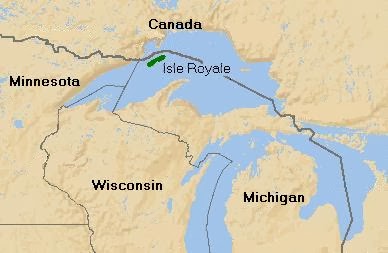
For those unfamiliar with Isle Royale, it is located in the north-west corner of Lake Superior. While it is only about 20 miles from the shores of Minnesota and Canada, it is officially Michigan territory. It holds a long history of human presence, mostly involved with the mining of copper. Both Native Americans and Europeans mined the island, with some pits dating back 5700 years. Logging and mining by Europeans and Americans left the island badly scarred, but once it was established as a National Park in 1940 those activities ceased, and the island began to recover.

Isle Royale National Park in relation to Michigan. How in the heck did we end up with it??


During the copper mining years many homes were built on the island as well as several resorts, primarily in proximity to Rock Harbor. Families who owned property on the island when it became Federal land were allowed to lease their property for as long as whichever family member whose name was on the lease lived. Today there are still a handful of properties with active residents, all of whom were children when their leases were signed, but most of the homes are empty. The Park Service tore many down over the years, but more recently a push has been made to preserve the structures for their historical significance. The Isle Royale & Keweenaw Parks Association works with the National Park Service to maintain the buildings, one of which is used for the Artist-In-Residence program.

Most of the island is now designated a wilderness area, although the area surrounding Rock Harbor and its shops and lodge is not. Most of the homes do fall within the wilderness, so there are some limitations as to what can be done to and around the homes. Cutting of trees is a big no-no, unless they threaten the stability of the structures. Our work focused primarily on painting, re-roofing, debris removal and some minor structural repairs. Major work, like shoring up foundations, is done by professionals. I'll talk more about the island as we make our way along this journey.


That journey began for me on Sunday June 9th, 2013, a day after I did a show in Kalamazoo. My original plan had been to drive all day Monday to Houghton, in the Keweenaw Peninsula, where the Ranger III departs for Isle Royale. A friend convinced me to leave Sunday if I could (it's a 10 hour drive) and the more I thought about it the better that idea sounded. If I could get across the Mackinaw Bridge Sunday, I would have time Monday to do a little exploring across the U.P.

I crossed the Mighty Mac around 7:30 in the evening, and stopped at the Straits State Park in St. Ignace. It's a nice campground with a gorgeous view of the bridge, but it's loud there as you hear all the traffic noise.


The Mackinaw Bridge from Straits State Park

I slept in the back of the van, which made getting in and out of the campground pretty painless. I was on the road Monday by 6:30 am, and drove west on US 2, which runs along the southern shore of the U.P., on Lake Michigan. I had never been farther west on US 2 than M-77, which runs north to the Seney National Wildlife Refuge, so I decided to drive over to Manistique, then take M-94 north towards Marquette. It was a little out of the way, but I wanted to do some sightseeing.

Eastern UP. This is an updated map as I had the wrong location for Wagner Falls. The hazard of waiting six months to write about something!


I pulled off at a nice little roadside park in Manistique and took the obligatory lighthouse photo, then walked down to the beach.


The Manistique Light


The shoreline along Lake Michigan varies here in the U.P. Much of it is sandy, but then you come across these areas where it's all sandstone. I was fascinated by how it brakes into rectangular chunks.


Manistique beach.

There were a great number of Common mergansers in the area.


From Manistique I drove north towards Marquette, planning to stop and see Wagner Falls, then head into town to have lunch at one of the best darn restaurants anywhere, Sweet Water Cafe. I had noticed a National Forest campground on the map off of M-94 and stopped for a look and a few quick photos. I say quick because the mosquitoes were just horrific. I must have had 20 follow me into the van. It would be a wonderful place to camp--but maybe not in June.


Indian River, Hiawatha National Forest


I reached Wagner Falls around noon, and the parking area was pretty full, but by the time I got my camera and had applied a liberal coating of bug spray, several people had left. As I made my way towards the falls, two more groups passed me, and by the time I reached the falls I was all alone.


Tiny falls downstream.

I wasn't there at the best time of day as far as the lighting goes, and I was without a tripod, but I made the best of what I had and managed to get a few long exposures by resting the camera on the boardwalk railing.


Wagner Falls


I stayed for 10 or 15 minutes, enjoying the sounds of rushing water, Red-eyed vireos and solitude, while the mosquitoes nibbled my ankles, which were exposed when I squatted to take pictures.


Next: Second half of my drive across the U.P., with a stop at Laughing Whitefish Falls.

Tuesday, December 11, 2012

Leelanau Waterfowl

Before I had stumbled upon the dead birds on the rocky beach I had managed to take a few photos of some live waterfowl. I recognized these buffleheads, but the other birds, who were much farther out and already moving rapidly away, were a mystery.


A pair of bufflehead. What a great name, bufflehead.

There was a narrow rocky promontory to my right that would have afforded great views of the shoreline but I didn't feel like walking that far. Interesting, our desire to build things. These would have made good blinds, if I'd had time to sit a wait.


I decided I needed a somewhat more hidden position to photograph these birds from. I noticed a small bay to my left that had some vegetation closer to the water. I walked back to the trail and cut over to the bay, and squatted down in the dead grasses.


Lake Michigan and Leelanau Peninsula. Taken with my iPhone.


I was able to get a few shots of the mystery fowl. There's a common merganser on the left, and a bufflehead on the right, but what the heck were these other birds?


A few minutes later they took to the air. Good damn thing, as my legs were falling asleep!


I snapped away, hoping to get a photo or two I could use to ID them.


I am always excited when I manage to get photos of birds in flight in focus!

This image finally confirmed for me that these were common goldeneye. It's fuzzy but you can see the black wing bars in the white patch on the secondaries. Only the second time I'd seen these birds.


I walked back to the car along the path that took my past the lighthouse.  All decked out for the holidays it was resplendent in it's new whitewash.


Leelanau Lighthouse. Taken with my iPhone.


As I neared the parking lot I saw this sign:


Taken with my iPhone.


The cedar it referred to was this hulking giant of a tree, one of the most interestingly shaped trees I've ever seen. I think it looks like a woolly mammoth.


Giant white cedar. Taken with my iPhone.

I must say how very happy I am with the image quality I am getting from my iPhone. I upgraded a few months back from a 3s to a 4s, and I love it. The file sizes are bigger and the overall sharpness of the image is much better. I only had one SLR with a big lens on it with me, so I was taking snapshots with my phone. I was delighted to see how good they looked when I enlarged them on the computer--better than the Nikon point and shoot we have. By touching the phone's screen you can dictate where the camera focuses and meters, giving you some limited control over the exposure. It's been great for those times when I haven't felt like lugging two cameras around, or fussing with switching lenses on one camera. I may use it more extensively in the future.