
For the sake of getting caught up a bit I'm going to make a quick run-through of February 3rd to the 19th. Those dates saw relatively little birding beyond watching my feeders thanks in large part to the terrible cold, wind and heavy snow that plagued us as well as 2/3 of the country. I've been doing these posts as journal entries (and yes, I'm keeping a written journal cuz that's how I roll) and will get back to that format starting on February 20th, farther down the page.
Lisa and I drove down to Ottawa County on February 3rd to a hotspot where several grassland birds that I needed for this year had been reported. It was forecast to become frigid for at least the next 10 days starting the 4th, so we decided to make a day of it and get in as much birding as we could. We stopped at Muskegon Wastewater on the way down and while we didn't see anything new we did get great looks at a male Northern Harrier. He was flying towards us as we drove down the lagoon road, and I slammed on the brakes when I realized what it was. Trying to get out of the car in a hurry to get some photos I jammed the car into park, got tangled up in my seatbelt, and just about took my head off on the visor that was across the driver's side window, blocking the sun. I scurried around the back of the car, camera ready, but the bird had vanished. I looked around, perplexed, then saw him rise up out of the ditch like a pale Phoenix. He must have whiffed on lunch as his talons were empty. He continued past us and I did manage a few decent photos, way better than anything I had before. I'll keep trying!
 |
| Male Northern Harrier, the "Gray Ghost" |
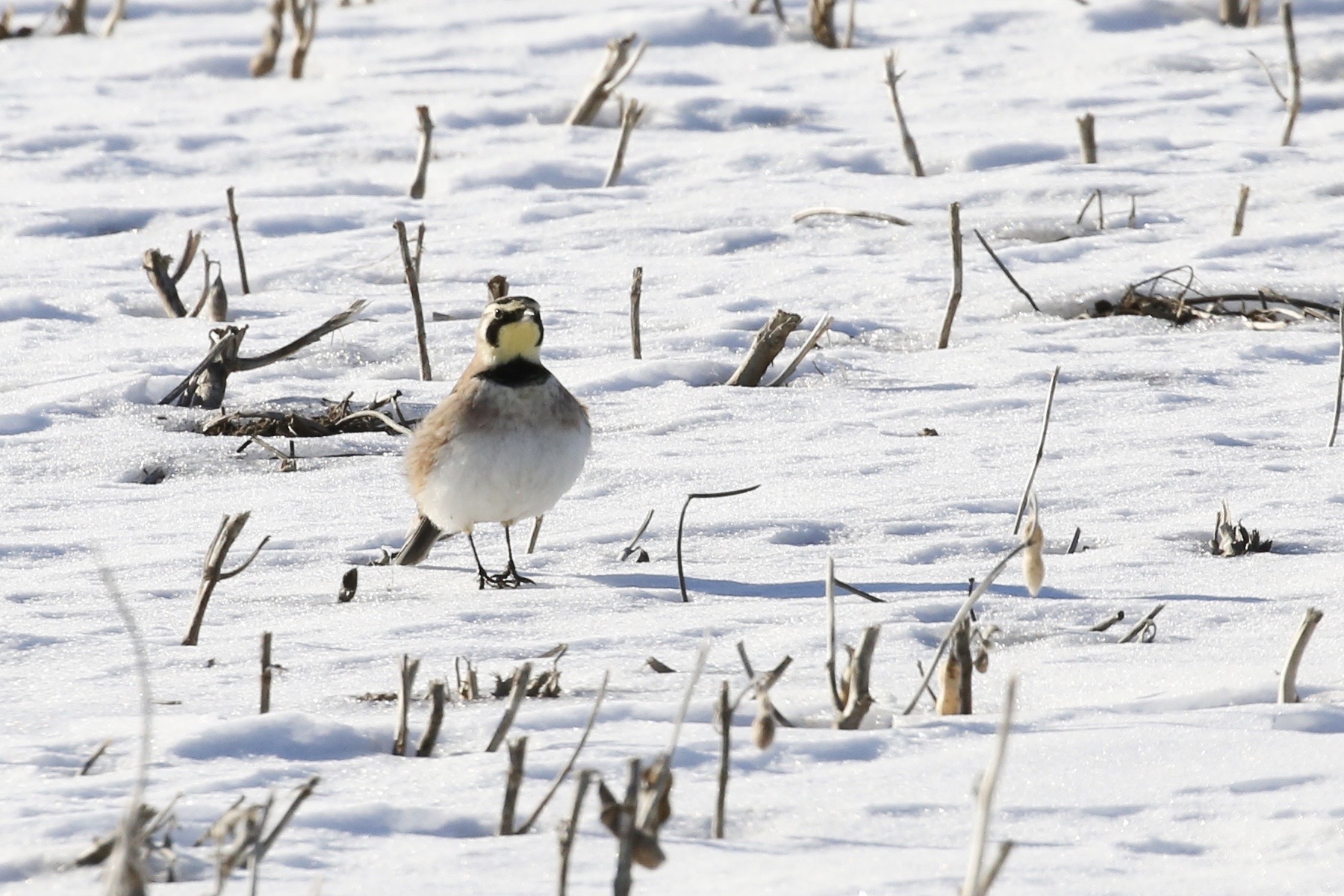
We drove from there to the hotspot at 128th Ave and Bingham Street in Ottawa County. It did not look remarkable in the least--mostly empty fields and a farm with maybe 50 head of cattle. As we neared the intersection Lisa asked what exactly we were looking for. I told her grassland birds so to watch the fields. She immediately pointed out her window and said, "Like those?" I slammed on the brakes again--there's a lot of that when birding--and backed the car up. Right there by the side of the road was a pair of Horned Larks (MBY bird #76). I was able to get some shots off before they began chasing each other around. We looked for Snow Bunting and Lapland Longspur but came up empty. We did find a flock of over 40 larks but they were out in a field and I could not pick out any other species.
 |
| Horned Lark floofed by the wind |
On February 10th we took a few hours in the morning to drive some of the backroads near home to see what might be in our own back yard. We'd gotten 8+ inches of snow on the 5th, so now there was easily a foot and a half on the ground. While we saw three pairs of Red-tailed Hawks (getting ready for mating season?) we didn't find anything to add to the list until we were getting ready to head home, when we found a house with feeders and I picked up MBY birds #77 (House Finch) and #78 (Pine Siskin).
On the 11th we dipped on a Barrow's Goldeneye in Manistee. This bird was at a marina that had bubblers, keeping the water open around the docks. As the temperatures have plunged, with some nights falling below zero, the waterfowl that have stayed are forced to seek refuge in places they might not normally be. When we arrived there were plenty of Common Goldeneye and several other species of ducks but we didn't see the Barrow's. All hope was lost when a couple drove in, parked, and proceeded to drag their ice fishing gear right past the marina, flushing all the birds to who knows where. The bird has been seen since but I've not yet made it back to look for it.
By the 15th we were 11 days into the frigid weather, and Texas was getting slammed with crazy cold, ice, and snow. I was starting to go bonkers from being cooped up in the house. We had more snow forecast for the coming night, and the weather wasn't too bad (relatively speaking) so we went back to 128th Ave to look for the birds we'd missed. The snow that had fallen since we'd last been there had forced the birds out of the fields and into the roads to scrounge whatever they could find--wind-blown seeds and bits of hay, as far as I could tell. We found plenty of larks before finally finding a flock with a couple Lapland Longspurs, MBY bird #79.
 |
| Lapland Longspur |
Named for it's exceptionally long hind toenail, or spur, this is an Arctic tundra breeder, here only in the winter. The male is gorgeous in breeding plumage with a black face and neck and rufous nape (back of neck). I saw a couple in breeding plumage in Alaska in 2014, and had first seen at Sleeping Bear Dunes in 2012. Before heading home we also found one Snow Bunting for MBY bird #80.

 |
| Probably the best photo showing that extra long spur. Click image for a better look, or follow the link above to see pics from Sleeping Bear. |
February 20th
A message came through late yesterday that a King Eider had been seen in Saint Joseph at Tiscornia Park, about a 2 1/2 drive from here. I moaned. We are preparing for a trip to the U.P. and we're leaving tomorrow, but a King Eider would be a life bird and a great addition to my Michigan Big Year, so I sent a message to our What's App group asking if the bird was still present this morning.
It was.
I considered timing and what we still needed to do to get ready to go north (pretty much everything) and decided to go. As I was running out the door Lisa stumbled out of bed and came along for the adventure.
We arrived before noon, gathered up our gear and donned our ice cleats. A message came through a half hour before we arrived detailing the rough conditions out on the pier. I had wondered about that since the piers and lighthouses are usually blanketed with ice this time of year. We had been lucky, up until February 4th, that the winter had been mild enough to keep the piers fairly open and walkable. The eider was feeding directly off the end of the north pier, so there was little choice but to give it a go.
Most of the channel was frozen, with just a patch here and there of open water, but a lead of open water could be seen off the end of the pier that extended north for several hundred yards. About halfway down the pier there's a gate, and I recall from earlier this year there are signs on it warning of the conditions and lack of life saving flotation devices. Now, however, the gate was encased in ice 1-2 feet thick and hip high. Beyond it the pier was a wasteland of jumbled shards of ice, frozen into crags of snow-covered misery. But there were people out there so I knew it was doable.
At a low and slightly narrow spot in the ice wall I was able to get my left leg partway over, like mounting a horse. But it was too high for me--I was on my tip-toe of my right foot with no way to get my body up onto the ice horse. I pulled my foot back over and contemplated my options, discussing it with Lisa and another person who had joined us.
Looking around I realized that quite a crowd had gathered and everyone was looking at me, like they were waiting for me to lead them to the promised land. The pressure was on. A young woman came sliding up in winter boots that had hard soles, and we urged her to go get ice cleats. She had come for the eider too, and if she were slipping here, there's no way she'd make it down the second half of the pier. After actually falling to her knees she retreated back to the parking lot.
With the help of a kind stranger and a boost from Lisa I was able to get my leg over and my body upright, then slid over sideways to the other side. In doing so I bashed the inside of my right knee and scraped the inside of my left thigh on an ice ridge on the other side of the gate. My God the bruises (and how I wish I'd taken some pictures of this)!
We got Lisa up and over and we picked our way along the lumpy, bumpy, hilly landscape until we came to the end of the pier. Lisa took shelter from the wind in the lee of the lighthouse while I pulled gear out of my bag. I turned around and there it was--an immature King Eider, diving and surfacing not 15 feet from the end of the pier.
 |
| King Eider (immature male) Life bird #511, MBY bird #82 |
He stood out from the rest of the waterfowl with that large white breast. There were Long-tailed Ducks, goldeneye, scaups, Redhead, mergansers, and all three scoters there as well, and all were diving down to the base of the pier, presumably picking at crustaceans and other juicy bits on the submerged rocks.
 |
| Eider with Long-tailed Duck |
Thick, jumbled ice extended far out into the lake, and with most of the channel frozen the birds were within easy viewing off the end of the pier, the reward for those nasty bruises. It was a beautiful day, one of the first "warm" days we'd had in weeks (low 30's) and the sun was popping in and out, but the stiff breeze off the water was finger-numbingly cold. Others had joined us, and two women who had made the trek "for the heck of it" asked what we were looking at. I lent them my binoculars and pointed out the different species.
 |
| Surf Scoter (adult male, center), with female SUSC (bottom) and adult male Common Goldeneye (top) |
I was thrilled to see an adult male Surf Scoter, a bird I'd seen fleetingly in Alaska. Such a clownish bird with that multicolored bill! All adult male scoters have colorful, oddly-shaped bills but none of the other scoters there were adult males.
 |
| From top left: Lesser Scaup, immature Surf Scoter, adult male Surf Scoter |
 |
| White-winged Scoter, probably immature male, (bottom) with immature scaup. |
 |
| Black Scoter, immature. I had seen one of these at quite a distance in January so was happy to get a photo this time around |
 |
| Male and female Common Goldeneye |
The thing that really stole the show, though, were the ice sculptures the wind and waves had made of the lighthouse and catwalk. Spray from pounding waves had coated everything in thick swirls of wind-shaped iced. I walked around and took a few photos of this oddly beautiful sight before we headed back.
 |
| Saint Joseph lighthouse |
 |
| A good look at the condition of the pier we'd just traversed--and now had to walk back down! |
 |
| Open lead full of waterfowl. |
On the way back down the pier we crossed paths with the young woman in the slippery boots who had gone downtown and gotten herself some ice cleats. She was practically turning cartwheels as she bounded down the ice, and she thanked us for the advice. We exited the pier much as we entered, mindful of our bruises, then walked down along the channel to the open water at the near end to find the Harlequin Duck (too far for photos) for MBY bird #83. On the way home we had a gorgeous male Cooper's Hawk fly across the road right in front of the car for MBY bird #84.
Next up: A U.P. birding adventure!
Ottawa County, February 3
#76) Horned Lark
17 Mile Road, Newaygo County, February 10
#77) House Finch
#78) Pine Siskin
Ottawa County, February 15
#79) Lapland Longspur
#80) Snow Bunting
Boardman Lake, Traverse City, February 17
#81) Iceland Gull (Life bird #510)
Tiscornia Park, Saint Joseph, February 20
#82) King Eider (life bird #511)
#83) Harlequin Duck
#84) Cooper's Hawk


