Showing posts with label Red-breasted merganser. Show all posts

Sunday, February 14, 2021

Scoters and Warblers, Michigan Big Year Vol 6

 January 29

I got a text from fellow Michigan Big Year birder Terry Grabill around 11:00 am that he'd seen all three scoters (surf, white-winged, and black) at the pier in Muskegon. I wasn't planning on birding today, but after letting it stew for a couple hours I couldn't resist going. I already had black, but needed the other two.

I walked the channel from the harbor mouth to the submarine museum, as Lisa and I had done a few days prior. I saw the White-winged Scoters right away, drifting and diving not far from shore, but a search for the Surf Scoter came up empty. 


White-winged Scoter, Muskegon Lake Channel


White-winged Scoter laughing at the silly birders.


I took advantage of the nice light to admire a pair of Red-breasted Mergansers and, of course, a Long-tailed Duck.


Red-breasted Mergansers, Muskegon Lake Channel


Love that red eye!


Long-tailed Duck. I just wanna pinch his cheeks.


The weather was pleasant with little wind so I walked out the short middle pier to check out the harbor but it was all mergansers, Mallards, and a ton of gulls on the ice that has built up on the south side of the north pier. I set up the scope and scanned for anything that looked unusual. My gull identification, beyond our normally occurring gulls, begins and ends with looking at their primary feathers (the flight feathers that you see extending over the tail when a bird's wings are folded) and looking to see if any of them were white or gray (most gulls have black primaries). White primaries would indicate an Iceland, Glaucous, or Glaucous-winged Gull, rare but not unheard of winter visitors.  I didn't see anything odd among the 200 or so birds, so I went back to the car and drove over to the south pier parking area. 


Inner light at Muskegon Lake harbor, from shore.


Harbor at Pere Marquette Park, Muskegon


I walked out the south pier as far as was safe. There were ducks off the end of the pier, and another birder was set up ahead of me with her scope. After about 20 minutes she packed up and I asked her if she'd seen a Surf Scoter, but she had not. I moved up to take her place. As clouds pushed in the temperature dropped, and I was starting to feel the cold come up through the soles of my hiking boots. I had watched as flocks of Redhead flew in down the channel to join the multitudes, continuing to scan for scoters. Just as I was about to give up I finally found the Surf Scoter, hanging out with a White-winged Scoter. Having the two together was helpful in identifying them both. They were too far to bother with trying to even get photos with my scope, so I packed up and headed home, not getting back until after 7:00 pm.


Lake Michigan sunset from the south pier, rocks coated with ice.

January 30

I was minding my own business, eating lunch and checking emails, when I read that the Yellow-throated Warbler that had been seen in December was still hanging around the feeders at a home up in Frankfort. A rare bird any time and anywhere in Michigan, it is a super rare bird this far north in January. Looking at other birds on my eBird needs email I saw that the pair of Red-necked Grebes were still being seen at Sleeping Bear Harbor in Glen Haven, about 1/2 hour north of Frankfort. The weather was still mild (relatively speaking) so I decided to make a day of it. 

I pulled up at the address to find one birder already there, a fellow named Roberto with whom I've chatted with online. He said the bird had been coming and going for about an hour. We stood only 10 feet or so from the feeders but he assured me the bird did not seem to mind. I left the suet cakes I'd brought for the homeowner, who was not home, on the stoop and waited. 

Within about 10-15 minutes another car pulled up and two guys, Ross and Mike, walked up the drive. They'd come all the way from the Ann Arbor area to see this bird, and were also planning on making the drive up to Glen Haven. The guys got to talking while I watched the feeders. Not five minutes later I heard a bird call that I was not familiar with, almost directly in front of us. I looked and there was the warbler, perched in a shrub next to the driveway. I pointed it out to the others, then it flew over to the suet feeder. We all got great looks at the bird before it flew around to the front of the house and into a large tree, then off down the road.


Yellow-throated Warbler, Frankfort


One of my favorite warblers with such bright, sharp markings.


Having already seen this bird down south, and since I'd gotten some decent shots of it, I decided not to hang around and wait for it to return. I told Ross and Mike I'd see them in Glen Haven and drove up to Sleeping Bear Dunes. I wanted to get the grebes and get home before dark. 

Well, you know what they say about the best laid plans--but we'll save that for next time.


Pere Marquette Park, Muskegon River Channel, January 29

#71) White-winged Scoter

#72) Surf Scoter

Elm Street, Frankfort, January 30

#73) Yellow-throated Warbler

Tuesday, February 9, 2021

Michigan Big Year Vol 5: A "Lifer," and an Unexpected Visitor at Home


A good friend of mine, Artist Christina Baal, (https://www.drawingtenthousandbirds.com/), gave me a book for Christmas called Zen Birding, and it's been most helpful for me in taking a different perspective on this listing thing. In it the authors David M. White and Susan M. Guyette talk about the usual Zen stuff--ego, expectation, beginner mind vs. expert mind. They talk about listing in the first chapter, its pitfalls as well as the joys it can bring. They warn that listing can sometimes become all about the list--simply checking off species names on a list and running to see the next. But they acknowledge that making lists is a common human trait, and that listing can actually increase one's enjoyment of birds, especially if we take time to observe and enjoy both them and the act of birding. That is, as long as we don't get angry or frustrated when we dip, and don't get jealous when someone else sees a bird and we didn't, or we get mad because we can't go birding because of work, (all about ego). This was a relief to me but also a lesson--I feel like I've been released to go make those lists, and warned that if I'm not enjoying it or if I'm having expectations or jealousy that I need to reexamine my priorities. And so, we move onward!


January 25

Lori had her knee replacement surgery last week so we have been sticking close to home and caring for her while she convalesces. That meant no chasing for a while, but today she was doing much better and there was a person coming for physical therapy in the afternoon, so Lisa and I decided to head to the pier in Muskegon to look for some of the rare waterbirds that had been reported over the previous days.

It had been sunny but by the time we arrived it had clouded up and the wind had increased, coming from the northeast. This meant off-shore, but it was still biting, even at 33°. We walked east into the wind along the channel as far as we could go, mostly with our heads down, then worked our way back slowly with the wind at our backs. Many birds drifted west on the current and we looked at each one carefully. A small flock of Long-tailed Ducks was drifting and feeding. Suddenly, as ducks do, they simultaneously started running and flapping across the water. They'd go several feet, stop, then start again. The goofy things never actually went anywhere but a little farther down the channel.

Long-tailed Ducks doing Long-tailed Duck things


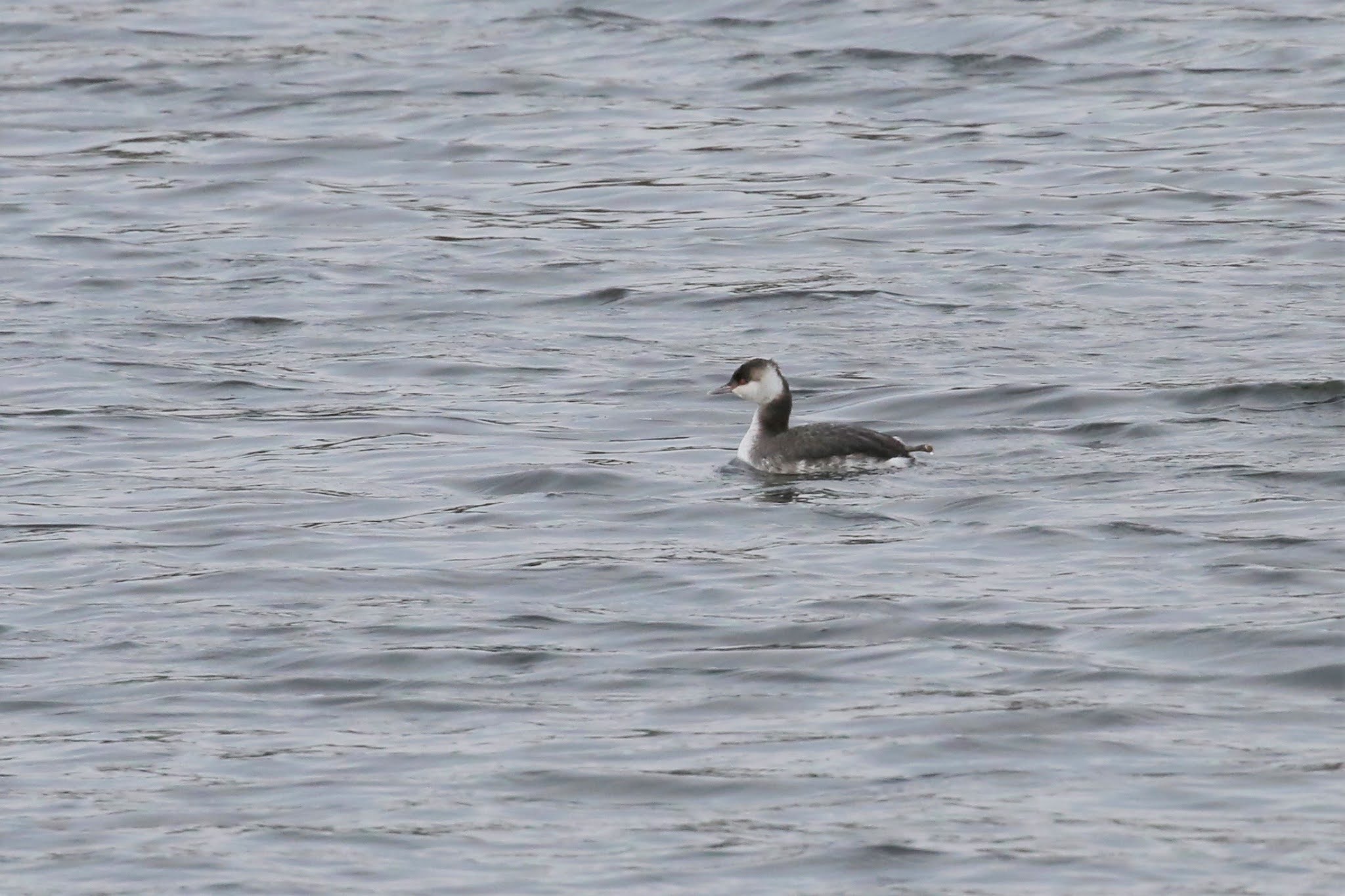
It was not long before I saw a Horned Grebe appear in the middle of the channel. Yay! This was a new life bird for me and the last of the seven North American grebe species I needed. I've seen Pied-billed Grebe just about everywhere, and Red-necked Grebe in Alaska in 2014, but then got the next four all in 2019--Clark's, Western, and Eared all out west over the summer, and Least down in Texas that fall. This Horned Grebe (MBY #68 and life bird #508) was the icing on the grebe cake, which by the way is probably my favorite family of birds.


Horned Grebe, non-breeding. I hope to see them in breeding plumage one day. Also, I realized when I was editing the photos that this poor thing is missing a foot
(that's it's footless leg sticking out behind it.)


After that we didn't see any new species in the canal, though we searched for some time. I knew some scoters and a Harlequin Duck had been seen the day before, and I hoped they had moved out into more open water. We watched the mergansers for a bit, hoping someone new might float by, then headed to the car and over to the south pier parking lot. On the way I stopped to check the harbor and had a small flock of Tundra Swans fly by, for MBY #69.

Female Red-breasted Merganser


Male Red-breasted Merganser taking off


We donned our spikes and walked out onto the icy pier. The big lake was fairly calm thanks to the off-shore winds but the pier was crusted with ice from waves pushed into the harbor from the northwest the previous day. We picked our way carefully along, checking the ducks as they dove and popped up here and there. The ducks we were looking for had frequently been seen with the long-tails, so we checked each and every one. Lisa spotted a lone Purple Sandpiper feeding on the water's edge among the boulders. Most of the surfaces were frozen, some with tick, opaque, gray ice and some with clear and smooth, but apparently there was enough exposed algae for this bird to pick through to find enough to eat.


Purple Sandpiper toughing it out on the ice along the pier.


We walked out as far as the bend in the pier, at which point the ice was so gnarly and bumpy that we didn't dare go farther, even with spikes. I looked longingly at the ducks at the end of the pier and scanned them with the scope, but couldn't pick out any oddities. We did see a lone Snowy Owl way out on the end of the north pier, which helped explain the blood and body parts we'd seen strewn along the pier.


Long-tailed Duck, becuase you can't ever have enough Long-tailed Duck photos.


January 26

At this point in the season I have seen most of the species that regularly occur at home, with the exception of Red-breasted Nuthatch. There is always the chance for a less-common bird to appear, but I wasn't holding my breath. We have hoards of Blue Jays who dominate the feeders, scooping up pounds of seed a day to cache in some secret location, and I think they are keeping some of the less-aggressive birds away. So imagine my surprise this morning as I was walking to the office and heard an unfamiliar call from the oak above my head. I paused and listened, then continued on to the office. As I started up my computer I looked out the window to see a juvenile Evening Grosbeak (MBY #70) at the feeder! I was hoping we'd have another shot at seeing one in spring as the flocks moved north, but apparently there's at least one still hanging around. These birds are very rare winter visitors here. Despite their name they are members of the finch family, and every 7-10 years they and other finches "irrupt" and flow south in huge numbers in search of food when the pine/spruce/larch cone crop is poor in the forests to our north. I was able to get back to the house and get a few photos for record. 


Evening Grosbeak


Lake Muskegon Channel, January 25

#68) Horned Grebe (also lifer)

#69) Tundra Swan

Home, January 26

#70) Evening Grosbeak

Tuesday, April 8, 2014

Rock Harbor to Mt. Franklin, and Saying Farewell to Isle Royale NP

 Isle Royale continuted:

Well, it's happened again. Over a month has gone by with no blog post. I was getting ready for my first show of the season, which happened to be all the way down in Houston, Texas, the last weekend in March. I had a lot to get ready, then four days total on the road, one day for set up, three days for the show, with a couple of days for birding on Galveston Island thrown in. I always think I will have more time than I do, and I just never managed to get to my office and finish this series. And so....

I had worked it out with John that I would be on the first boat back to Rock Harbor Tuesday morning. We loaded a bunch of gear into the skiff and Alan piloted the boat back to civilization. John and I picked out a shelter for our group to use. It was going to be a tight fit, with six of us squeezing in.

Once we were settled I got ready for my hike up Mt. Franklin. I was going to have to hoof it if I was to make it back in time for dinner. It is a nine mile hike up and back, so I figured if I left Rock Harbor by 11 am I would have time for lunch at the summit and then be able to get back down by 6 pm, get changed and ready for dinner at 7 pm. I borrowed a small backpack from John to carry rain gear, lunch and a miscellany of other things, and stepped onto the trail.

Before I had even left Rock Harbor, I ran into Sarah. Remember Sarah? She is the retired nurse I met on the Ranger III who was doing a seven day backpacking trip. Solo. With borrowed equipment. Never having backpacked before. I was quite relieved to see her, actually, and she told me all about her adventures and misadventures. She was sporting a black eye, compliments of one of many falls on the trail. But the parks folks had kept an eye on her, and given her permission to stay several nights at Three Mile campground (the first along the trail west from Rock Harbor and usually a one night only campground), then OK'd her to return to Rock Harbor and stay in a shelter for several nights. I suspect they figured that would be easier on them than having to go rescue her in the backcountry. It was decided that I would share her shelter as she was alone in it, freeing up some space in ours. Once I finally began my hike I was 15 minutes behind schedule.

I don't like hiking in a hurry. I like to take my time and see things and catch my breath. But I didn't have that luxury if I wanted to make it back in time for dinner, so I set a quick pace. My plan was to get to the top with enough time to eat and relax for a little while, then I'd know how fast I had to come back down.


Tobin Harbor Trail towards Mt. Franklin/Three Mile campground.

I really had to resist the urge to stop and look at flowers and butterflies, though there were a few things that forced me to stop, like these Red-breasted mergansers resting on a log.


Red-breasted mergansers, a life bird that I saw several times on this trip.

Calypso orchids lined the trail, along with many other wildflowers. June is the time to go if you're into plants!


Calypso orchids along the Tobin Harbor trail.

Butterflies were everywhere, all different kinds. This tiger swallowtail was feeding on blue-bead lilly flowers.


Tiger swallowtail.

Once the Tobin Harbor trail meets the trail for Mt. Franklin it takes a turn to the north, and crosses Tobin Creek, the marshy area at the west end of Tobin Harbor.


Boardwalk across Tobin Creek.

Up and up the trail climbs, passing a beaver pond where later I saw Wood and Ring-necked ducks.


Beaver pond.

After four and a half miles I finally reached the summit and the famous Greenstone Trail. A left turn took me to a look out over Belle Harbor and to Canada in the distance. I sat down, took off my boots and socks, and ate lunch.


View from Mt. Franklin.


Belle Harbor in the foreground, Canada in the distance.

The rocky summit was covered with wild columbine, and the sound of bees and birdsong filled the air.


Columbine along the Greenstone.

As it turns out, I did not actually reach the official summit of Mt. Franklin. Several hundred feet farther down the trail, past some trees, is the marker for the peak, I later learned. I didn't know this at the time, and I was tired enough when I got there to not care all that much. After 30-45 minutes I put my boots back on, shouldered my pack (which would give me a headache later on--no hip belt), and headed back down towards Rock Harbor. I was able to pace myself going down and spent some time photographing the flora along the way, including this Ram's head orchid.


Ram's head orchid along Mt. Franklin trail.


I had seen these poplars on the way up, but they were not so impressive from that angle. Coming back down they seemed to soar over the trail.


I spotted this old pile of wolf scat along the trail too. I even picked a tooth out of it, a canine from some smallish rodent, but I managed to loose it on the way home.


Wolf scat, with boot for scale.


Back on the Tobin Harbor trail I had the sun to my back, and I took a little more time to enjoy the views of the harbor. The trail also served as a butterfly highway, and I could see their shadows on the path in front of me as they approached from behind. They fluttered along in both directions, narrowly missing me as I walked along.


Tobin Harbor.

I made it back to Rock Harbor with plenty of time to get ready for dinner and stretch out sore muscles. I was exhausted--I don't know if I've ever hiked nine miles in a day, and I was not in particularly good shape. But, it's good to know my limits, and that I can take on such a hike as this and still be able to function.

It was a long night sleeping in the shelter, as I had finally gotten used to sleeping alone in my tent. I was warm enough, but Sarah snored, and I tossed and turned a lot. At dawn I got up and got my gear packed and onto one of the carts to be loaded onto the Ranger III, then made my way to the restaurant for a group breakfast. John and Allen had come up for breakfast and to make sure we all got on the boat.


The Ranger III at Rock Harbor.


It was another glorious day, and a fine one for the trip back to Houghton. I know we got very lucky with the weather, especially for those trips across Superior. It can be a very rough ride in bad weather, and many people experience terrible seasickness. I would suggest keeping Dramamine on hand just in case.


Leaving Rock Harbor aboard the Ranger III

I can't say enough what an amazing experience this was. I worked with some wonderful people, had some amazing experiences, and really fell in love with the place. I am looking forward to going back some day.


Tuesday, December 31, 2013

Day One on Isle Royale

Isle Royale continued

Before we get started I want to show you a few more maps that give a better idea of where I was on the island. As I have mentioned, Isle Royale is about 40 miles long and 9 miles wide at its widest point. As I was not there to backcountry camp but to work on restoring some of the structures on the northeast end of the island, I actually saw very little of the park. Most of the cottages are along Tobin Harbor, so that is where I spent my time.


The red box shows approximately where the closeup map below is located.


Purple line shows the water route to the dock for the Dassler Cabin and the location of the cabin. When the weather's good this is the most convenient route, but it is possible to get to Rock Harbor by going down Tobin Harbor. It is about 1/4 mile hike from the docks on Tobin Harbor to Rock Harbor so that route is avoided if there's lots of stuff to haul.


We had arrived at Rock Harbor around 2:40 pm, and within a half hour I was on my way to Scoville Point and the Dassler cabin with a skiff full of food and gear. Alan, our certified boat operator, was at the helm and I traveled with Mary, a veteran of the volunteer crew and our primary cook, although I had volunteered to cook three of our dinners.


The Ranger III at the Rock Harbor docks.

The day remained clear and relatively calm, and we had a pleasant 20 minute boat ride.


Rock Harbor Lodge. People pay A LOT of money to stay here!

We chugged along and I marveled at the scenery, all rocky and thick with black spruce. Before I knew it there was the Dassler cabin, perched upon its own little promontory across a small cove from Scoville Point.

The Dassler Cabins. Sleeping cabin is on the left, the main cabin on the right. I don't know why this image is so overexposed but it's the only one I got from this view.

The Dassler Cabin doesn't have its own dock. The one the Dasslers put in kept getting swept away by ice and storms, so we used one perhaps a quarter mile farther down Tobin Harbor that is also used for access to two other nearby cottages, one which is still occupied. Alan dropped Mary and I at the dock with all our gear and Rubbermaid tubs full of food and supplies and went back for more people. This was perhaps the most exhausting and treacherous part of the trip, carrying the bins over rocky, uneven ground all the way back to the cabin. We made four trips in all, three with bins and one with our gear. My arms hurt for two days!


The Dassler sleeping cabin, with the tip of Scoville Point on the right across the cove. This building has two rooms and is very bright inside, and if I ever won a residency on Isle Royale, this is where I'd spend most of my time. The sleeping cabin is about 25 yards from the main cabin.

The Dassler Cabin, as seen from the front, or water side. It's pretty dark inside, with its small windows, dark panelling and surrounded by trees. The trees cannot be cut as the cabin is in a wilderness area. This covered area served as our dish washing station. 

There is of course no running water, so all water consumed must be filtered. We'd bring water up from the cove and have water filtering parties. There is a filtration system set up inside but it wasn't working properly--one of the tasks on our list for the week was to clean it up and get it going again. I had brought my gravity-style filter, where you fill up the top bag, open a valve, and the water flows down through the filter into the bottom bag--or in our case, a bucket. Needless to say this is much less work and I spent a lot of my free time filtering water.


Alan, Liz and Roger filter water behind the Dassler Cabin.

After dinner I had some time to explore the cove. I'd been told a loon had been hanging out there for several days, and I'd noticed a few other water birds, so I went down and sat on the rocky shore.


Cove near Dassler cabin.


Dassler sleeping cabin. There is a bedroom in the main cabin as well.

The loon was not at all bothered by my presence, and came quite close to me.


Common loon. Their calls rang out across the cold water at all hours of the day and night. I woke several times that first night to their haunting songs.

As I sat, the other birds swam slowly closer and closer. They seemed more ill at ease with the loon's presence than mine. These turned out to be a new bird for me--Red-breasted mergansers. I love the wispy little feathers sticking out from the backs of their heads.


Life-list birds! Red-breasted mergansers.

Back up by the cabin I walked to the Tobin Harbor side to watch the sun set. I don't think there's ever been a better place to put a bench.

Dassler cabin bench, with the point of Smith Island on the left.

It took only six hours for me to fall in love with this place.

Sunset over Tobin Harbor.

We were warned about the voracity of the mosquitoes after dark, so I made my way back to my tent site. The moose kept this area clear of trees. There were five or six of us camping in this general area, but I think that is not going to be allowed in the future. There are occasionally hikers that come down this way and the park staff are left to explain why there are folks camping here. I crawled into bed listening to the songs of the White-throated sparrows, who sang long into the night, then started again early the next morning.


My campsite.

Next: Day two, and a hike to Lookout Louise