Wednesday, October 20, 2010

Becoming Monarch

Once the last of the caterpillars became chrysalises, we waited patiently. One morning a chrysalis from an earlier batch was ready to emerge. It's casing had become clear, and we could see the orange and black of the wings inside. I went into my office for 15 minutes, came back out and discovered a butterfly. Rats. So when this little fellow showed signs of emerging, I sat with my camera at the ready.

He took his sweet time....


But finally, a crack appeared.


Then legs pushed at the casing.


Finally the abdomen slipped out,


...and he did a nifty acrobatic move to flip around and cling to the casing. We knew we had a male thanks to the pincher-like protuberance at the end of its abdomen.

At this point the abdomen began pumping fluid into the wings, stretching and elongating them.


After several hours of drying out we got him to crawl up on a stick, where he sat for several more hours before taking to the air. All the way to Mexico he will go. With any luck, some of his descendants will make it to our back yard next summer, when we will certainly be ready to offer a little assistance in hatching another generation of monarchs.

Monday, October 18, 2010

Metamorphosis

In mid-August we found a bunch of Monarch caterpillars on a patch of milkweed out in the back 40 (OK, the back two). We watched one late one evening that looked like it was going to metamorphose, but darkness fell before anything happened. So I went back out the next morning to check, and it was gone--no caterpillar, no chrysalis, nothing. So we got out an old aquarium, cut some milkweed, and gathered up several large caterpillars, who then lived in our dinning room for several weeks.


Over the course of those weeks we added a few more, and several of our first batch went through their cycle, changing from caterpillar to chrysalis to butterfly. We somehow managed to miss the drama each time, but finally one morning we caught one in the act.

It had gone into "J" the night before, having secured itself to a stick with fine silk. It hung there all night, and was still in J the next morning.


An hour or so later, it had straightened out a bit. Lori and I watched closely.


Then, a split at the back of the head! Here we go!


When it reached this point it thrashed around violently, until the dead skin, now way up by its foot, fell to the bottom of the tank.


As it settled, the wings, seen here on the left, stretched out along its sides, and it began to harden.


Eventually it looked like this, one from an earlier batch. Note the gold markings. Just a spectacular creature.


The whole process took about an hour. Fourteen days or so later, we caught one of its counterparts, who had become a chrysalis just before this one, emerge as a butterfly. Check back next time for its emergence.

Wednesday, October 13, 2010

Ruby

Cranefest is a wonderful Audubon festival. As a nature artist I am guaranteed to talk to other nature lovers. The setting is beautiful, at the Kiwanis Club's youth area at the Baker Audubon Sanctuary, which is only open to the public for this festival. The second weekend in October is always awash with color, and the weather, while it can be chilly, is nearly always pleasant.

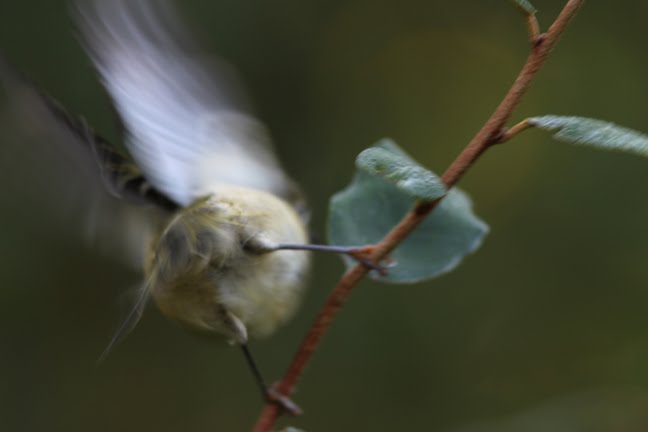
After rising early Sunday morning and watching the cranes, I turned my attention to the edge of the clearing. A small bird fluttered among the branches, and I tried to locate it to get a shot.


It proved quite adept at hiding.


Peek-a-boo!


After a while I gave up, and took a walk down the mowed path. Back in the shade of the trees I came across a young American robin, feasting on a bug.


He watched me carefully.


To my left I noticed movement. Right on the edge of the trail was a bird similar to the one I had been watching earlier. By the time I got my camera around it took off. But at least I'd gotten a good look at it, and was fairly certain what it was. I just needed that last piece of evidence.....


Ah, there we go, a Ruby-crowned kinglet. I have only seen this bird at my place once, so this was a special treat.


There were several of these tiny puff balls moving through the autumn olive, picking off bugs. This one stopped and posed for me.


Just as I was getting ready to head down the path, another alighted before me. Always save the best for last, I say.

If you want to know more about kinglets, read Bernd Heinrich's Winter World, a wonderful book about how animals, including the kinglet, survive northern New England's often bitter winters.

Monday, October 11, 2010

Cranefest


I am stepping away from the Ontario posts to get into real time. I will finish Ontario at some point, but I wanted to share with you some images from Cranefest, an annual event held at the Audubon Society's Baker Sanctuary near Bellevue, Michigan. The sanctuary encompasses Big Marsh Lake, where upwards of 9,000 Sandhill cranes gather before they begin their migration.


It's a wonderful event, with 18 artists, several commercial vendors including some selling native plants and birdseed, a book sale, silent auction and, of course, the cranes.


Here's a look at part of the marsh visible from the festival area.


This Peregrine falcon is part of a local group's collection of raptors. I believe they actually do falconry with their birds. Gorgeous creature.


Since we drag our old RV to many of our shows, we camped Saturday night in their parking lot. That enabled us to get up early and go down to one of the viewing areas to watch the cranes take flight. When we arrived they were just beginning to stir and stretch their wings. The birds in the foreground are just a fraction of the birds in the marsh.


We had been hoping for a mass exodus, but they took to the air in dribs and drabs, starting long before the sun rose.


They took the the air in pairs,


or in groups of 20 or more. The morning air reverberated with their calls.


I counted over 40 in this shot. I spent over an hour there, watching the cranes take off over the misty waters of the marsh. I hope some day to get to the Platte River in Nebraska, where as many as 100,000 cranes gather at a stopover point along their migration route. But for now, the Baker Sanctuary suits me just fine.


Saturday, October 9, 2010

Excuses

I want to extend my sincerest apologies for not getting to my next blog post this week. My last art show is this weekend and I had more work to do to get ready than I'd realized. That combined with "regular" work plus it's been beautiful here so who wants to sit inside? has meant I just haven't gotten to it. But I will finish up the Ontario trip and then update you on our chickens, and post some awesome photos of a monarch caterpillar becoming a chrysalis, then emerging into a butterfly.

Cheers!

Monday, October 4, 2010

A Four Lake Portage

After a very hectic week preparing for and hanging our gallery show at the Riverside Arts Center in Ypsilanti, Michigan, a week I started off with a raging head cold, I am back to blogging. I am ready to finish the Ontario trip (just three more posts!) and get back to "real-time" posts for a while. Fall is in full swing, we have narrowly escaped a couple of frosts (which our squash plants are happy about) and I am itching to get back out on the trail now that the temps and bugs are down. But for now, back to Ontario!


One of the things we wanted to make sure we did while we were in Ontario was to spend a day exploring Crescent's neighboring lakes. MacGregor to the northeast, south of that Kenny Lake, then Mudhole Lake between Kenny and Crescent were all connected with portages to form a loop trail.

Crescent Lake is on the bottom right of the map below. We decided to go to MacGregor first, so we paddled to the far end of Crescent, near where we'd seen the wolf, and carried our yaks along the first portage.


I am not sure at which portage Lori took this picture of Lisa and I, but for those of you who may not know what it means to portage, this is it.


You carry, drag or otherwise hump your canoe or kayak between lakes or around falls or dams in rivers. Four lakes meant four portages, the longest of which was 1148 feet, the shortest 196 feet. Since none of us could carry one that far alone we had to work in groups, but the most all four of us could carry together was three, in train-like fashion. The trails were quite narrow and uneven, with tree roots and rocks that lay in wait to twist and ankle or knee. That meant that at least two people had to make two trips to get all the yaks from lake to lake. In total we carried the 'yaks nearly half a mile. We all had sore shoulders when we were done!

But MacGregor Lake alone was well worth the work. The loon we'd been hearing in the distance while we portaged greeted us near the shore of MacGregor.


We were thrilled to see she had a juvenile with her. Only a few more weeks and they'd be leaving for warmer waters.


MacGregor is bigger than Crescent, with several small islands and a much more rugged feel with a rocker shoreline that featured some sheer cliffs.


That's Lori to the left, taking some shots from a different angle.


Proof that cedar trees can grow anywhere.


Plated rock tripe and other lichens grew on the shaded rock walls.


White pines towered over the shore.


We lingered long on MacGregor Lake, exploring, stopping for lunch. Karin had an interesting experience, but that is for another post. I loved this lake, its wildness, loved feeling, if only for a few hours, that we were completely removed from civilization.


The other two lakes were less charming. Kenny Lake looked much like Crescent, without the rocky shore of MacGregor, and as it was situated right on the highway we did not linger long. We did see this common merganser, resting on a log, back in a small cove.


Mudhole Lake, the smallest of them all and the last of the four, seemed more like an obstacle to get past in order to return to camp. But in all it was a great day, and we all finished with the feeling that we'd accomplished something. Needless to say we did not do much kayaking the next day!

Next: Karin's big day.