Thursday, December 5, 2013

Isle Royale, Here We Come!

Back in June of this year I worked with a volunteer crew on Isle Royale National Park. The group's mission is to restore and maintain the numerous cabins and cottages located on the north-east end of the island.

For those unfamiliar with Isle Royale, it is located in the north-west corner of Lake Superior. While it is only about 20 miles from the shores of Minnesota and Canada, it is officially Michigan territory. It holds a long history of human presence, mostly involved with the mining of copper. Both Native Americans and Europeans mined the island, with some pits dating back 5700 years. Logging and mining by Europeans and Americans left the island badly scarred, but once it was established as a National Park in 1940 those activities ceased, and the island began to recover.
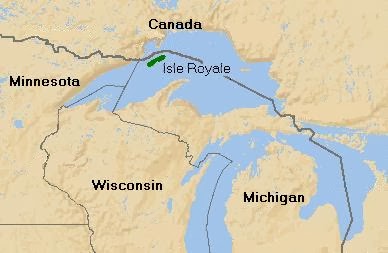
Isle Royale National Park in relation to Michigan. How in the heck did we end up with it??


During the copper mining years many homes were built on the island as well as several resorts, primarily in proximity to Rock Harbor. Families who owned property on the island when it became Federal land were allowed to lease their property for as long as whichever family member whose name was on the lease lived. Today there are still a handful of properties with active residents, all of whom were children when their leases were signed, but most of the homes are empty. The Park Service tore many down over the years, but more recently a push has been made to preserve the structures for their historical significance. The Isle Royale & Keweenaw Parks Association works with the National Park Service to maintain the buildings, one of which is used for the Artist-In-Residence program.

Most of the island is now designated a wilderness area, although the area surrounding Rock Harbor and its shops and lodge is not. Most of the homes do fall within the wilderness, so there are some limitations as to what can be done to and around the homes. Cutting of trees is a big no-no, unless they threaten the stability of the structures. Our work focused primarily on painting, re-roofing, debris removal and some minor structural repairs. Major work, like shoring up foundations, is done by professionals. I'll talk more about the island as we make our way along this journey.


That journey began for me on Sunday June 9th, 2013, a day after I did a show in Kalamazoo. My original plan had been to drive all day Monday to Houghton, in the Keweenaw Peninsula, where the Ranger III departs for Isle Royale. A friend convinced me to leave Sunday if I could (it's a 10 hour drive) and the more I thought about it the better that idea sounded. If I could get across the Mackinaw Bridge Sunday, I would have time Monday to do a little exploring across the U.P.

I crossed the Mighty Mac around 7:30 in the evening, and stopped at the Straits State Park in St. Ignace. It's a nice campground with a gorgeous view of the bridge, but it's loud there as you hear all the traffic noise.


The Mackinaw Bridge from Straits State Park

I slept in the back of the van, which made getting in and out of the campground pretty painless. I was on the road Monday by 6:30 am, and drove west on US 2, which runs along the southern shore of the U.P., on Lake Michigan. I had never been farther west on US 2 than M-77, which runs north to the Seney National Wildlife Refuge, so I decided to drive over to Manistique, then take M-94 north towards Marquette. It was a little out of the way, but I wanted to do some sightseeing.

Eastern UP. This is an updated map as I had the wrong location for Wagner Falls. The hazard of waiting six months to write about something!


I pulled off at a nice little roadside park in Manistique and took the obligatory lighthouse photo, then walked down to the beach.


The Manistique Light


The shoreline along Lake Michigan varies here in the U.P. Much of it is sandy, but then you come across these areas where it's all sandstone. I was fascinated by how it brakes into rectangular chunks.


Manistique beach.

There were a great number of Common mergansers in the area.


From Manistique I drove north towards Marquette, planning to stop and see Wagner Falls, then head into town to have lunch at one of the best darn restaurants anywhere, Sweet Water Cafe. I had noticed a National Forest campground on the map off of M-94 and stopped for a look and a few quick photos. I say quick because the mosquitoes were just horrific. I must have had 20 follow me into the van. It would be a wonderful place to camp--but maybe not in June.


Indian River, Hiawatha National Forest


I reached Wagner Falls around noon, and the parking area was pretty full, but by the time I got my camera and had applied a liberal coating of bug spray, several people had left. As I made my way towards the falls, two more groups passed me, and by the time I reached the falls I was all alone.


Tiny falls downstream.

I wasn't there at the best time of day as far as the lighting goes, and I was without a tripod, but I made the best of what I had and managed to get a few long exposures by resting the camera on the boardwalk railing.


Wagner Falls


I stayed for 10 or 15 minutes, enjoying the sounds of rushing water, Red-eyed vireos and solitude, while the mosquitoes nibbled my ankles, which were exposed when I squatted to take pictures.


Next: Second half of my drive across the U.P., with a stop at Laughing Whitefish Falls.

Monday, November 18, 2013

The Majestic Upper Tahquamenon Falls

We arrived back at the campground after our journey to Whitefish Point with some daylight to spare, so we had a fire and watched from the riverbank as the light faded from the sky.


Tahquamenon River from the Rivermouth Campground.

We were right about the weather Saturday, as the clouds from the night before had foretold--it began raining around midnight and rained right through much of the morning. Not wanting to be camper-bound we hopped into the van and drove up to the Upper Falls, where there's a gift shop and brewery. We figured we'd shop for a while then have lunch at the pub, hoping the rain would have cleared by the time we were done.


The Tahquamenon Brewery and Pub.


The pub is a welcoming place and a bit of a surprise in an otherwise wild landscape. It's a microbrewery and have four beers on tap at any one time. I am not a beer drinker, but the pub also has excellent food. I had Lake Superior whitefish, which I think is the only thing to eat when you're in the U.P. (that and pasties, of course). For more info on the brewery, check out their site here.


Giant vats of beer.

As it turned out, our plan worked. When we left the pub it had stopped raining. The wind was still yowling, but it was at least dry. I wanted to walk down to the Upper Falls, since Lisa and I had mostly missed it the day before. She didn't want to go so I left her and Lori in the van and hustled the mile or so to the falls.  It's an easy, wide, paved path that leads to many great observation areas next to and below the falls. I went right to the stairs that drop down into the ravine and end in a viewing platform just above the falls.


The view was spectacular, as usual!


Upper Falls, Tahquamenon River


Sometimes known as the "root beer falls", Tahquamenon is known for its tannic acid-stained waters, the result of draining nearly 800 square miles of swamps and lowlands in the Eastern U.P.


I moved farther down the observation deck to get a few shots from around the front of the falls.


Foam from the falls piles up at the base.


I love how dynamic this image is.


Closer still.

Climbing back up the 90-some stairs I then made my way downstream to another observation area. I tell ya, it just doesn't get any better than this.


Back at the parking lot I noticed two small birds, wet and huddled against the wind, atop a concrete curb. I rushed to get my long lens as I realized these were not birds I was familiar with. I snapped a bunch of photos, perplexed by their behavior. We later identified the pair as Horned larks.


Horned lark

I'd seen one before but not this close. While looking at the images at home I realized one of the birds had a serious injury. I don't know if that explains their behavior but it would certainly make sense.

Poor thing has a mangled foot

Later in the day we went for a drive and a walk down the Tahqua Trail, which runs along the north side of the river. The North Country Trail meets the Tahqua several miles upstream from the campground, and there's a nice, new-looking gravel parking lot there. (I hope to hike the NCT from one end of the U.P. to the other when I'm 50--I think it would be a great way to celebrate.) There was property for sale along the river, and we couldn't help but think how amazing it would be to have a cabin there, so close to the falls and Whitefish Point.

Wednesday, October 30, 2013

Whitefish Point

 Once Lisa and I had recovered from our five mile hike from the Lower to the Upper Falls at Tahquamenon State Park, we decided to make the best of what looked like might be the only dry time left to us that weekend. We decided to drive up to Whitefish Point, a place that can be decidedly nasty when the weather takes a turn for the worse.

There are any number of reasons to visit the area. Number one for us of course is it's a great place to go birding. Michigan Audubon runs the Whitefish Point Bird Observatory there, where they do owl banding, among other things. There is also the Shipwreck Museum, gift shop, and several other buildings as well as, of course, the Whitefish Point Light Station. (Get more info about the place at Michigan.org).

Lori and Lisa with Mr. Pickles at the Whitefish Point Light Station.

The geography of the place lends itself nicely to birdwatching--any bit of land sticking out into a big body of water is going to attract birds looking for rest and shelter. Whitefish Bay also attracts lots of boats and ships (I will not enter the debate about what's a boat and what's a ship), and happens to be the place where literally hundreds of them have met their demise. The bay offers shelter, but the point can also create confounding waves for captains to try to navigate. The most famous sinking here was on November 10, 1975, when the ore boat Edmund Fitzgerald sank only 15 miles or so from Whitefish Bay, taking with it a crew of 29. Storms in this part of the world can blow up quickly, and the huge expanse of Lake Superior can allow for waves over 25 feet.


Reference for those unfamiliar with Lake Superior.

We decided to forgo the museum in favor of the wildlife refuge adjacent to the observatory, which apparently is part of the Seney NWR unit. I guess the place was "officially" closed as we were there during the government shutdown, but there were no gates, and the two older fellas who were sitting watching the bird feeders made to attempt to stop us.


Sign at Whitefish Point

The habitat here is very brushy--high winds and brutal winters keep most vegetation low to the ground. It's very shrubby, which is great for birding--they can't escape to the tops of tall trees here!


Woods, Whitefish Point-style.

The woods were abuzz with birds, but we didn't have a lot of time to linger and identify. We did see Swainson's and Hermit thrushes, Ruby-crowned kinglets, Cedar waxwings and Yellow-rumped warblers in this part of the refuge.


Swainson's thrush--note the paler color and buffy markings on head.
 
The trail ultimately lead towards the beach. This area was populated by scrubby pines, probably all that could live in this sandy environment. The space between the woods and the dunes was scattered with palm-sized stones, which are found pretty much everywhere along the south and east shores of Lake Superior. My guess is this area used to be the shoreline, where stones get piled up by the waves, then it was cut off either by the dunes piling up or the lake level dropping--or both.


Dunes between woods and shoreline.

Down on the beach I spied bird prints in the sand, probably made by a crow.


The big lake was lively that evening, but not frighteningly so. The sun had come out and while the wind was pretty cold, the day was pleasant.


Lake Superior's famous rocky beaches.

At the bird observatory building we had seen a list of recently sighted species, which included two not normally seen in the area--a Parasitic jaeger and a petral (we couldn't remember which one). So of course we were certain that every bird flying by was one of these exotic creatures. It turns out that we didn't see either bird, though I did see my first adult Black tern (I am pretty sure I saw a juvenile in North Dakota).


Black tern fly by--NOT a petral!

I do not know my gulls and terns, and thought this one might be a jaeger, but it turned out to be an immature Herring gull. Poo.

Young Herring gull.

I did get to see one of my favorite birds, the Sanderling, working the beach over for supper. This one caught what looks to be some kind of shield bug.


Sanderling.

 Just to the west of the light station are rows of what I can only imagine are breakwaters. No one in their right mind would have tried to build a pier or other structure here. I liked the color of the wood against the deep blue of the cold water. The land mass in the distance is Canada, on the Eastern shore of Lake Superior. To the left, around a bend, is Lake Superior Provincial Park.


Oh Canada!

 As the sun began to dip below the dunes we headed back to the parking lot. That's when I noticed, there on the beach within view of the light station, a memorial to the crew of the Edmund Fitzgerald. And as we prepare for a late autumn storm here in the Great Lakes (winds gusts up to 50 mph!!) we will keep our fingers crossed that we don't see another tragedy like this in our lifetimes.


Here is a video with footage of the Edmund Fitzgerald set to Gordon Lightfoot's 1976 tribute to the sunken vessel (which, BTW, was the first single I ever bought. Come on--I was 10!).  http://www.youtube.com/watch?v=hgI8bta-7aw


Wednesday, October 23, 2013

Tahquamenon Falls River Trail


 We took advantage of a rare weekend with nothing on our schedules to take a three-day trip up to Tahquamenon State Park in Michigan's Upper Peninsula. We had debated for weeks about where to go--Pictured Rocks, Pigeon River State Forest, Sleeping Bear Dunes. The government shutdown eliminated PIRO and Sleeping Bear as options since both are National Parks, but even after we were on the road we did not decide for sure to go to Tahquamenon and not Pigeon River until we were in Gaylord, in Northern Lower Michigan. The forecast was for rain in both places much of the weekend, but warmer below the bridge. But Lori really wanted to go to the U.P. to do some research for her next book, so to Tahquamenon we went.

We planned on camping in the modern Lower Falls campground, but it was pretty busy (at least for October) so only stayed one night, electing instead to camp at the rustic River Mouth unit, where there were only four other campers. Before moving camp, Lisa and I decided to hike the four-mile River Trail, which links the Upper and Lower Falls. Lori, who was feeling a bit under the weather, agreed to meet us at the Upper Falls at 12:30. Leaving around 10:00 we felt we had plenty of time.

Map of the Upper and Lower Falls area at Tahquamenon State Park
 
Well...here's the thing about trail distances. They don't always tell the whole story. We left from the campground and walked down to the eastern side of the Lower Falls and the concession/boat rental area, about .2 miles. We lingered by the falls, taking pictures, then walked down along the river to the viewing area of the western side (the river is divided by an island at the Lower Falls), where we lingered longer.


East side of the Lower Falls, Tahquamenon State Park


River geology.


West side of the Lower Falls. There seemed to be a lot of water in the river for autumn.


Lower Falls from viewing platform.

We had probably walked a half mile, and been gone about 30-45 minutes, when we came to this sign just past the last viewing area for the falls:


Sign marking the start of the River Trail.

We stopped and stared at the sign. This marked the beginning of the trail, the "official" start to the four mile trek. We considered not doing it--we weren't sure we would be able to meet Lori on time. But the weather was good and I was concerned that we would not have another opportunity the following day, so we pushed on.


Along the River Trail, Tahquamenon Falls State Park.
 
Because we had to maintain such a fast pace there was not much time to stop and rest, much less take photos. The day turned from cloudy to clear and we both found ourselves to be over-dressed, and it wasn't long before I was sweaty and over-heated. I really don't like to hike like this. To me the point of hiking is not to get from point A to point B but to immerse myself in my surroundings. But there was no cell service and no way to tell Lori if we'd decided to turn back, so we had to march on.

We did catch a glimpse of this sparrow--either a Chipping or Clay-colored, I can't decide which--along the river's edge.


Yet another mystery bird....

Despite feeling rushed, we enjoyed the beautiful afternoon and gorgeous scenery.


The blue blaze indicates this is part of the North Country Trail.


At each mile there was a marker, so we were able to track our time and pace. We managed 30-minute miles, more or less, and arrived at this sign, marking the other end of the River Trail, at around 12:45. Of course, this is not at the parking lot, or even at the Upper Falls--there's still another .3 or .4 miles to the parking lot, so in reality the hike, from parking lot to parking lot, is probably closer to five miles. It felt like it, too--we were tired, hungry and thirsty, being in terrible shape after a summer crammed with busy but devoid of much exercise.


We paused briefly at the nearest overlook to take in the Upper Falls, then continued our march to the parking lot, a half hour late. Lori was waiting patiently, although she had considered driving back to the campground in case we had changed our minds about the hike.


The magnificent Upper Falls, Tahquamenon State Park.

Back at the campground we hooked up the trailer and drove down to the River Mouth campground, where there were no barking dogs, no children, and virtually no neighbors. After setting up camp there, we drove up to Whitefish Point to do a short hike, see Lake Superior and whatever birds may be around.

Next: Whitefish Point.

Wednesday, October 9, 2013

An Unexpected Hiatus--And New Artwork

Where have you been, you ask? Just busy with life, I guess. I had no plans to take a break from my blog, but this summer got pretty crazy, and the next thing I know it's October, and I am totally out of the habit of blogging. It's really a tremendous amount of work, especially when there's photography involved. Images have to be sorted, edited and arranged in a way that they fit into whatever story is being told. I would often spend over an hour writing one blog post, and as it turned out, I just didn't have the time or energy to do it these past few months.

My plan was to "take time off" this summer from a hectic show schedule and spend more time doing some things around the house, as well as getting out more, at least on a day to day basis. I dropped my show schedule down to 10 from 17, but I somehow had less time for "me" things than more. I did take two extended trips--my Isle Royale trip in June and a vacation with Lori and Lisa to Theodore Roosevelt National Park in August. Prepping for these trips ate up a lot of time, in addition to the trips themselves. I also spent much time editing Lori's third installment in her Holly Wild mid-grade fiction series, which gobbled up whatever extra time and energy I had. But now the book is printed, my last show for the year is this weekend, and I am out of excuses and ready to jump into some new artwork.

Artwork! Right! I'm supposed to be making art! I only managed four new pieces from July 2012 to July 2013, although in my defense they were all larger, time-consuming pieces. I have way more pieces that I want to do than I have time for, and now after our trip out West I have even more (wild horses!!). I did produce one new piece over the summer, a Ruby-throated hummingbird feeding on a rose of Sharron in our backyard. It was actually a female, but for the added color I turned it into a male:

"Ruby", colored pencil and ink on Bristol board. 7x10, framed to 11x14. $395.00

So it's time to get back on the blogging horse, but rather than go back to June and Isle Royale, I think I'll start with our most recent excursion, a four-day weekend at Tahquamenon Falls in Michigan's U.P., keeping these posts more timely, and save the summer vacations for something to write about this winter.

Upper Falls, Tahquamenon State Park

Yipee!