Showing posts with label Blue-gray gnatcatcher. Show all posts

Friday, January 8, 2016

Birds of the Corkscrew Swamp Sanctuary

 Not only does the Corkscrew Swamp contain the largest remnant of old-growth bald cypress in the world, it also hosts a lot of birds. Over 200 species have been sighted there, and while that's not as many as you might find on a wildlife refuge in a migration flyway, say, in rural eastern Oregon, it's still a respectable number. What was great about Corkscrew was how dang close those birds were. The boardwalk takes you deep into the swamp and there are literally birds everywhere, sometimes just a few feet from the walkway.

Before heading out onto the trail, we stopped at the visitor's center and checked the board for recent sightings. While I am happy to just go for a walk and take pictures, there's always that part of me that wants to log a new bird. I don't recall now all of the species on the list (I wish I'd taken a picture of the board) but one that stuck out was a Blue-headed Vireo. I'd never even heard of this bird (although it does migrate through Michigan) so we made that our target bird. Wouldn't you know, it would be one of the first birds we'd see, right in the area where the list said we'd find it. I wish they were all that easy!


Blue-headed Vireo in some deep shade. Pretty little bird with a touch of yellow and bold white eye ring.

Lots of little birds flitted about the swamp, including this female Palm Warbler. I wish I'd gotten better shots, but she was clinging to this branch above the water and nabbing insects from the surface. I love watching their behavior as much as I enjoy their sheer beauty.


Female Palm Warbler on the hunt.

The little birds are very difficult to photograph because they move so dang fast, and, in a situation like this, they are usually in the shade, which means slow shutter speeds and, consequently, blurry photos. I was really happy, then, to get a few decent shots of a Blue-grey Gnatcatcher more or less in focus, from tip to tip, with a bonus of a tasty morsel in its beak. I need to practice shooting with a fill flash to help stop movement and bring these guys out of the darkness.


Blue-grey Gnatcatcher with a spider--yum!

I think one of the things I love so much about photographing birds is it brings me closer to them. Not only do I get to study them in the field, through the lens, but I get to study them further at home, months or even years later. And there's always the challenge of getting a better image of a bird I've already seen. It goes like this:

1) Get an image, any image, of a bird seen for the first time
2) Try to get better images of a bird already photographed
3) Finally capture that "OMG I can't expect to do better than that" image that all photographers dream of.

I have very few number threes, which is what keeps me going back out into the field, keeps me shooting. This image is not a level three, but is certainly a number two--I'd only gotten fairly poor images of Great-crested Flycatchers until I came across this gorgeous bird. While its crest is not raised you do get a good look at those rusty primaries.


Good looks were had of a Great-crested Flycatcher.

But the birds who stole the show in the swamp were the wading birds. Holy moly, they were all over, and close. Little Blue Herons were plentiful, and we watched as this one nabbed a tasty treat then paused to scratch an itch.


Little Blue Heron.

White Ibis were everywhere, probably the most plentiful bird in the sanctuary. I was able to get good shots from a variety of angles. I like this one showing its narrow bill and blue eyes.


White Ibis in the soft afternoon sun.

This is not the greatest quality image as this bird was in some deep shade but as you can see, he found himself quite a meal in a large black crayfish. They probe the muddy bottom with that long narrow bill until they bump up against something, then bring it up and inspect it. He swallowed this crustacean whole.


Ibis and crayfish. The water behind the bird is really pretty, I just noticed.

There were a lot of immature Black-crowned Nightherons too, and we watched this youngster stalking prey. He eventually lunged but came up empty.


Imm. Black-crowned Nightheron hunting.

I waffled back and forth about whether this is an Anhinga or Double-crested Cormorant but I have finally settled on Anhinga--the red eye is what finally settled it. Cormorants have green eyes. In any case, it had speared this fish, and we watched as it worked it off it's bill and swallowed it. This is one of the only shots not obstructed by a branch, which is also another challenge when shooting in the woods.

Anhinga and an unfortunate fish.

Did I mention that the birds where really close? This is an uncropped image of a Great Egret who was just below the boardwalk, stalking prey.


Almost too close to see!

The sanctuary boardwalk closed at sunset and we were hungry, so we hustled through the last half mile or so and headed back to the van for a picnic lunch, then went back out to the boardwalk to cover that last bit more leisurely. Much to my delight, right past the visitor's center at the intersection of the loop, was a male Pileated Woodpecker, going to town on a pine tree. Oh happy day! Getting pileated shots is not easy--in most places they are pretty shy birds. But this one, well, he didn't care at all about the people milling about underneath as he searched for insects. I did a piece based on this bird as soon as I had a chance--maybe the fastest I've turned a photo around to art. It sold at the first show it was displayed. Guess I should do some more!


The magnificent Pileated Woodpecker.


Thursday, June 6, 2013

Searching for the Red-Shouldered Hawk

Last week Lori and I went out to Unit 4--the part of the Brighton State Rec Area that we've been managing--to look for hawks. We have identified a number of listed species in the area, including Blanding's turtles, which are considered a species of special concern.  On several previous trips to the area we have heard--and seen at least once--red-shouldered hawks, a threatened species in Michigan. We saw a red-shouldered several years ago in the huge cottonwood on the edge of our property, and I had one fly over me, calling, when I was in the chicken's pen last year. They have a very distinctive, descending call, that sounds something like figaro. Our property is nearly adjacent to Unit 4, so it is not surprising to have seen the birds in both places.

I made a report and sent it in to the Michigan Natural Features Inventory, who likes to know about listed species. However, they really only want to know about breeding pairs. Had we seen a nest or other breeding activity? they asked. Well, no. So, we set out last week to see what we could see. I didn't hold much hope--we are fully leafed out here now and the chance of finding a nest was slim to say the least. But it was a good excuse to get out and stomp around in the woods. I had also not yet photographed a red-shouldered in the park, and I wanted some concrete visual proof of their presence there.

We parked along the road near the trail crossing, and before I could even get to the trail this red-spotted purple butterfly landed on the road in front of me. We'd had rain recently, and this little beauty was sipping moisture and minerals from the roadbed.


Red-spotted purple butterfly.

Shortly after leaving the road but before the woods the trail passes through a small meadow. This is an area were we have heard the red-shouldered, and seen as many as three hawks flying overhead. So we stopped to watch and listen. Within 20 seconds Lori announced there was a cuckoo in the cherry tree next to the meadow. I found the bird and got a few shots (these are cropped quite a bit). I could tell she was right by the size of the bird and it's bright white undersides. I had heard cuckoos the last few times I'd been out in the woods, so I was thrilled to be able to see one. These are my first photos of the black-billed.


Black-billed cuckoo.

I noticed a second bird, and got a few shots of it, too. Lori was insisting these were black-billed, but I clearly saw a yellow bill on the second bird, and had not gotten a good enough look at the first to say for sure. So we debated--black or yellow??


Yellow-billed cuckoo.

The disagreement was ended later when we got home and realized there was one of each feeding in the same tree! The yellow-billed has more white on its tail and that distinctive yellow lower mandible, while the black-billed has a bright red eye ring.


Cuckoos eat caterpillars, and are one of the only birds to eat fuzzy caterpillars like tent and gypsy moth. Good thing, because we discovered we have an infestation of gypsy moth caterpillars in the park this year.

While I had my face crammed against my camera, photographing the cuckoos, Lori spotted a hawk overhead. I got a few shots of it as it circled, but I am not certain if this is a broad-winged hawk or a juvenile red-shouldered.


What are you?!?! I think it's a red-shouldered, but it is very similar to the broadwinged. We've seen both in the area. Will have to get better photos than this for a positive ID.

 On the way out of the meadow I spotted a blue-gray gnatcatcher working an oak along the edge...


Blue-gray gnatcatcher. You can see some of the freeze damaged leaves here. 26 degrees Mother's Day night....

 
...and this widow skimmer dragonfly. There were several other species there too, including common whitetail and twelve-spot skimmer. I have heard that some birders have also become dragonfly watchers, and I can see why.


Widow skimmer dragonfly.

Unit 4 is a pretty diverse section of the park. There's a creek that winds through it, leading from Chenango Lake to empty into the Hay Creek near our house, which then feeds the Huron River. The creek passes through a marsh/wet meadow, a low-lying area surrounded by steep, forested hills. There's a swamp (where we've done most of our work and have ID'd over 40 native wildflowers so far) and two small meadows, along with mature oaks, maples and black cherry and a few stands of pines. It is a perfect place to find all sorts of birds thanks to this diversity.

We did finally make it to the woods, and I did some climbing around, searching a few big oaks. But the hills are steep, and in this particular area there's lots of multi-flora rose (a nasty invasive) and so I gave up pretty quickly. But we walked along the trail and eventually came to a deer path that leads off towards the marsh. It's been there for years but we've never taken it, so we decided to see where it leads, and if we could get a view of the marsh, where we've seen the hawk.

Boy, could we!

Beautiful wet meadow/tamarack swamp.

I am a lover of open sky, having grown up on a lake, so I fell in love with this spot immediately.  Some flowers were blooming, and I could see there would be many more as summer approaches. I haven't had time to ID these yet.


I heard hammering in a grove of tamarack nearby, and looked to see a pileated woodpecker blasting away on a snag.


Pileated woodpecker. Look at those shoulders!

 While I stood still against a poplar the bird took off and flew directly overhead, into the woods to land on an oak. It started to move down the trunk into a spot where I would have had a clear view of it, but something yummy caught it's eye and it moved back up. Shortly after this it flew off.


 Clouds had started to build and it was close to lunchtime so we headed back. Good thing, because within a half hour it was pouring rain. We didn't see any more hawks, but I did find a spot where I am sure I will spend a lot of time watching for them.

I have a show this weekend, then I am driving up to the U.P. Sunday, and from there taking the slow boat to Isle Royale National Park. I am part of a volunteer crew working on the restoration of some cottages on the island. I am very excited about spending time on this remote, north woods island, and am sure I will have lots to blog about when I get back.


Tuesday, December 20, 2011

Artwork--Blue-grey Gnatcatcher

After taking a lot of time to get the bobcat finished I wanted to do a small piece that I could complete a little more quickly so I could feel like I'd gotten something accomplished.  I have a number of pieces ready to go at any time--I get the images ready and the main composition sketched out so when I'm ready to start another piece I have several I can choose from, depending on my mood.


"Blue & Grey", 6 x 9, colored pencil on Bristol board.
 
I chose the gnatcatcher because I wanted to play around with some background, and I have the time (and therefore the mental space) to experiment this time of year..  I have done very few pieces with any background at all, other than a branch or tree that the animal is sitting on or clinging to, and I've never done any with a complete background.  This image was perfect, one that I shot on the final day of the Tawas Point Birding Festival this past spring.  It was cold, windy and raining, and the overcast made it quite dark out.  I had to shoot wide open to get enough light so the result was a very shallow depth of field and a blurred background.  I like that the cross-hatching is visible in the background as it gives the piece movement, and reminds me of the driving rain this little bird had to endure.

Any feedback you'd like to give--positive or negative--would be greatly appreciated!


Monday, June 13, 2011

Grasslands and More

Saturday dawned wet and windy. I drove down to the hotel to meet the car pool group for the grasslands birding tour. I had run into a couple of friends at the dinner the previous night, Kathleen and Hartley. Kathleen is a biologist and works for Oakland County Parks and knows a great deal about birds. Since I have a conversion van that seats something like 57 people I invited them to ride along with me. That morning I ran into two ladies in the hotel lobby I had met on day one (Karen and Mary? again it has been too long and I have forgotten their names!) who joined us on the trip.

We met up with our guide, a first-timer named Matt, and we caravaned out to the old air force base in Oscoda. He proved to be quite adept at finding and identifying birds, especially by the their song. During the 20 minute trip Kathleen read to us about all the birds we could potentially see at the airport grassland--larks and sparrows of various kinds, Bobolinks and the elusive Upland Sandpiper. We were all a-twitter by the time we got to the airbase, excited by the prospects of what we might see.

We parked on an old concrete slab near the tarmac and poured out of our cars. It was 45 degrees, drizzling, with a wind from the north east at 25 mph. I could think of worse conditions to be birding in, but would be hard pressed to do so. Even so our enthusiasm wasn't dampened. Matt began briefing us on the birds that might be seen and then stopped and said, "I hear a Savannah Sparrow over there somewhere" and pointed to his left. All I could hear was the wind-driven rain against my slicker so I took his word for it.

As usual the group shuffled off one way and I went another. I guess I am just not one to follow the crowd. I saw two brown dots off at some distance moving through the green grass, which at this time was only about four inches tall. My camera was in the van so I got my glasses on the birds--through my binoculars they just looked like bigger brown lumps. So I said, again to no one in particular, "There are a couple of birds out there." The group came running. "Where? Where?!?" "There, just forward from that utility pole." The glasses and scopes went up, and after some careful consideration Matt announced "Upland Sandpipers!!" The group was elated. I looked again. Yep, brown lumps, but I was willing to take Matt's word for it, and made a mental note to check them off my list.

We moved a ways down a dirt path then stopped again. This time I got my camera out, and crouched in the lee of the van. Someone pointed out a pair of Bobolinks in the grass--this was the best I could do. There was also a Meadowlark on the fence but it was even farther away so I didn't bother with a photo.


As we watched the Bobolinks some else pointed out Horned Larks at the edge of the road. This was another new bird for me, and one that I had really hoped to see. I think its horns were plastered to its head by the rain, but here it is. Never did turn and face the camera.


I did eventually see the Savannah Sparrow, perched on a twig along the other fence row. Another new bird! Very similar to the White-throated but paler and with a longer yellow eyebrow. I noticed many of the grassland birds had yellow on them. Hmmm.....


We eventually bailed on the open fields in favor of a more sheltered area. Near the air base was a marsh that had only recently been opened to the public. This was the first place on this trip where I felt like I was up north--boggy with birch trees, black spruce and bearberry, I took a moment here to soak it in.


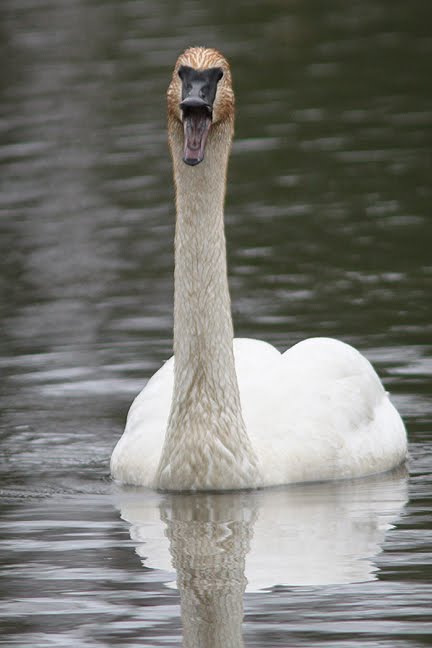
A pair of Trumpeter Swans glided across the water. They moved with such ease and speed it seemed as if they were being pulled across the water by strings.


I guess we were boring them....


After the grasslands tour Kathleen, Hartley and I stopped at a Mexican restaurant for lunch, then decided to skip the presentations that day and head back to the campground and hike the point. We parked near the lighthouse and picked up the trail head. A volunteer maintains an oriole feeding station near the trail head and the place was filthy with them. The two ladies who had ridden with us that morning had pulled into the lot five minutes before us and said they had been watching an Orchard Oriole from their car but it had just flown away. Darn it! I did get some nice poses from the Baltimore Orioles, though.


Not too long into the hike we saw the Ring-necked Pheasant cock that I had heard on previous jaunts. He hurried along the other arm of the trail.


The weather was still pretty nasty, and we talked about turning around and heading back, but I was determined to walk the loop. I'm glad I did. Just around the corner was a Swainson's Thrush, another first. Cute little bird with long legs and a buffy face, he did not seem too bothered by us.


Around another bend and this Blue-gray Gnatcatcher posed prettily among some branches.


But the most exciting moment for me came out on the point. The trail was turning to head back but a short off-shoot went out towards the water. I followed its call. There among the grasses was a female American Redstart, hunting bugs in the rain.


I followed her, trying to keep her in focus as she hopped and fluttered. Finally she landed on this branch and flashed her tail feathers at me.


The end!

Wednesday, May 11, 2011

More Warblers

Right off the bat I want to apologise for the crappy quality of these images. Lori and I returned to the creek where Lisa and I had seen the Black-throated blue the day before, and I set up my camera and tripod and watched for movement in the trees on the far bank. But these birds are small, and there seemed always to be branches in the way, and even with a 420mm there's only so much I can do. These images are heavily cropped on top of that, so....

ANYWAY, I caught a pair of Yellow rumped warblers, the male,


and female searching for bugs in the canopy.


I then spotted another bird, got the camera around and began shooting. It was so far away that all I could tell is that it was probably another warbler. Not until I got home did I see that it was a Northern parula, another first for me. Yay!


Note the yellow chin and orange breast.


Hopefully I can get some better shots down the road, although the window for songbird photography is closing. Soon the trees will be completely leafed out and they will be nearly impossible to see.


I did manage a nice shot of a Blue-gray gnatcatcher resting among new maple leaves.


We also found this nest, which Lori later identified as made by a Red-eyed vireo, so we have another bird to watch out for!

Monday, May 9, 2011

Woods Walk

After a long day in the car coming home from a poor show in Madison, Wisconsin, a drive that took us through one of the biggest cities in the country (Chicago) and one of the most polluted industrial areas in the country (Gary, Indiana) I was ready for a walk in the woods. Lisa and I unloaded the van, grabbed binoculars and camera gear, and set off to check on our little spot in the woods, the place were we've been pulling garlic mustard to help preserve the native flora there.

My intent was to get pictures of whatever flowers were blooming, so I didn't bring along my tripod, or my lens extender that turns my 300mm into a 420, necessary equipment for photographing birds. As fate would have it, long before we came across any trillium or Jack-in-the-pulpit, we ran into some birds.

The first part of the trail runs along a marsh, and it's a great place to see birds. The first one we spotted was a Black-throated green warbler. I was so excited--I've only seen this bird once before, last year in Ontario, and to find it practically in my back yard was a delight.


In that same spot was a pair of Blue-gray gnatcatchers. The female was working the branches looking for, well, gnats I suppose, while the male sat and sang to the little lady.


A closer shot of the male.


After checking out our target area, which was pleasantly devoid of garlic mustard (yay!) we decided to walk the rest of the loop. We came across an Eastern towhee working the leaves under an Autumn olive, then further along heard a song neither one of us recognized. We stopped and waited to watch for movement in the shrubs. Finally this little fellow showed himself--a Magnolia warbler!


This was a first for me and I took a whole bunch of crappy photos to celebrate. I plan on going back out today with the proper equipment and try to get some better shots.

Next we spotted a pair of White-throated sparrows. This is the male--notice his yellow lores, the area just in front of his eye.


Where the end of the trail meets the beginning, I again heard rustling in the leaves under some shrubs. We waited patiently, me squatting with camera ready as the bird was behind some branches at first. Finally it emerged. An Ovenbird! At first I thought it was a kinglet, so small and olive-colored. For some reason I thought Ovenbirds were brown and stripped. Silly me.


Last but not least, near a small creek that crosses the trail, we saw this Black-throated blue warbler. Again, I had seen this bird last year in Ontario, but never here at home. What a treat! I can't wait to get out this afternoon and see what else we can find!


"In every walk with Nature one receives far more than he seeks." John Muir

So true--we went looking for wildflowers and found a whole bunch of warblers instead!