Showing posts with label fungi. Show all posts

Friday, November 5, 2010

Fungus, Part 2

Ready for your second (and last) fungus lesson?

For whatever reason this post went much better than the last, where I easily spent four hours trying to positively ID every image. Perhaps these were more distinct, or maybe I am getting better at it. Whatever the case, I didn't have to spend much more time on this post than I do on most others.

On that note, let's get to it!

We'll start with a lichen, actually--Flavoparmelia caperata, or common greenshield. This is apparently one of the most common lichens out there. An interesting thing about lichens--they are extremely sensitive to pollution. According to Joe Walewski in his book Lichens of the North Woods, foresters and ecologists use lichens as indicators of the health of forests. The more diverse the lichen population, the healthier the environment. Common greenshield is one of the hardier varieties and is often the first lichen to return to a once polluted environment.


Here is a "young" Pellinus ignairius, a bracket fungus whose top loses its color as it ages and becomes charred-looking. This one is still very colorful.


This one was easy--a birch polypore, or Piptporus betulinus. Often, identifying the substrate upon which the fungus is growing is the most important information after a description the fungus itself.


Now this one was frustrating. I looked through the book three times and could not come up with a name for this one. It is a gill fungus (note the underside), perhaps two to three inches across, with a distinctive knobby stalk, growing off a yellow birch. I thought maybe Pluteus articapillus, or deer mushroom, but the book says it has a smooth stalk. Hmmm....


These tiny little guys are in the Mycena family, perhaps viscosa. The Mycena genus has hundreds of species, but this seemed to match what was in the book. They were growing out of the ground in a mixed part of the forest--you can see white cedar as well as maple leaves.


This one was easy, looked exactly like the guide photo, right down to the paper birch log it was growing on--Tramete pubescens. I was curious about the meaning of the name so I found this online: Trametes means "one who is thin"; pubescens means "with hairs of puberty, downy." I will have to look at one of these a bit closer next time to see if I can find the hairs.


Below is a nice bunch of honey mushrooms, Armillaria mellea. I have another image of a few of these whose crowns are not cracked like this. I assume then that these are older. Note the one at the bottom right of the frame, where you can see the underside and stalk--very important in identifying fungus, I came to realize.


Towards the end of the hike (yes, these have gone in the order I found them along the trail) was this little oddity. It looks like a Pileated woodpecker had been working over this red pine, only a few feet off the ground. In the wound was now growing the jelly fungus Dacrymyces palmatus, or "fairy butter". Can you get a better name than that? I can see little wood nymphs coming out at night with their little knives and spreading this on little slices of bread.


And lastly, the tooth fungus Hericium americanum. While not as impressive as some of the images I found of it, this was growing exactly where it was supposed to be, on the side of a hardwood log.


Whew!

For anyone who may be interested in doing a little field work of their own, here are a few tips, gleaned from my own troubles in identifying these fungi (and this can apply to nearly everything):

1) Have a bit of working knowledge before you hit the trail so you know what to look for. Knowing what the differences are between each group, and therefore knowing what you should be looking for, is mighty helpful. Before I started to do this blog I wouldn't have known a bolete if you'd conked me on the head with one!

2) Carry with you a small ruler and/or a coin such as a quarter to use as reference with each subject. This makes size easily discernible when you go back to look at your images.

3) Don't just look at the top of the mushroom--peek underneath, look at the stem and the underside of the specimen and describe what you see. Make some notes if you can't get a good picture.

4) Pay very close attention to where it is growing! Is it on a log or stump? What kind of tree is it growing on? Some fungus prefer hardwoods, other conifers. Is it growing directly out of the ground? Look up--what kinds of trees is it growing underneath? Are you in a coniferous forest, hardwood forest or open grassland or pasture? All of these things will help a great deal to narrow the list.

5) Lastly, do not assume that the specimen in your guide is going to look exactly like your picture or the specimen right in front of you. While you can walk in a woods anytime from May through September and the maple tree before you will look pretty much the same, mushrooms are very short lived and can change dramatically in a short period of time. If the image in your book was taken early in a mushroom's life, and yours towards the end, your specimen may look totally different.

Like warblers in autumn, fungus can be tricky to ID. Give yourself as much information to go on and you'll increase your chances of getting a positive identification. Trust me, I learned the hard way!


Tuesday, November 2, 2010

Fungus, Part 1

At the Michigan Audubon's Cranefest they have a book sale. Boy, am I a sucker for book sales. Chock full of nature-related tomes, their sale is heavy on guides--bird guides of course, but pretty much everything else under the sun--butterflies, caterpillars, rocks, flowers, tracks and scat, everything for the budding naturalist. Lori already had a good book on lichens, but lacked a good fungus book. They had several, and I settled on George Barron's Mushrooms of Northeast North America, a Lone Pine field guide.

Eager to put my new book to the test, I paid special attention on my hikes in Wilderness State Park to all the slimy things growing on tree, stump and rock. It was a perfect time of year for it--fall is fungus time, and since the weather had been wetter up north than here at home, the area was replete with subjects. I actually began to feel a bit overwhelmed by the numbers of lichens and fungus I found, and am feeling so again as I begin to try to identify them all. However, it was fun having something new to look for, and lichens and fungi are small and force you down to ground level, where you begin to notice things you would have otherwise missed.

A disclaimer: in no way do I attest to the accuracy of any of these identifications! I have done my best with the resources I have to get an accurate ID, but sometimes all I have been able to do is get it in the right category (bracket fungi, coral fungi, etc.). The process can be baffling, and there are few guides that are comprehensive. While an image I took may look similar to one in the book, it by no means actually is--some individuals can not even be ID'd on sight, but require testing to be sure. So with that....

One of the first things I found was this grouping growing on the end of a cut log, a tree that had fallen across the trail. Along the log's outer edge grew a ring of purple-toothed polypore, Trichaptum biforme, a bracket fungus. Below that is another bracket fungus with some orange coloring, possibly Postia fragilis. Frustratingly, I have yet to identify the white fungus at the bottom.


Here is another small mushroom I can't ID. Anyone? click on the image to see a bigger version.


On this desiccated log is growing blobs of black witches butter, Exidia glandulosa, along side what I believe is cockscomb coral, Clavulina cristata, whose tiny little fingers stood less than an inch tall along the log.


A bit further along the same log grew common powderhorn, Cladonia coniocraea, a lichen. Lichens are completely different than fungi. Perhaps it is time for a few definitions.


A fungus is one of a group of organisms that share these qualities: They do not produce chlorophyll and lack the vascular system by which to move it; they also lack leaves, stems and roots, and do not produce flowers but rather reproduce via spores; they feed on organic matter by secreting enzymes that break down structures into molecules which they can absorb.

Lichen, on the other hand, is produced by a symbiotic relationship between algae and fungus. The algae provides the fungus with energy through photosynthesis, the fungus provides the algae with nutrients and protection from the elements. They tend to grow on hard surfaces like rocks and tree bark, but some, like the trumpet lichen below, grow on softer, more decomposed matter. While fungi tend to be tender and so fairly short-lived (over the course of a season), lichen are quite hardy and live for years.


This common bracket fungus, Trametes versicolor, is also called turkey tail. Bracket fungus are tough and woody in texture and may survive many years. They tend to grow from the sides of trees, sticking out like shelves. Like all fungi they break down wood and help return nutrients to the soil for the next generation of plants.


I am pretty sure this is Austroboletus gracilis, a mushroom in the bolete, or sponge mushroom, family. They prefer soil under conifers, of which there is an abundance here. The undersides of bolets have tubes rather than gills, as most mushrooms do. It gives the underside of these organisms a solid look.


Apparently the forest rodents like A. gracilis.


I tight-roped a downed tree across some very mucky ground to get close to this impressive bracket fungus known as the red-banded polypore, Formitopsis pinicola. (It's times like these that I wish I understood Latin better so that the scientific names held more meaning for me.) This specimen was easily eight inches across.


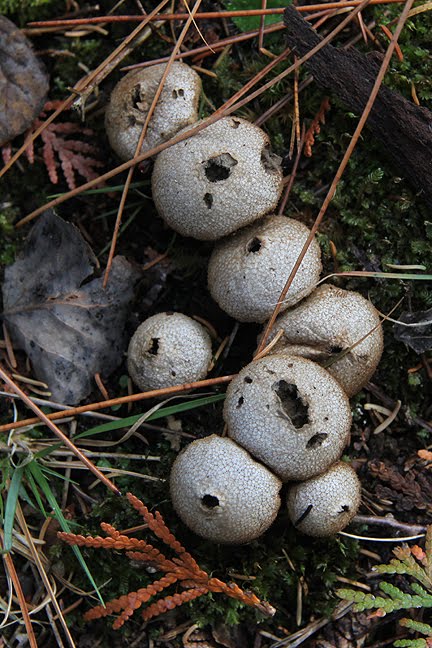
Ah, puffballs. What child hasn't played with one of these? Puffballs can change radically in appearance over their lifespan, so I am not certain what these are--perhaps Lycoperdon perlatum, or gem-studded puffball. These are obviously older and have already erupted. They are edible, though they don't look all that tasty to me!


Last but not least is an image that perhaps most sums up what a boreal forest looks like up close. It's hard to look at a black spruce and not find lichens growing on the branches. The upper left arrow points to sinewed bushy lichen, Ramalina americana. Bottom right may be hooded tube lichen, Hypogymnia physodes. Bottom left could be N. bottlebrush frost lichen, Physconia leucolyptes. Again, I am only giving my best guess based on the reference material I have and what I can see in my photos.


I have another set of images to go over from the rest of this hike, and will post those next time. Since this post took me over four hours to put together, I may not post again until later in the week!

And if anyone has a positive ID on any of these, by all means speak up!