Showing posts with label Horned Grebe. Show all posts

Wednesday, February 10, 2021

Seven Grebes of North America

In my last post, Michigan Big Year Vol 5, I write about seeing a Horned Grebe in Muskegon. I mentioned that this was life bird #508 and the final species of the seven North American grebes that I needed to see. It occurred to me today that I should have talked more about the other six species, but rather than edit that post I figured I'd just do a separate post.

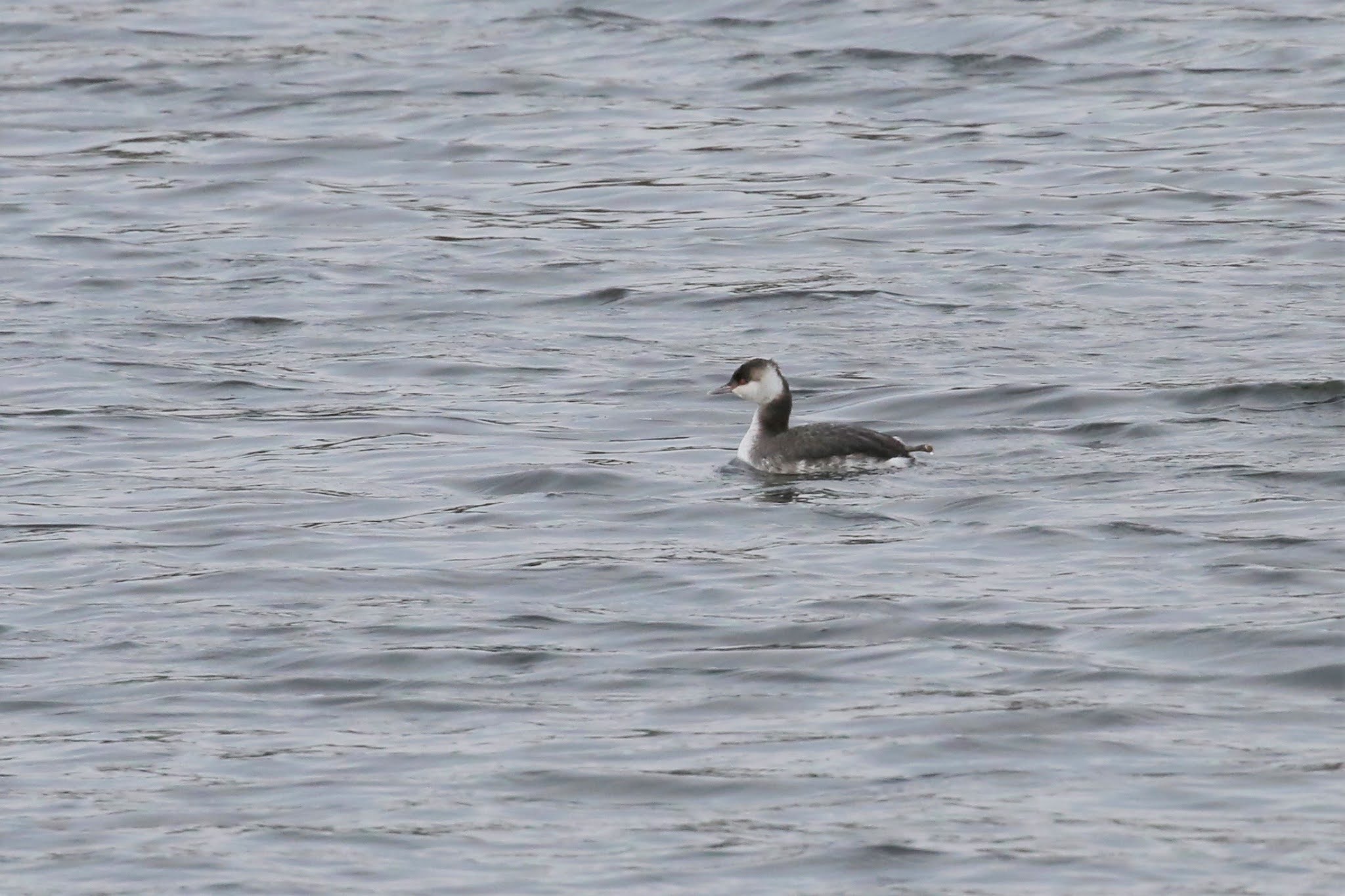
To recap, the Horned Grebe (HOGR) is a small grebe at 13.8", slightly bigger than the pied-billed. It's a wide-ranging species, breeding across Canada to Alaska and wintering along the Pacific coast and in the southeast. It's typically only seen in Michigan during migration. This bird is in non-breeding adult plumage. I hope to one day see one in breeding plumage.


Horned Grebe, Jan 25, 2021, to round out the N American grebe species. 


I could not tell you when I first saw a Pied-billed Grebe, but it was almost certainly in Florida in winter. This was my first grebe species and I think they are darned cute. Slightly smaller than the horned at 13", it is the most widespread of the North American grebe species, breeding north from approximately the middle of the country north into Canada, winters in the southern half of the U.S.


Pied-billed Grebe in breeding plumage (note the blue bill).
Photographed at Howard Marsh, Ohio, May 2019


Pied-billed Grebe, immature. Photographed in some National Wildlife Refuge somewhere in North Dakota, August 2013


Pied-billed Grebe yawning, Merritt Island NWR, January 2020


Pied-billed Grebe showing off it's classic grebe-shaped head. 
South Padre Island, Texas, November 2019

Red-necked Grebe was my second grebe species. I first saw a pair of them on Duck Lake in Interlochen, Michigan in November 2012. I was a fledgling birder, and had stopped at the state park and walked to the lake for a look. I could see the birds at least 100 yards out on the lake and knew they were a new bird but didn't know what they were. I ran back to my car, grabbed my camera, and ran back, tripping over a branch on the way (I think there was snow on the ground) and falling flat on my face. I got some craptastic photos but was able to identify them when I got home.

A few years later I got better looks of this species on Wasilla Lake in Alaska, where a female was on a nest near the dock for our hotel. This species breeds across Canada to Alaska, winters off the Pacific and North Atlantic coasts and in Lake Huron, preferring open water to lakes and ponds. 


Red-necked Grebe


In 2019 I had several shows out west and spent days researching birding locations along our route and near where we'd be staying. After my first show in Colorado we headed north to Idaho, stopping for two nights to camp on Utah Lake and bird the area. We were treated to several Clark's Grebes near the boat launch of the campground. This is a large grebe, about 25", with a bright red eye and long orange bill. This is a Western species, rarely seen east of the high plains. 


Clarke's Grebe, Utah Lake, August 2019. 


Clark's Grebe showing off that classic grebe head shape.


Clark's Grebe. Note how the eye is surrounded by white.

On our way home from Idaho we stopped at several locations along I-94, including McKenzie Slough, just south of the highway in North Dakota. There I picked up two new grebes, including Eared Grebe. There were several birds in the wetland, but one adult with it's growing chick was fairly close to the road. This is a small species at just over a foot long, and tends to remain west of the Great Plains (though as I write this there's one in Wyandotte, MI). They are known by their frilly "ear" patch and short, black bill. 


Eared Grebe, McKenzie Slough, North Dakota, August 2019


Eared Grebe


The second grebe we found at McKenzie was Western Grebe. Very similar to Clark's with a similar but slightly wider range, they were considered the same species until 1985. The easiest way to distinguish this bird from Clark's is the black hood extends below the eye, encompassing it. The bill is also more yellow than orange.


Western Grebe, McKenzie Slough, August 2019. Note the little one on it's back.


Western Grebe with chick

Last on the list, my sixth of seven grebes, is the Least Grebe. As its name suggests, this is the smallest of the North American Grebes--at nine inches, four inches shorter than the pied-billed. This species is darker than the pied-billed, and sports a yellow eye. In the U.S. it's only found in southern Texas.


Least Grebe. Santa Ana NWR, Texas, November 2019


I love this family of birds. I find them striking and entertaining. I love their bright eyes, the fluffy buts of the littler ones, the stark black and white of the larger birds. Their courtship rituals are legendary with head bobs and sprints across the water, diving in unison. There are 22 species world-wide, so I hope one day to add a few more of this family to my list.

Tuesday, February 9, 2021

Michigan Big Year Vol 5: A "Lifer," and an Unexpected Visitor at Home


A good friend of mine, Artist Christina Baal, (https://www.drawingtenthousandbirds.com/), gave me a book for Christmas called Zen Birding, and it's been most helpful for me in taking a different perspective on this listing thing. In it the authors David M. White and Susan M. Guyette talk about the usual Zen stuff--ego, expectation, beginner mind vs. expert mind. They talk about listing in the first chapter, its pitfalls as well as the joys it can bring. They warn that listing can sometimes become all about the list--simply checking off species names on a list and running to see the next. But they acknowledge that making lists is a common human trait, and that listing can actually increase one's enjoyment of birds, especially if we take time to observe and enjoy both them and the act of birding. That is, as long as we don't get angry or frustrated when we dip, and don't get jealous when someone else sees a bird and we didn't, or we get mad because we can't go birding because of work, (all about ego). This was a relief to me but also a lesson--I feel like I've been released to go make those lists, and warned that if I'm not enjoying it or if I'm having expectations or jealousy that I need to reexamine my priorities. And so, we move onward!


January 25

Lori had her knee replacement surgery last week so we have been sticking close to home and caring for her while she convalesces. That meant no chasing for a while, but today she was doing much better and there was a person coming for physical therapy in the afternoon, so Lisa and I decided to head to the pier in Muskegon to look for some of the rare waterbirds that had been reported over the previous days.

It had been sunny but by the time we arrived it had clouded up and the wind had increased, coming from the northeast. This meant off-shore, but it was still biting, even at 33°. We walked east into the wind along the channel as far as we could go, mostly with our heads down, then worked our way back slowly with the wind at our backs. Many birds drifted west on the current and we looked at each one carefully. A small flock of Long-tailed Ducks was drifting and feeding. Suddenly, as ducks do, they simultaneously started running and flapping across the water. They'd go several feet, stop, then start again. The goofy things never actually went anywhere but a little farther down the channel.

Long-tailed Ducks doing Long-tailed Duck things


It was not long before I saw a Horned Grebe appear in the middle of the channel. Yay! This was a new life bird for me and the last of the seven North American grebe species I needed. I've seen Pied-billed Grebe just about everywhere, and Red-necked Grebe in Alaska in 2014, but then got the next four all in 2019--Clark's, Western, and Eared all out west over the summer, and Least down in Texas that fall. This Horned Grebe (MBY #68 and life bird #508) was the icing on the grebe cake, which by the way is probably my favorite family of birds.


Horned Grebe, non-breeding. I hope to see them in breeding plumage one day. Also, I realized when I was editing the photos that this poor thing is missing a foot
(that's it's footless leg sticking out behind it.)


After that we didn't see any new species in the canal, though we searched for some time. I knew some scoters and a Harlequin Duck had been seen the day before, and I hoped they had moved out into more open water. We watched the mergansers for a bit, hoping someone new might float by, then headed to the car and over to the south pier parking lot. On the way I stopped to check the harbor and had a small flock of Tundra Swans fly by, for MBY #69.

Female Red-breasted Merganser


Male Red-breasted Merganser taking off


We donned our spikes and walked out onto the icy pier. The big lake was fairly calm thanks to the off-shore winds but the pier was crusted with ice from waves pushed into the harbor from the northwest the previous day. We picked our way carefully along, checking the ducks as they dove and popped up here and there. The ducks we were looking for had frequently been seen with the long-tails, so we checked each and every one. Lisa spotted a lone Purple Sandpiper feeding on the water's edge among the boulders. Most of the surfaces were frozen, some with tick, opaque, gray ice and some with clear and smooth, but apparently there was enough exposed algae for this bird to pick through to find enough to eat.


Purple Sandpiper toughing it out on the ice along the pier.


We walked out as far as the bend in the pier, at which point the ice was so gnarly and bumpy that we didn't dare go farther, even with spikes. I looked longingly at the ducks at the end of the pier and scanned them with the scope, but couldn't pick out any oddities. We did see a lone Snowy Owl way out on the end of the north pier, which helped explain the blood and body parts we'd seen strewn along the pier.


Long-tailed Duck, becuase you can't ever have enough Long-tailed Duck photos.


January 26

At this point in the season I have seen most of the species that regularly occur at home, with the exception of Red-breasted Nuthatch. There is always the chance for a less-common bird to appear, but I wasn't holding my breath. We have hoards of Blue Jays who dominate the feeders, scooping up pounds of seed a day to cache in some secret location, and I think they are keeping some of the less-aggressive birds away. So imagine my surprise this morning as I was walking to the office and heard an unfamiliar call from the oak above my head. I paused and listened, then continued on to the office. As I started up my computer I looked out the window to see a juvenile Evening Grosbeak (MBY #70) at the feeder! I was hoping we'd have another shot at seeing one in spring as the flocks moved north, but apparently there's at least one still hanging around. These birds are very rare winter visitors here. Despite their name they are members of the finch family, and every 7-10 years they and other finches "irrupt" and flow south in huge numbers in search of food when the pine/spruce/larch cone crop is poor in the forests to our north. I was able to get back to the house and get a few photos for record. 


Evening Grosbeak


Lake Muskegon Channel, January 25

#68) Horned Grebe (also lifer)

#69) Tundra Swan

Home, January 26

#70) Evening Grosbeak