
This route takes you up and around Mt. Washburn and across Dunraven Pass. This is an area that typically sees the earliest and latest snowfall in the park, and I think it had already been closed once this year but had reopened. In any case, it's a bit of a harrowing drive when you're pulling a camper, though I saw folks with MUCH bigger rigs than us.
For those of you who have never been to Yellowstone, the place is huge. Approximately 63 miles by 54 miles, it is over 2.2 million acres. The speed limit is 45 mph, (slower in busy places), and the roads wind around geologic features, so it takes a long time to get anywhere. Of course the scenery is amazing, so that's not a problem, but it's certainly something you have to prepare for. Many of the campgrounds are first come/first served, which is why we didn't have reservations--that and the fact we weren't sure when we were going to arrive. We thought coming in on a Monday would mean a better chance of getting a site. We were quite surprised to find that not to be the case, as the park was still very busy.
We made it to the Tower Falls campground some time after 10 am, and there were no sites available. We were told there were still sites at Mammoth, 45 minutes away in the northeast corner of the park, so we headed up. Until we secured a site, I was going to be a nervous wreck. I shouldn't have worried--there were still six sites at Mammoth when we arrived. I was so relieved. We got camp set up, and our site had a beautiful view of the mountains in the Custer Gallatin National Forest. We ended up staying three nights at Mammoth, spending most of that time in the Lamar Valley.
 |
| Setting up camp in Mammoth. What a view! |
By 1:00 we were back on the road and ready to explore. Our first stop was Lava Creek, a little bump out in the road where there's a picnic area and trail. With the dogs along we couldn't go more than 100 feet from any developed area, (or someone had to stay back with them), so we weren't able to explore as much as I would have liked. The general rule about Yellowstone is that over 90% of people never leave their cars, or venture past developed areas. So if you've avoided the park because of its crowed, bear-jammed reputation, try planning some day hikes, or backpack. Walk more than about a quarter mile down a trail and you may not see another person all day. (But be sure to pack bear spray!!)
 |
| Lava Creek |
At Tower Junction we continued east along the NE Entrance Road and into Lamar Valley. If you're looking for wildlife in Yellowstone, this is the place to be. While you can reasonably expect to see critters just about anywhere, this is where they gather in the greatest numbers. The famed Druid Pack of wolves made their home here. Bison, pronghorn, elk, all frequent the valley, and nine years ago we saw two bull moose there, although moose are now rarely seen in Yellowstone.
NE Entrance Road crosses first the Yellowstone River, then the Lamar River. We pulled over on the far side of the bridge over the Lamar to poke around and take some photos. Finally feeling freed from the confines of the van and the constant travel, I climbed down to the river's edge. The view wasn't all that great from down there, but I sat for a bit, enjoying the sun, marveling at the huge boulders in the river.
 |
| The Lamar River near the NE Entrance Rd overpass |
We had timed the trip perfectly with the park's peak color. In this part of the country there's little more than yellow to set the park ablaze, but by golly, it's enough.
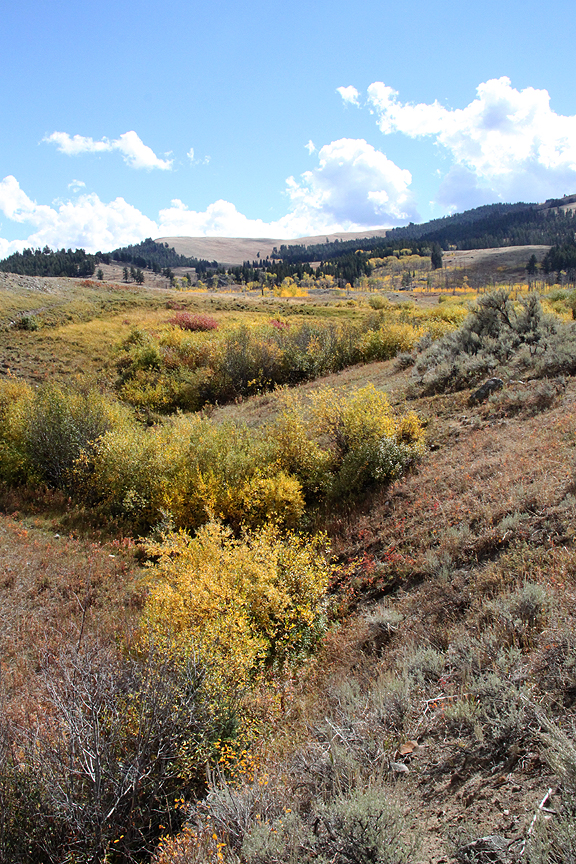 |
| Fall color near the Lamar River |
 |
| Willows ablaze |
Even though the day use area and campground were closed, we paid a visit to the Slough Creek area anyway. The Buffalo Creek fire was still burning somewhere over the ridge, and while we could not see or smell smoke on Monday, we did on Tuesday morning when we returned to wolf watch. The Junction Butte pack had denned on the south side of the hills north of the road, and apparently provided quite a show to many folks this year as the pack was clearly visible. Their den area burned, but the pack survived.
(They did not, however, survive Montana hunters. Since being delisted, all the states around Yellowstone have a wolf hunting season. This pack, so close to the border, was hard hit--the day the season opened, three members were shot, JUST outside the border. Hunters learn the pack's habits, then lay in wait, and as soon as the animals cross the invisible line, they're shot dead. This happened the day we left for home at the end of our trip. The pack had lost its Alpha male on September 15th. He was injured, but had taken an elk down in the Lamar River. He had sustained further injury, and was then killed himself by the Prospect Peak pack. Whether the Junction Buttes survive and rebuild, or disperse, remains to be seen. It's not an easy life, being a wolf.)
Bison were plentiful. In 2007 we did not see nearly this many bison, but it could be that this year they were already moving down into the valleys for winter. I could write an entire post--or three--about bison, but I decided to pick a handful of images for this post instead. Such massive animals, they still have a grace about them. And to see them on the plains in Yellowstone, you could imagine what it looked like before we nearly wiped them out.
 |
| Bison near Slough Creek |
This big bull stood sentinel, the west wind blowing through his thick hair.

Female bison horns tend to curve inward less than the male's, so I am guessing this is a young-ish male, with a European Starling along for the ride. This is typically where you'd see Brown-headed Cowbirds, a species that evolved along with bison and developed nomadic tendencies. This meant they could not incubate their own eggs and raise their own young, so they learned to lay an egg in another bird's nest, and let them do the work.
 |
| Bison and starling. |
There were mamma's with calves too, though the calves by now were a pretty good size and already growing their horns.
 |
| Bison calf |

We drove all the way out to the Pebble Creek campground to check it out, then drove back through the Lamar Valley. We stopped at Tower Falls and at the Narrows. I wasn't all that impressed with the view of the falls, but loved the view of the Yellowstone River as it approaches the falls.
 |
| Classic West--fast, rocky rivers, spruce-covered hills, and bare buttes. |
We stopped a few more times on the way back to camp, including this spot along Yancy Creek to see the basalt cliffs.
 |
| Basalt cliffs along Yancy Creek |
The warm day brought with it some late pop-up storms. The sky threatened but we did not get any rain where we were. The clouds to the north sure made for a dramatic backdrop for the light of the lowering sun.

And better yet? A Yellowstone rainbow.

Back at camp we had several elk cows wander by. There were two big bull elk in Mammoth, one with a large harem. It's not unusual for them to congregate in areas populated by humans. Elk in the park are not hunted, so they feel safe with us, especially because wolves tend to avoid us. The same thing happens on Isle Royale with the moose, where cows and calves like to hang out near Rock Harbor.
 |
| Elk cow in Mammoth campground. |
We ended the day with this gorgeous view above the campground. Already, I didn't want to leave. And later that evening, I heard my first elk bugle.


