Monday, November 23, 2009

The Religious Naturalist

I have been reading A LOT of books lately about nature; ecology, philosophy, journals, social issues, spiritual issues. For a long, long time I just couldn't get interested in non-fiction. I think that I was unhappy and needed the escape that a good work of fiction provided. Also, I realize now, I was not doing what I wanted to do--work that involved art, the environment and wildlife. Perhaps I was shielding myself from what I knew deep inside I wanted to do but thought I could never.


Anyway, all that changed when I picked up a copy of Sigurd Olson's Reflections From the North Country nearly two years ago. I had been compiling quotes on nature, and his name came up several times. I was curious about this fellow and so looked him up online. What a book that was! His words resonated with me right out of the gate, and it started me on a path of voracious reading. I read another one of his books, then Aldo Leopold, Annie Dillard, E.O. Wilson and Paul Hawkin to name a few.


One of the things that many of these authors shared was a healthy spiritual connection to nature, and in some cases a complete rejection of the idea of a personal God. However, that lack of faith did not leave them wallowing in a spiritual void--they looked at the natural world and saw everything they needed to sustain their souls.


I was fascinated by this. I have never been a religious person in the traditional sense. I could never get behind the notion of a personal God or even the idea that there is some sort of "consciousness" that created the universe. It just never made any sense to me. What resonated with me was (and is) the life that exists all around me--the Creation, if you will. It is tactile, it is obvious, and it excites me and fills me with wonder and reverence.


Being without God in a God-fearing world can leave one feeling...isolated. What was wrong with me? How could I not believe when so many did? Was I missing something? I tried, I did, to get on board. Read some of the Bible (what a beautiful man Jesus was!), went to this church, then that church, but try as I might I could not buy into God ("God" with a capital G being the Christian version). But what stayed with me, had been with me since I was a child, was nature. My awe and amazement and delight in everything living outside my door. I worshipped it, in my own quiet way.


So the turn of events that lead me to try my hand at making a living as an artist also started me on a spiritual journey. I wanted to learn. I wanted to know about the subjects that I was drawing, to learn about their habits and habitats, their lives. So I began researching, and the more I learned the more I wanted to know. At the same time I was trying to create a product, and I was using quotes about nature that resonated with me on some notecards. I wanted to know about the people who had uttered or written such sage words, so I began to research them too. What a world I found! Emerson and Thoreau to be sure, but also Henry Beston and Chet Raymo and Bernd Heinrich...the list goes on and on.


It wasn't until I picked up a copy of Chet Raymo's When God is Gone, Everything is Holy that I finally had a name for what I was--a religious naturalist. A religious naturalist is essentially one who rejects the supernatural, embracing instead the natural world for their spiritual identity. There is the belief that all life is interconnected, and science is called upon to reinforce these spiritual beliefs. In a sense, the religious naturalist relies on science, while the followers of other faiths, if you will, rely on myth.


How happy I was to see that I wasn't an outcast after all! I generally eschew labels, but in reality we all need to not only define ourselves in some way but also feel like we fit in--community is one of the basic needs of human beings. To find there were like-minded people--and a lot of them--was an epiphany for me. So in addition to reading about habitats, species, living for a year in the desert or in the woods or on a beach, I have been reading about religion, primarily religion and science, ever seeking a firmer grip on what it means to be human, and what it means to be me.


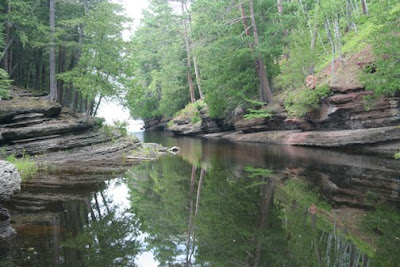
On those slow blog days I will do a "book review", a summery of something I've read, some quotes and thoughts. I hope to have some lively feedback as a result! (The photos, BTW, are from the Porcupine Mountains, a trip I took last year with Lisa and Lori, who had won an Artist in Residence there. I wanted to give you a little visual stimulation as well! I will probably blog about that trip this winter.)

Friday, November 20, 2009

Artwork--Blue Heron con't

Day...five? I've lost track already. Anyway, here she is. After a slight freak out yesterday (not liking something I did) all is well.

See ya Monday.


Along the Boardman

We didn't have much time for exploring on Sunday as we had to head home that afternoon, so we stayed closer to Karin's than on Saturday. After some debate, we decided to walk along the Boardman River. There were benches for Lori (still recovering from foot surgery) and a nice path down the river bank.

Here is the Michigan DNR's description of the Boardman:

The Boardman River is located in Grand Traverse and Kalkaska counties in northwest lower Michigan. It rises in the Mahan swamp in north central Kalkaska County and flows in a southwesterly direction for 40 miles. Turning north for nine miles, it empties into Grand Traverse Bay at Traverse City. The Boardman River system drains a surface area of approximately 186,000 acres and includes about 130 linear miles of stream.

The end of the river, passing near Traverse City, is an urbanized--there are several dams for hydroelectric power, and the trails are well-used and well-warn. But the Department of Environmental Quality has determined that the river is better off without the dams and has begun removing them. The ponds that were created by the backwaters are still there, but much smaller now. Karin took us to see one of these ponds, and show us how folks who once had "lake front" property were now high and dry.

We stopped at an old boat launch to take a look. I, however, was much less interested in the homes than in the little waterfowl skittering around on the pond. I jumped out of the car and grabbed my camera, and to my delight, saw that they were buffleheads!


I am an amateur birder, and only recently started keeping track of the birds I've seen. It's hardly enough to call it a life list yet, but it's always exciting to find a bird I've never seen before. I have never paid waterfowl much attention--to me all duck-like birds were mallards--but I've learned a lot in the past few years and now look much more closely at who's swimming around on a pond or lake.


The photo below shows two males on the right, two females on the left.


The lowering of the pond level revealed some interesting things, including long abandoned boats.


We drove farther upstream to the trail along the river where we could deposit Lori at an overlook and the rest of us could walk a little. Next to the path to the river there were fields of sumac. I like the goldenrod in the background, I think it looks like snow.


The Boardman is a much larger, faster river than the Crystal, faster too now that the dams are coming out. And while the area is much more heavily used, there were still plenty of pretty scenes.


I was genuinely surprised to see recent beaver activity here. We found several beaver-chewed sticks in the water, small branches stripped of their bark, and this tree which had been gnawed on not all that long ago. Perhaps the beavers up along the Crystal had been trapped out, while the population here was somewhat protected by development? Hard to say for sure. There are certainly species--raccoons for one--who have adapted to living closely with us and benefit from living in an urban area where there's no hunting or trapping.


Popular with kayakers, the Boardman has several spots with class I or II rapids. This was the gnarliest part of the river that we saw, and keeping in mind it's mid-November, pretty impressive. I'd like to go back in the spring and see it filled with run-off.


As the river nears the dams downstream it slows down a bit, but it's much faster now than it was pre-dam removal. The Boardman is actually a pretty good trout stream, better if you go farther upstream than here, but still fishable in the lower areas. Removal of the rest of the dams should improve its quality further.

You can see here how high the water was before restoration. It's not so pretty now, but given time nature will reclaim this area. The regenerative abilities of nature never cease to amaze me. Usually, we just need to get out of the way.


We are looking forward to a winter trip to TC to visit Karin and do a little skiing or showshoeing. Yeehaw!

Correction: no dams have as yet been removed. Water levels have been lowered in anticipation of dam removal. Thanks, Karin.

Thursday, November 19, 2009

Karin's Request

Well, Miss Fish, here ya go. Remember, we weren't really there all that long! I'll let the images "speak" for themselves. Enjoy!


The Crystal River Part 2

We dawdled awhile by the river, enjoying the late afternoon sunlight and the grassy marshes that the river passed through, then piled back in the car to head back to Karin's. But less than a mile down the road we crossed over a bridge and Karin mentioned that there was a canoe portage there where the river passed through three large drain pipes under the bridge. I turned the car around and we all tumbled out again.


Here is a look upstream at this beautiful, placid river.


Karin noticed a trail along the east side of the river so off we went, exploring the riverbank. One of the first things I noticed was all of the beaver activity. Lots and lots of trees had been felled in the woods along the river. It all looked pretty old, nothing recent that I could see, but it was neat to see all the stumps with chew marks in them, rather than the clean, straight cut of a lumberman's saw.
.

Here's a close-up of the stump, clearly showing the tooth marks in the wood. This was one of the bigger trees that was felled. Most were only about 3 to 4 inches in diameter. This tree would have been stripped of its upper branches once it was down.


Here's another that didn't quite get finished, but enough damage was done that the tree died, and it's now full of holes and excavations, providing homes for many birds.


I loved the feeling of this place, the quality of the light, the softness of the earth, thick with duff, below my feet--had it been warmer I would have taken my shoes off.
.

The base of this long-dead tree was strewn about with wood chips, most likely from a pileated woodpecker looking for bugs.


I didn't want to leave this place. The calm of the waters, the gentle sunlight through hazy clouds, a feeling like I was in some kind of fairy forest. I could almost believe that I was somewhere untrammeled by man, that I was alone with the beavers and the birds. Along this river I experienced one of those moments when I feel at one with a place. It's such a fleeting feeling, because as soon as you recognize it, it's gone. It's that moment when there are no thoughts, no conscious "me" but rather a worldly "all", when I am no longer projecting myself onto my surroundings but rather letting my surroundings wash over and within me. It is these moments that I long for, that instant when I am one with the world.


Wednesday, November 18, 2009

Artwork--Blue Heron continued

She's coming along nicely. It looks like I've gotten a lot done, but I have miles yet to go on this. I'm excited, though! Been years since I worked a great blue.
.

They are one of the birds I grew up with. They'd hang out on our neighbor's dock (ours was only 2 sections long) but they were very shy and if they caught a glimpse of you off they'd go. Their shyness gave them an air of mystery. I always loved their grace, and I admired any creature that would tolerate contact with human-kind, however fleeting.

The Crystal River

After spending a few hours in Glen Arbor, we headed east out of town on Highway 22, then took a right at county road 675. The sun was just starting to peak out and I was looking forward to a pretty drive across the Leelanau Peninsula back to Traverse City. As we drove around a bend in the road this beautiful little river came into view. I quickly checked for traffic and veered off onto the shoulder, much to the delight of my fellow travelers (they like it when I do spontaneous things).

We piled out of the car and started exploring the river. Here Karin, Lori and Lisa are enjoying the scenery.


The Crystal River is a lovely, shallow, slow moving river that winds its way through the western part of Leelanau Peninsula. Karin said she has kayaked the river but that there are some parts that are so shallow you have to get out and drag your boat. Sounds like my kind of river!
The current was so slow moving there was barely a ripple on its surface.
The sunlight grew stronger as we dawdled along the riverbank. What a gorgeous fall afternoon.


So calm was the water that the opposite bank was clearly reflected on its surface.


The area is dominated by hemlocks and birch trees. I love these trees. They are both cool climate trees and so we don't see many down state. The birches especially are "north woods" tress and any sight of them makes me long for a cozy log cabin, flannel shirts and a hot cup of tea.


For me there is no substitute for clearing my mind like taking a walk in the woods. There's so much to see, so much to know, that it takes me right out of my head, erases stress, reminds me that my life is just a tiny part of the greater glory that is the world that sustains us. I cannot help but think that if people spent more time outdoors, exploring, learning, getting to know their world, that they too would be much happier for it. Our ever-increasing distance from nature is perhaps the greatest failing of modern man and our "civilized" world.